


University of North Carolina Athletics
LEE PACE'S EXTRA POINTS: Bunting: Passion, Heart, Carolina Blue Blood.
Dec. 14, 2000
Click Here For Extra Points (PDF Format)
 Download Free Acrobat Reader
By Lee Pace
John Bunting's to-do list runs halfway to Efland in the early days of his administration as Carolina's new football coach. Learn recruiting rules in the 480-page NCAA Manual (he can't go on the road until he passes an NCAA-mandated test). Hire a coaching staff (he's interviewed every current Tar Heel assistant and has already named fellow Tar Heel warrior Jim Webster to a coaching position). Plow through the stacks of resumes (some 100 have been shipped or faxed into the Carolina football office in two days). Handle media requests (at the moment a newspaper photographer is snapping frames while Bunting's talking to the Fabulous Sports Babe or maybe the guy in Birmingham or maybe the guy in Charlotte).
At 3:35 p.m. Wednesday, Bunting catches his breath and looks out his office window onto the playing field in Kenan Stadium, its bermuda grass browned by the early frosts of December. Up to the left is the North Donor's Box, to the right the Press Box, beneath him thousands of blue seats and to the far end of the arena the old field house.
"I was walking through here the other night, and I get the creeps, I get the shivers," he says, looking a hundred yards ahead of him and 30 years behind him.
"I don't quite see all the renovations. I see the field and the pine trees, I see Ehringhaus Dormitory where we lived, I see the sidewalk where we walked in two groups on Saturday mornings from our dorm to the stadium to get dressed for the game.
"I see Coach Dooley's office, I see John Lacey's training room. I see a lot of memories. What a special place to come back to."
For the first time since 1956, when Jim Tatum was hired to navigate Carolina's football fortunes, Carolina has tapped one of its own. Bunting (UNC, Class of 1972) returns to Chapel Hill to hopefully save a vessel that, while certainly not sinking, was gasping for air on nearly a weekly basis for a season and a half. Carl Torbush was fired Nov. 20 after a three-year term of 17 wins, 18 losses and innumerable yawps from fans, media and, ultimately, a thumbs-down judgment from administrators Dick Baddour (director of athletics) and James Moeser (chancellor).
Torbush's ouster in the grand scheme was to be quickly followed by the introduction of an established, high-profile coach. But when Virginia Tech coach Frank Beamer shook on a deal with Baddour one night and changed his mind the next morning, Baddour was back to a blank canvas.
Over the next three weeks, the mosaic of a personable, intense, passionate, tough, smart and confident man would emerge.
"John Bunting is a man of passion," Baddour said.
"This man will energize our fan base," Moeser said.
"He's tenacious and hard-nosed," said former Tar Heel teammate Eric Hyman, the athletics director at TCU. "His teams will reflect his personality. His teams will play tough and with the fervor John had. At the end of the day, though, he'll put his arm around you. He'll have compassion for the kids. It's a tough combination, but John can pull it off."
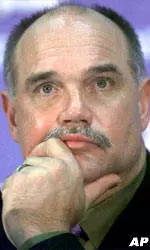
Bunting's appointment didn't generate the tidal wave of excitement that Beamer's would have. He's been an NFL assistant for eight years and a Division III coach for seven before that. He's hardly been on the radar screen. Thus it was a mix of curious media people, athletic department staff, players, ex-teammates and assorted others who gathered in the Bowles Room below the Koury Natatorium in Chapel Hill on Dec. 11 to view Bunting's introduction.
He said the right things.
He said them with conviction.
His umbilical cord to Carolina's past was comforting.
It was apparent this wasn't simply another job.
In the background, former Tar Heel quarterback Gayle Bomar watched in wonderment as Bunting charmed the audience. Someone asked him about the glitzy ring on his right hand, the one he collected after helping the St. Louis Rams to the Super Bowl title last year as co-defensive coordinator. He paid homage to the accomplishment, then reached in his pocket and pulled out a smaller, older ring.
"This ring right here is just as important to me," he said. "It's my 1971 ACC Championship ring that I won with a bunch of hard-working guys who had one common goal. That's what we're going to work to get done here."
Everyone but the media types broke out into applause.
Bomar said chills ran down his body.
"To have given so much of yourself over four years to this program, to have so much pride in it, to hear John talk like that was so touching," Bomar said. "I'll promise you this: There will be no doubt that our team will never lack for motivation or inspiration, that it will play hard for 60 minutes and will get stronger in the fourth quarter. That was a trademark of Bill Dooley teams. John personified that."
Behind Bomar stood his son, David, a starting safety on the 2000 Tar Heels and a departing senior.
"Gosh, Dad, I wish I still had a year to play for him," he said.
Several who will play for him are excited about the challenge.
"He has the swagger of a winner," defensive tackle Ryan Sims said.
"He's been to `The Show,'" cornerback Errol Hood said. "You can't help but pay attention to what he says.
"When he first talked to us, the light kind of hit the Super Bowl ring," receiver Bosley Allen said. "It had this glow to it."
"You could feel the power around him," defensive tackle Will Chapman said.
Bunting is a man who wore Carolina T-shirts under his uniform playing for the Philadelphia Eagles for 11 years, who took wife Dawn on a tour of campus en route to their 1991 wedding at Topsail Beach, who would break into song--"I'm a Tar Heel born, I'm a Tar Heel bred"--watching Tar Heel basketball games while coaching in New Jersey in the 1980s.
Now, he's got the job he always coveted.
"When I first met John in 1977, if I'd have asked him where he'd ultimately like to end up after he's paid his dues, he'd have said North Carolina," said former Eagles teammate Ron Jaworski.
Now that he's back, Bunting faces a hectic first month. He's got to hire a staff, to begin with. Two days into the job, he'd hired Webster, a Carolina linebacker from 1968-71, and was contemplating who on the current staff he'd retain and what newcomers he'd hire. He'd apparently done a good job over the telephone of securing the continued verbal commitments of 12 high school players.
Bunting has yet to reveal much of the schemes he'll employ. Those will depend to some degree on his selections for offensive and defensive coordinators. One glimpse he did provide at his press conference is that his offense will not be a gimmick-based system or a pass-happy, basketball-on-grass theme. For all the short-term successes that many media-genic offenses enjoy, the program overall slides because the team's defense is facing a finesse attack throughout spring ball, pre-season camp and three days a week in practice. When games against powerful offenses with strong tailbacks, fullbacks and tight ends crop up, the defense is no good because, as Bunting says, "it's gotten soft." Bunting cut his teeth defending Bill Dooley's three-yards-and-a-cloud-of-dust attack, he matured as a coach helping defend the sport's most sophisticated offenses in the NFL. You can count of something combining the best of the old and the modern.
And you can count on a renewed commitment to the heritage of that storied turf in Kenan Stadium.
"It's a privilege to run out on that field," Bunting says.
"He's one of the family," Hood adds. "He knows what it's like to wear that blue."
Those who've read Extra Points the last two years understand that I was solidly behind Carl Torbush and hoped he'd be retained. I believed there were enough problems beyond his control and that the learning curve from coordinator to head coach mandated some patience over the mistakes he did make. I told anyone who'd listen that if Torbush could just get over the hump, we'd have for a career a man who's loved light blue since his boyhood days in East Spencer, who understood the intricacies of the University's juggling act with academics and athletics, whose heart would never flutter from a wink from another institution.
I also recognized the vise Baddour found himself in--balancing a sincere desire to see Torbush succeed with the reality of running a business, a business that faced soft revenues because of divisive opinions over the state of the program. The fact that the university would soon embark on a $1.5 billion fund-raising campaign and that athletics are a key part of external relations made for an even murkier kettle of fish. The pain of the division was palpable, my dentist, a loyal, generous and reverent Tar Heel fan, paused from a recent tour of my mouth to say, "Peace in the house. That's all I want. Peace in the house."
Baddour was correct in saying upon firing Torbush, "The current state of the program seems to rest on a game-by-game, year-by-year situation, and that is not an atmosphere for success." That sentiment was echoed by running backs coach Darrell Moody, who said: "These kids feel like every game they're playing for our jobs. That's not fair. It's not right. They had to go one way or the other--make a long-term commitment to Carl or go in another direction."
Baddour apparently decided on that direction following the Tar Heels' bitter 17-6 loss at Virginia on Oct. 28, a game in which the Tar Heels dominated statistically but still could not beat an average Cavalier team. It was Carolina's fourth consecutive loss to a key ACC rival and guaranteed a best-case finish of 6-5. Rumors by then were popping up around Chapel Hill that Beamer was ripe for plucking if a job at Carolina were available and the money was right. Those rumors reached the news media the week of Thanksgiving just after Torbush's firing was announced Nov. 20. Beamer did nothing to dispute them through preparations for his team's season-ending win over Virginia that Saturday night, and the Tech family had all but resigned itself to losing its home-grown coach.
"I'd say it's 99 percent he's going," one source told The Roanoke Times. "I think Frank is gone."
Baddour asked for and received permission to officially contact Beamer on Sunday morning, and Beamer and his wife flew to Chapel Hill for a tour of the facilities and meetings with Carolina administrators. What worked about this impending union was that Carolina had many of the luxuries Beamer had unsuccessfully fought for at Tech--good practice facilities and an indoor structure on the way, a state-of-the-art stadium, and an excellent national name. A package of a reported $1.2 million per annum popped eyes around campus--football denizens saluted the university's commitment to the game while academics decried misplaced priorities. What didn't work was the thought that Beamer would leave the warm mitten of the Blacks- burg hill country--where he'd been reared, played football and taken 15 years to build a reputable program. "He's played here, he's coached here all these years," Tech tailback Lee Suggs said. "It'd be funny to see him in different colors."
Beamer told Baddour and a UNC attorney Sunday evening that he was accepting the job, that he'd inform his staff and his players Monday morning and return to Chapel Hill for a press conference. But over the next 18 hours, Beamer's designs crumbled amid guarantees from Tech of a potful of money for him and his assistants as well as varied facility improvements.
"The grass always looks greener," Beamer said, "but then you sit back and see how green the grass is right here."
It was the second time in six months that Baddour had to pick himself up and dust off after fastballs to the temple from first basketball coach Roy Williams and now Beamer. From a quick turnaround of Torbush-to-Beamer, Baddour now had a full-scale research project on his hands. Where to go with Plan B?
The telephone and airplane became Baddour's blood system for the next three weeks. Names like Jim Donnan, Gary Darnell, Marty Schottenheimer, Clyde Christensen, Butch Davis, Dom Capers, Randy Walker, Jeff Bower and Terry Bowden were linked at various points to the job. Through it all, one name kept popping up.
"As I was talking to the experts, it was interesting how many times the conversation came back to John Bunting," Baddour said.
As Gayle Bomar read the media reports and heard the buzz over the search, he was intrigued with the idea of Bunting and decided to call his old teammate. Their playing association wasn't particularly tight, as Bomar was a senior in 1968 when Bunting was a freshman. But Bomar remembered all the havoc Bunting and his fellow freshmen created for the first-team offense during practice. "The scout team is not supposed to screw up the plays for the offense," Bomar says. "But John and those guys were so darn intense. We had more than one extra-curricular skirmish in those practices." Bunting, meanwhile, remembers sitting in the stands as a freshman and cheering lustily as the varsity upset a top 10 Florida team during a torrential downpour. "I had the utmost respect for Gayle Bomar," he says. "He was so competitive. He had a fire in his eyes. They competed so hard in that Florida game. I was so tickled for the older guys, they'd worked so hard."
That night in early December as Bomar talked from his home in Chapel Hill to Bunting in New Orleans, he felt a warm glow flowing over the phone line.
"John blew me away with how passionate he was about the job, that Carolina was where he wanted to be, that he wanted to get the program back to where it had been," Bomar says. "I could tell he had that fire in his belly. He didn't talk about the money, didn't talk about being a head coach. All he wanted to do was help Carolina realize its potential. There was not an ounce of doubt in his voice at all. At that point, I jumped on bandwagon. I said, `This guy needs to be here.'"
Dick Baddour and James Moeser had formed the very same opinion.
John Bunting looks at the graph on Page One of Extra Points, at the ups-and-downs of Carolina football over three-plus decades. Each time the program seems poised for sustained excellence--whoosh--the rug's pulled out.
"Isn't it amazing?" he muses. "Each program has been to the pinnacle, with the exception of Carl's. Things just didn't go right for him. Bill's went up, then to the dogs in one year, then back up. Mack Brown started shaky, then went up and never got below seven.
"It's difficult unless you've got tremendous continuity, got the right support people involved to maintain the level of the Florida States. It's hard to maintain. Eight wins in this business is pretty good. Wow. This is a very interesting graph. It's not real pretty, that's for sure."
Continuity.
That's the million-dollar word here. Carolina's had good continuity, but not the kind of Bobby Bowden/Tom Osborne/Dean Smith consistency that creates the Holy Grails of college athletics. Bill Dooley won a lot but ultimately was lured away by the idea of being a coach and athletics director, a post Carolina wouldn't give him but one that Virginia Tech would. Dick Crum was never completely comfortable in the fish bowl of a major Southern university. Mack Brown tired of the shadow of Carolina hoops and longed for the football-reverent environment of a place like Texas.
Bunting is 50 years old. Every step of his playing and coaching career has directed him to this job. He could have 20 good years to go.
"This is my last stop," he says with conviction.
"Confidence without arrogance is a powerful combination," says Rick Steinbacher, an administrator in the Carolina football office and Bunting's right-hand man in his first week at Carolina.
Bunting looks once again to the far end of the stadium, to the field house where a vanquished band of Tar Heels showered and dressed after busing back from Duke in 1969, his sophomore year. Duke coach Tom Harp installed a gadget play known as the "Shoestring" or "Swinging Gate" or, simply, "The Killer," as Harp called it, and its deployment for a 53-yard touchdown was the difference in a 17-13 Blue Devil win.
"We had a chance for a winning season, but we lost and finished 5-5," Bunting says. "I sat down in the locker room, and for the first time I cried as a Tar Heel."
That's the kind of passion John Bunting's felt all these years for Tar Heel football. Two weeks earlier, Carl Torbush sat in the same office and contemplated what had gone wrong. He admitted that firing him and hiring Frank Beamer would have been quite a coup for the university. He wondered like everyone else where the search was heading, who would soon occupy his desk. He said he'd carry no grudges and no bitterness. "But I'll tell you this," he said. "They won't find anyone who cares more about this place and this program than I do."
Wow. It looks like that might be a close call after all.
|
