University of North Carolina Athletics
Brewer: The Best Tailback Of All, McCauley Is the Choice
October 4, 2001 | Football
Oct. 4, 2001
By Rick Brewer, SID Emeritus
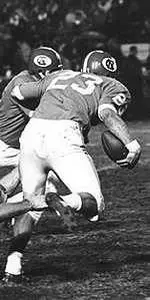
His number was 23.
That's because when he came to Carolina it was the closest number to Charlie Justice's retired 22 that was available.
No one thought Don McCauley would approach the accomplishments of Justice. But, Tar Heel coaches knew he could be an exceptional player.
It's unlikely they even knew just how great he would really be.
McCauley would take a prominent place in the college football record books. He would be the key performer in Carolina's return to national football prominence in the early 1970's. And he would eventually play a role in one of the biggest professional football stories in history.
However, it is for his achievements at Carolina that he will be honored at halftime today. He will be recognized on campus for his selection last spring to the College Football Hall of Fame. Official induction ceremonies will come in December at the Hall of Fame dinner in New York.
When Bill Dooley was hired to rebuild the Tar Heels' football fortunes in the late1960's, he needed a centerpiece for his offense. That player was McCauley.
Dooley, a former offensive coordinator at Georgia, believed a team had to be able to run the football in order to be successful. He wanted a ball control attack that would keep opponents' offenses off the field.
With McCauley, the Tar Heels would run the ball better than at any time in history.
Dooley's offense was designed to feature a durable and versatile tailback. McCauley was that player.
At 6-0 and 212 pounds, McCauley wasn't as big as many of Carolina's future tailbacks would be. He certainly didn't have the size of Natrone Means. Nor did he have the speed of Kelvin Bryant or the moves of Amos Lawrence.
But, he has been Carolina's best all-around player since Justice, the Hall of Fame tailback of the late 1940's. He was a brilliant receiver out of the backfield, handled his team's punting, threw halfback passes and was used to return kicks.
The only player who can approach all his skills is probably Leon Johnson in the mid-1990's.
"I don't want to get in any arguments with old Carolina fans who remember Charlie Justice, but McCauley may be the best back they've ever had," said Maryland Coach Roy Lester in 1970.
McCauley was the first of Carolina's record 24 players to rush for 1,000 yards. Considering all he could do on the field, he's still regarded as the best of them all.
He came to Carolina from Garden City, N.Y. in 1967 when freshmen were ineligible for varsity play. With Dooley still building an offensive line, McCauley ran for only 360 yards as a sophomore, but caught 23 passes and return 24 kickoffs for 538 yards.
After a 1-4 start in 1969, Carolina won four of its last five games for a 5-5 record. McCauley rushed for 716 yards down the stretch, an average of 143.2 yards per game. He led the Atlantic Coast Conference in rushing with 1,092 yards, breaking Justice's school rushing record in the process. He had 14 receptions for 238 yards and returned 17 kickoffs for 440 yards. That included a 97-yard return against Wake Forest.
But, McCauley's best performances were still to come.
As a senior in 1970 he had 324 carries for 1,720 yards. That broke O.J. Simpson's NCAA record for yards in a season. Adding his reception and return yardage, he led the nation in all-purpose running.
He also scored more touchdowns and had more points than anyone in college football. Along with his rushing total, his 21 touchdowns and 126 points still stand as ACC single-season records. He was a runaway selection as ACC Player of the Year and became the first ACC running back to be named a consensus All-All-America. In fact, Ted Brown is the only ACC runner ever to be a consensus choice.
In 1970 McCauley gained over 100 yards in 11 of 12 games, counting a Peach Bowl performance. He had over 100 yards in 16 of his final 17 games in a Tar Heel uniform.
He saved his greatest performance for his last game in Kenan Stadium, rushing for 279 yards on 47 carries in a 59-34 win over Duke.
What may have set McCauley apart from other great players was his honest modesty.
"Nobody on this team is envious of the attention Don gets," said Tar Heel defensive tackle Bud Grissom after that win over Duke. "He's the humblest guy I've ever met. He walks around with the linemen like he's one of us."
Dooley shared that admiration for his star tailback.
"If he had gotten a big buildup before the season, he would have won the Heisman Trophy," says Dooley. "But, we were just starting to get our program going and had been 5-5 in 1969. It was tough to promote players for national honors under those circumstances.
"Plus, there weren't many games televised. People in other parts of the country didn't know how really talented
Don was."
But, his teammates and everyone in the ACC knew.
"I've never seen a better or more durable player than Don," says Paul Hoolahan, executive director of the Sugar Bowl. Hoolahan was an offensive tackle for the Tar Heels and one of McCauley's chief blockers.
"Don didn't need much of a hole to get his yardage. In fact, he often picked up ground when there weren't any holes."
His durability was amazing. He carried the ball 324 times, an average of 29.5 per game. With the physical pounding that a tailback must take, that's one of the most incredible numbers of all. Only Mike Voight has come within 75 rushes of McCauley's total in Carolina history.
"The thing about Don was he never complained about what he was asked to do," says Paul Miller, the Tar Heel quarterback at the time. "He might have carried the ball 28 or 29 times. But if we called his number in the huddle, he'd line up and take it again. I think he actually got better as the game progressed as he wore down defensive players trying to tackle him.
"He was the complete back. In addition to his running, he was a great blocker and knew how to truly fake a handoff which set up our play-action passes. He probably got hit as much when he didn't have the ball as when he did. I don't know how he went through a whole season without getting seriously hurt.
"Because of the position, all tailbacks get banged up and no one had the bruises that Don did. But, he was ready to go every Saturday."
N.C. State tackle Dan Medlin knew what it was like to play defense against McCauley.
"It's extremely difficult to tackle McCauley because he has such great balance," said Medlin. You can't arm-tackle him because of his strength and you can't go for his legs because of that balance. I guess the best way to tackle him is to have help from someone else."
The only people who ever complained about McCauley were members of the media. They could never get him to talk about himself. When surrounded by reporters after a game, he'd always give credit to his offensive line, the other backs and the defense for doing its job.
After a great game in an early-season win over Kentucky in 1970 he was swamped by writers.
"Look, why don't you talk to Ron Grzybowski," he said. "He'd make a great story. He's been a defensive player for three years and now has made the switch to offensive guard. He opened some holes for me that anyone could have run through."
That was typical of McCauley.
When told of McCauley's comments, Grzybowski simply shook his head.
"Don makes his own holes," he said. "When Don has the ball, I just have to push a guy straight back. He can then run over me and the defender, too. He's so quick, and can cut off a block better than anyone. It's great knowing he can turn a two-yard gain into a touchdown."
Wake Forest Coach Cal Stoll probably summed McCauley up as well as anyone.
"I'll tell you what McCauley is-he's a professional-type player competing against a bunch of college kids," said Stoll.
The pros felt that way, too. After the 1970 season, Baltimore Coach Don Shula was offered the head-coaching job of the Miami Dolphins. But, the Colts wanted something in return-the Dolphins' first round draft choice. They used that selection to pick McCauley.
Shula led Miami to two Super Bowl victories and one perfect season. Even more than Joe Namath and the New York Jets winning the Super Bowl in 1969, it was Shula's Dolphins who proved the old American Football League wason a par with the more established NFL.
McCauley played 11 seasons with the Colts, about twice the career of most pro running backs. He replaced Tom Matte in the Baltimore attack. In just his second year he led the Colts in rushing, was third in pass receiving, second in kickoff return yardage and third in scoring.
He eventually became the best third-down specialist in the league. His determination and power made him tough to stop in short-yardage situations and he was also a great threat as a pass receiver in those situations.
But, it's for his Carolina career that he's being honored here this weekend. He'll give credit to Dooley and his teammates for all he accomplished.
The thing is-he'll mean what he says. Don never knew how great he really was and what he meant to this program. Even now, he still doesn't.