University of North Carolina Athletics
Tar Heel Monthly: Perception Vs. Reality
April 17, 2002 | Men's Basketball
April 17, 2002
Tar Heel Monthly is a new monthly publication devoted to the stories and personalities behind UNC sports. For more information, visit www.tarheelmonthly.com.
The following is excerpted from the most recent issue of the magazine.
By Adam Lucas
Matt Doherty is hard to miss.
That's true figuratively, of course. He is the head coach at one of the most storied programs in college basketball history, which means that he spends most of his time at the metaphorical center of Chapel Hill, where basketball can seemingly alter the mood of the entire town. On the days after Doherty's Tar Heels win, everything looks shinier. After losses, Chapel Hill resembles a cartoon where the dark raincloud follows residents everywhere they go.
If basketball isn't the heartbeat of the village, it's at least a kidney.
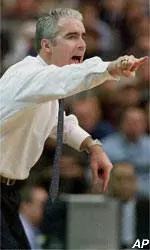
But Matt Doherty is also quite literally hard to miss. In most every gym that he enters during the ACC season, he's the sharpest-dressed guy in the place. He stands between 6-foot-7 and 6-foot-8, depending on who is doing the measuring. When he rises off the Carolina bench to make a point or stomps his dress shoe to get a player's attention, everyone in the arena is aware of him.
For that reason, his volume and mannerisms (which were lovingly referred to as "intensity" last year during the 18-game winning streak by the same people now criticizing them) are subject to scrutiny. And almost unbelievably, there is a group of people out there in Tar Heel land who think that Doherty "screams too much."
Perhaps he should try to make his point in calm tones such as, "Gee, Melvin, I believe that perhaps you should stand a little closer to that Jason Williams fellow on defense in the event that he attempts to heave the ball at the peach basket." In all likelihood, however, that's not going to work. It's a simple fact of life: coaches scream. The same way that fans get into the game and have to raise their voices, coaches have to figure out a way to make themselves heard.
Don't believe for one second that Dean Smith never upbraided a player on the court in front of the fans. There's a legend that goes around about how Smith once called a timeout after a particularly egregious error by a fairly big-name player. Smith gathered his team around him in the huddle and proceeded to look around the group while directly addressing the offending player. "If you ever do that again," he said, "You'll be off the team."
What? The great Smith forcibly correcting a player's mistake? It goes against the legend -- that seems to have grown greater since his retirement-that he never raised his voice, never made any corrections. Smith was a coach. He was the greatest coach of all time, but he was still a coach. And what most coaches learn the hard way is that if they don't coach, they don't stay employed very long. Correcting players is just part of the job description.
"For 30-plus years people saw a more docile coach on the sideline here that didn't do a lot of barking on the sidelines," Jonathan Holmes said. "People got used to Coach Smith and Coach Guthridge, who were a little more laid back. It's just a change, and people have to get adjusted to it."
Change, even when it comes to Carolina basketball, is not always bad. Smith was one of the great adapters of all time. When he saw a way to work the rules to his advantage, he did. When the rules allowed it, he invented the Four Corners. When the NCAA legislated that out of the game with the shot clock and three-point line, he won just as handily as before.
Strategies change. Coaches change. Jerseys change. OK, scratch that last one.
Sometimes, it's hard to adjust to change. Rising sophomore Jackie Manuel (who quashed all transfer rumors with a succinct "I'm not transferring. I will be here.") admitted that he had a little trouble adapting to a new style of leadership.
"It was a little hard to get used to," he said. "In high school, my coach was laid back. He pretty much told me it was my team and let me do whatever. When you get on the college level, it's totally different."
Coaches who find a great player and "let him do whatever" don't usually last long in major college basketball. Just ask Pat Kennedy.
If Carolina had been 20-8 instead of 8-20 this year, Doherty's style wouldn't even be up for debate. As it stands now, it almost seems that fans would prefer to latch on to isolated incidents rather than look at the overall picture. Carolina made some absolutely horrendous errors this year. They occasionally turned the ball over in ways that would make a middle school coach blush. By and large, Doherty's standard reaction was this: he nodded and clapped his hands.
What a maniac that guy is, huh?
"Coach Doherty isn't even the most intense coach I've had," said Melvin Scott. "It's no big deal to me. The fact that he's 6-8 is the problem more than anything else, because when he stands up, everybody sees him."
Give Scott credit for wisdom beyond his years. Something as simple as being tall can create a perception that's very different from reality. When Mike Krzyzewski stands, he's not even in the sight lines of most people watching the game. That's how he is able to get away with some things that would earn other coaches an immediate technical foul. The fact that he wins games in bunches doesn't hurt, either.
For some reason, the fact that Doherty's sideline manners are different from his predecessors has become a point of contention. What he doesn't get credit for are the positive changes that he has brought to Carolina basketball. Even when they were rolling up wins at the rate of 30 per season, Tar Heel basketball has never really been "for the people." There has always been talk of family, but that family extended only to the players and staff. Fans were made well aware that they were pressing their collective noses up against the window, never to be allowed inside. They didn't know the secret handshake. They didn't know the player nicknames. They didn't get to talk to the coach.
Matt Doherty's interactions with fans and the general public are warmer than anything that's ever been seen in Chapel Hill. He doesn't have to do it, because Tar Heel fans have been conditioned over the past 40 years that you don't tap on the glass case containing Carolina basketball. But he has been willing to step outside the box and allow the public to touch the program. Watching him at his weekly radio show, done live at a Chapel Hill restaurant with a peppy group of fans in constant attendance, it's almost unbelievable that the tall salt-and-pepper man joking with the fans in attendance is the same guy who draws criticism for being too harsh.
On at least three different occasions this season, Doherty bought an item off the menu for everyone in attendance at his show. It's hard to imagine Smith, who had a greater talent for keeping the public out than for letting them in, doing the same thing. But Doherty's good humor with fans is slowly building that same Smith-like loyalty. When a call went out before the Duke game at Cameron Indoor Stadium this winter for fans to come to the Smith Center to give the team a sendoff, it was a group of those regulars from the radio show who arrived a full two hours early in order to tailgate before the departure. Eventually, close to 100 fans made the trip on a cloudy, overcast day forecast for rain. To put that in perspective, Indiana made a miracle run to the Final Four, and when they returned home to Bloomington, they were greeted by a crowd that didn't even reach 200.
With the talent that's coming back and the influx of highly-regarded freshmen, it's a safe bet that it may not be long before Doherty makes a Final Four trip of his own. When that happens, he'll be hard to miss. He'll be the 6-foot-8 guy nodding his head and clapping. And he will be lauded for his intensity.