University of North Carolina Athletics
Tar Heel Monthly: Maples and Greenberg Lead Carolina Baseball
May 9, 2002 | Baseball
May 9, 2002
y Adam Lucas
Tar Heel Monthly is a new monthly publication devoted to the stories and personalities behind UNC sports. For more information, visit www.tarheelmonthly.com.
The following is excerpted from the most recent issue of the magazine.
On a dusty high school field in June, 1998, newly-appointed North Carolina head baseball coach Mike Fox and top assistant Chad Holbrook found their closer of the future playing American Legion baseball. And their third baseman of the future. And second baseman, right fielder, and shortstop. The best news was that it wouldn't take five scholarships to sign those players -- it just took one, to Chris Maples.
Fox and Holbrook found the sparkplug of this year's nationally-ranked Tar Heels at a showcase in Clemson a few months later. It was the classic case of a player who met the team's needs. The coaches were a little concerned about Adam Greenberg's pronounced crouch at the plate, but the Tar Heels needed a left-handed hitting centerfielder, and that's exactly what Greenberg could do.
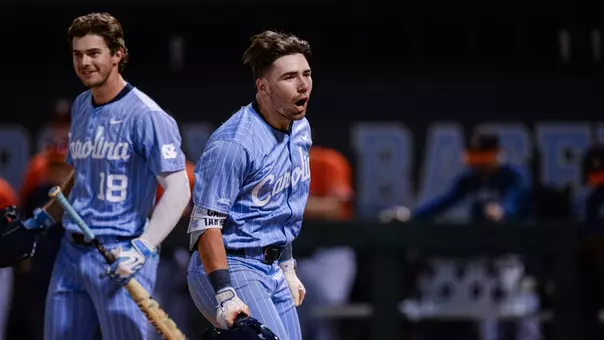
Fast-forward to the spring of 2002, and the dynamic duo of Maples and Greenberg are engineering a return to prominence for Carolina baseball. Maples is the easygoing local boy from Hillsborough, the one who keeps you on alert at all times with his penchant for practical jokes and laser-guided humor. Greenberg is the import from Connecticut, the speedy leadoff man who has suddenly developed a power stroke this season. He also has learned the perfect foil to Maples' humor. Earlier this season against Towson, Maples was needling him in the dugout, complaining that Greenberg was trying to wait too late on the ball. The result? Greenberg hit three home runs in the same game for the first time in his life.
 | |
| Chris Maples and Adam Greenberg have helped lead the Tar Heels to a tremendous 2002 season. |
"It's kind of like a storybook," he said. "A guy comes in, and he's not really recruited very highly. Guy doesn't play much as a freshman, then steps up and gets bigger and stronger and starts hitting for power. Now in his senior year he's on the verge of turning some heads and getting national attention."
Most of those heads that are turning are watching balls fly over the fence at Boshamer Stadium. The 5-foot-10 senior had a combined nine home runs in the first three years of his Tar Heel career. With almost a month left in the season, he has smacked 19 round-trippers in 2002 and is closing in on Devy Bell's single-season school record of 24 homers.
His power surge mirrors that of the team. Carolina hit 30 home runs in the entire 2001 season. They're on track to triple that figure this year, and six players have already set career highs in home runs.
The genesis of the change came late last season in a series against perennial power Georgia Tech. After noticing a substantial difference in the physiques of his players as compared to the bulky Jackets, Fox went to strength coach Greg Gatz and asked him to ratchet up the offseason conditioning.
"What happened the previous year was that we did our training in the fall and then gave them a couple weeks off," Gatz said. "Then they came back for just a couple weeks before the break, and they didn't get much out of that. This fall we went through a four-week phase early, then had the fall season, and then had at least six weeks to actually get some more training in before the holidays."
That increased strength has been a boon to Maples, who was lightly recruited coming out of Orange High. He was the runnerup for player of the year in the Pac-6 Conference, and then batted .420 for American Legion Post 452 the summer after his senior year. That's where Holbrook and Fox spotted him.
Fox had been on the job only about a month when Holbrook told him there was a middle infielder from Hillsborough who had been in contact with the Tar Heels. The status of Brian Roberts was unknown, so middle infield looked like a need.
"Chris was probably the only player I had any contact with before August," Fox said. "We drove over and watched him play that one time and noticed his arm strength and how athletic he looked."
Maples played shortstop in that game, and the Tar Heel braintrust thought he might have potential as a catcher if he didn't work out in the infield. As it turned out, catching has been about the only thing he hasn't done in Chapel Hill. He played middle infield as a freshman and sophomore, including being named to the All-Tournament team as a sophomore at the NCAA Regionals in Upper Monclair, New Jersey. As a junior, he moved primarily to third base as his power production increased dramatically (a team-leading seven home runs) but his average dipped while his strikeouts increased.
Although he spent most of the summer learning the outfield with the Durham Braves of the Coastal Plain League, necessity forced him to move back to third for 2002. His average is up (.341 through the beginning of May) and he has proportionally kept his strikeouts under control while substantially increasing his power.
 | |
| Chris Maples launched three home runs against NC State on April 20. |
"He's such a carefree, relaxed type of kid," Holbrook said. "He just saw it as a challenge. He has a very live arm and runs his fastball up there from 90 to 93 miles per hour. He gets strikeouts, and that's what you have to have late in the game."
Maples has made 17 appearances for the Tar Heels this year, racking up 21 strikeouts in 16.1 innings pitched and saving four games. Opponents are hitting just .136 against him, the best figure on the team. His 1.10 ERA is also the team leader.
Not too bad for a kid who hadn't pitched in a game before this year. He had fooled with a curveball in high school but this year has developed a three-pitch arsenal -- fastball, changeup, and slider. After admitting that he was more of a thrower than a pitcher in the fall, his mechanics are improving, and it's possible that despite his powerful bat, it's his live arm that will get him a shot in the pros. There's no question that he has the physical tools to compete at the next level. It's the mental side, and facing adversity similar to that presented at Wake Forest earlier this year-when he walked one and gave up a two-run single in the pivotal eighth inning of a loss-that is the most difficult part of becoming a pitcher.
"The mental part is definitely the hardest part," Maples said. "The physical part will be there. You can have bad mechanics and still be a pitcher. If a guy hits a homer, you have to come back and throw three strikes and strike the guy out. But if a guy hits a homer and you're rattled easily and can't find the plate, that's trouble. When you're pitching, it's a one man show."
Adam Greenberg knows about being a one-man show. As a freshman in 2000, he was just the second Tar Heel ever to be named ACC Rookie of the Year. The Guilford, Conn., native led Carolina in six different offensive categories and put together a 21-game hitting streak. His 98 hits immediately put him in some lofty company, as they tied him with major league All-Star B.J. Surhoff for the second-most hits ever by a Carolina player.
But his sparking season also had a drawback.
"That kind of season is a heavy burden to bear sometimes," Fox said. "You get labeled as the best freshman in the league, and it's a very good league. People out there who aren't involved with baseball say that if you do it once, you should be able to do it over and over again. But players aren't robots. They have other pressures on them that affect their play. You get pitched a little differently, and you get everybody's best."
 | |
| Adam Greenberg is playing the game, and enjoying it, like he did as a freshman in 2000. |
Then, as a sophomore, he discovered that he was a marked man to opponents. He saw more offspeed pitches and opposing hurlers were no longer willing just to throw him a fastball to keep his tremendous speed off the bases. Greenberg's batting average slumped over 75 points and his home run production dipped from eight to two. To further complicate the situation, his family was undergoing a difficult move from Connecticut to New Jersey. Greenberg serves as almost a father figure to his younger brothers, who were struggling with the move.
"It was probably the toughest year of my life," Greenberg said. "It was especially tough with how the team was doing [the Tar Heels missed the NCAA Tournament]. Coming off what I did my freshman year and the team having great success, but then having those struggles my sophomore year was definitely my toughest time."
They were the kind of struggles that couldn't be fixed by a simple batting stance adjustment or patience at the plate.
"I remember sitting in the office watching tape and trying to figure it out," Holbrook said. "We took some at bats from his freshman year and compared them to his sophomore year so that we could see the difference. There was no difference in his swing. But you could look at the kid's face, and his freshman year he had a smile and was having fun. His sophomore year, when he stepped in the batter's box he looked like he had the weight of the world on his shoulders."
The solution for those worries turned out to be the summer Cape Cod League. Perhaps the best-known of all the summer baseball leagues, the Cape features some of the most talented college players in the nation. When Baseball America picked its 42-member pre-season All-American team before 2002, 25 of them had played in the Cape Cod League.
For two months, those players use wooden bats instead of the college standard of aluminum and showcase their talents for both fans and major league scouts. It's a summer that can turn a virtual unknown into a touted professional prospect. That's what happened to Tar Heel Russ Adams, who had a steady sophomore year and then vaulted to prominence on the Cape, batting .281 and winning the Outstanding Pro Prospect Award.
Greenberg, Adams' partner at the top of the Tar Heel lineup, didn't win any awards for his .269 average and seven stolen bases. But for him, the summer was just as refreshing.
"The Cape Cod League was probably the best summer of my life," he said. "Coming off that sophomore year, I needed a new environment. I had wanted to go to the Cape my whole life, because growing up in Connecticut it's something you hear about all the time. It was escape, a getaway from everything that had happened and a new beginning."
He turned the new beginning into a 2002 season that might rival his freshman campaign. His batting average is back up in the mid-.300's, he has started every game, and he's getting on base almost one out of every two plate appearances.
But it's his power numbers that have taken the most noticeable jump. Greenberg always possessed more power than the typical slap-happy leadoff hitter, but this year he has already powered 14 home runs and driven in 47 runs, both career highs. His slugging percentage is nearly 100 points higher than his previous career high, and he has led off six games with a homer.
The only question about the 5-foot-9 junior is if he'll remain in Chapel Hill for his senior season. The draft after their junior year is when college players have the most leverage with professional teams, but despite his gaudy numbers, his size remains a bit of a question mark with scouts who like their prospects to fit the ideal height and weight molds.
For the moment, Greenberg says he's only concerned about making it to the College World Series this year and leading the Tar Heels to a national championship. Fox and his staff would love to have him back, of course, to compete with the Clemsons and Florida States of the ACC that regularly have seniors turn down the draft in favor of another shot at making it to Omaha.
When he does decide to take a shot at the pros, he's likely to find a familiar face staring down at him from the mound in some minor league park someday.
"Chris and Adam have really had different paths since they've been here," Fox said. "They're different people and different personalities, but they're both so important to what we do here."