University of North Carolina Athletics
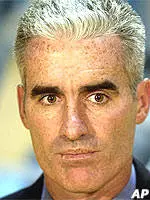
A Candid Conversation With Matt Doherty: Part 1
June 19, 2002 | Men's Basketball
June 19, 2002

 |
|
Adam Lucas: How long does it take you to recharge your batteries after the season?
Matt Doherty: I think it's important to get a break. My family and I spent a week at Disney World, then we went over to Amelia Island, where the ACC had its meetings, for about four days. That was a good break. In an ideal world, I guess you'd take two weeks. Dick Baddour always talks about taking two weeks-that first week you're sort of down shifting, and then you get to enjoy the second week a little bit. I made a conscious effort not to take my laptop or check my voice mails. It was much needed to get away and spend time with my family.
AL: When we get into this time of year with recruiting, is that therapy for you or is it just another hectic time of year?
MD: It's another hectic part of the year, but it's exciting and a fun part of the year. The excitement of recruiting good players makes it fun.
AL: What's the best part of being the head coach at the University of North Carolina?
MD: The chance to coach the best basketball program in the country, to walk the same sidelines as Coach Smith and Coach Guthridge and have the opportunity to win national championships at my alma mater. That's pretty special. Not many people have that opportunity. It's also great to be able to interact with Coach Smith and Coach Guthridge, whether it's talking about basketball, seeking their advice, or playing golf.
Plus there are some other things, like having the chance to play golf at Pinehurst. North Carolina is a great state in which to live and raise my family. The climate and the people are great, and being at a special place like the University of North Carolina is a great benefit.

|
|
MD: The scrutiny. Even having played here and coached at Kansas and Notre Dame, I didn't realize the microscope that this position was under. That may sound naive, and you'd think if anybody would have a handle on that, it would be me. Mack Brown said about Texas football that the best thing is that millions of people care, and the worst thing is that millions of people care. That's true with the basketball program here as well. Everyone has an opinion. There is perception and fact, and quite often they're not close to being one in the same. For example, I spoke in Kinston to an alumni group recently. I was the last speaker and it had been a long evening. I spoke for about a half hour after a football coach spoke for about a half hour. At the end of my talk, I always ask if there are any questions. I asked and then waited a few seconds. I didn't want to beg for questions. No one raised a hand, so I said thank you and I want to leave you with a quote. I read the quote and sat down. The next day, I hear, 'Matt Doherty ducked questions in Kinston.' That just totally blows my mind that people say things like that. I don't know if it's to stir the pot or if that's really the perception, but more often than not those people aren't around and have no idea. I read something the other day about my relationship with Julius Peppers. It said that Julius Peppers wasn't afraid to get in my face. I don't ever remember yelling at Julius Peppers, and Julius never ever got up into my face. It blows my mind that those things are out there and that people don't know the truth. I don't know sometimes if they even care about the truth, because what is made up makes for good conversation. Julius is one of the most laid back kids I've ever coached, at least until someone on the other team would hit him with an elbow.
AL: Speaking of some of the rumors out there, let's talk about some of them. How is your relationship with Coach Smith?
MD: People have speculated about that, and we have a very good relationship. I talk to him at least once a week.
AL: When you talk to him, is it usually about basketball or about something else?
MD: It could be anything. It could be golf, it could be X's and O's, it could be personnel, it could be religion or politics, it could be anything. He is a very wise person who has a lot of experience. I try to draw upon that experience. At first, I didn't want to bother him. As a former player, I never wanted to knock on that door because I knew how busy he was. I took that approach when I got here, but the more we're together, the more comfortable I feel with things like calling him late at night at home or calling him at the beach.
AL: Have you ever thrown a ball at a player in anger?
MD: No, and I can't believe this is still an issue. The situation that you're referring to happened when Joe [Forte] threw a pass to Brendan Haywood, and it hit Brendan in the shin. Joe was upset at Brendan for not catching the ball. I asked Joe to come over, and I got about ten feet from him and passed the ball to his shin, and of course he missed it. I was making a point to him that he had thrown a bad pass. Then it came out that I had lined him up against the wall and thrown the ball at his head or something. You ask Joe and he'll tell you the same thing.
AL: How is your relationship with Coach [Phil] Ford?
MD: There's not a more loyal Carolina person than Phil Ford. He loves Carolina basketball. If there's somebody who could be bitter towards me, it's him, and that's the farthest thing from the truth. We talked a lot during the season. He'd come visit me during games, and we'd laugh about being the head coach at North Carolina and how it's different moving over to the head coaching spot.
AL: What have you learned about following a legend that you might not have known before?
MD: It's a lot harder than I thought, and I thought it was going to be hard. I coached at Notre Dame and I became familiar with their football program, which I think is very similar to Carolina basketball. There are other basketball programs out there, like UCLA or Kentucky or Kansas, but none are as far-reaching as Carolina. We have the state, but we also have the nation and even internationally in terms of the interest and exposure. It creates a lot of scrutiny. The thing about Notre Dame football is that there has never been a coach in recent history who has lasted more than ten years. There wasn't the infrastructure set up or the relationship with the former players with just one staff, whereas I came in here after 30 years, and now there really is change here. Some people embrace change, but a lot of people don't like it. That really made it a challenge.

|
|
MD: I'm a part of that 35 years, and I worked seven years for Coach [Roy] Williams, who worked here for ten years. There's not going to be much deviation. I will make changes that I see fit, just like Coach Smith did. Here's a coach who went from a lot of ball control when there was no shot clock or three-point line, to coming down in transition and shooting three-pointers. I may play a little different next year and people may say we're not playing the way Carolina plays. But the game is different. There aren't many great seven-footers out there. We're going to be younger, and I don't want to give them as much information to start. We'll play a little different than we did the past two years, and that's not because I'm trying to go away from Carolina basketball. Carolina basketball has always been based on playing hard, playing smart, and playing together. We will continue to do those things. Those things will not change. But just as Coach Smith's style changed according to the rules and personnel, so will ours.
AL: How has your relationship with your staff grown since you've been here?
MD: I think one of the best things I did was bring my assistants with me, because they are loyal to me. Through tough times, I know they will be loyal. We might not always agree on things, and that's okay. We had some real heart to heart talks during the year and after the season, and it was neat because we knew we had each other and we were going to get through it together. That's the loyalty that I learned at Carolina and that's the loyalty I exhibited in bringing those guys with me, and it's paid off.
AL: What are the strong suits of this staff?
MD: Their organization, their work ethic, their passion for doing a great job, ability to recruit, and ability to care for people. We have some good basketball minds, from Doug Wojcik who played for a team that had no right going to the NCAA Final Eight, and he was the point guard on that team. He worked with Don DeVoe at Navy, and you have to be able to coach to win there. There's Bob MacKinnon, whose dad was an NBA coach for so long, and Bob has been a head coach. Fred Quartlebaum played basketball at Fordham, and David Cason played for Kevin Stallings at Illinois State and was the MVP of his team.
AL: Does each staff member have individual responsibilities in terms of instruction?
MD: Doug and I work with the big men before practice, and Bob and Fred work with the guards. I oversee the entire practice plan and bring it all together.
Tar Heel Monthly is a monthly publication devoted to the stories and personalities behind UNC sports. For more information, visit www.tarheelmonthly.com or email Adam Lucas at alucas@tarheelmonthly.com