University of North Carolina Athletics
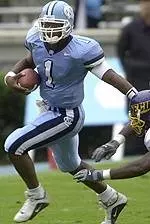
No Looking Back
January 23, 2003 | Football
Jan. 23, 2003
This story originally appeared on October 13, 2001 in the Raleigh News & Observer.
By Barry Svrluga
CHAPEL HILL -- Ronald Curry leaned back and spoke softly, the only way he really speaks, of what had been and what might be. So much. Just so much. He is 22.
"I feel old," Curry said.
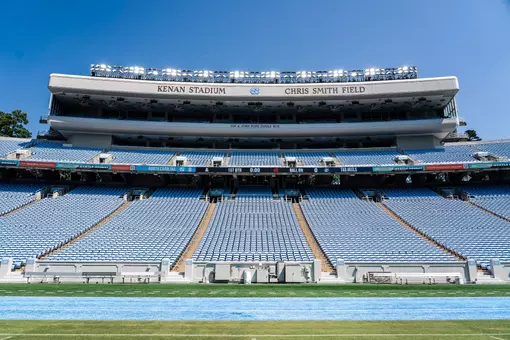
He is North Carolina's quarterback, and he will lead the Tar Heels into Kenan Stadium today against Virginia, a senior, with just a half a season remaining. He is engaged to be married and ready to graduate. Not long ago, he got up out of bed in the morning and limped to the bathroom, an old man's hitch in his step. He has been watched and wondered about since ... oh, it's hard to tell now.
It would be nice, he thinks more than occasionally, not to have to deal with it all.
"I look forward to it, just getting away from sports," Curry said just the other day. "I love it; I enjoy it. But there's a lot to it that I could do without.
"The spotlight part of it. Sometimes, you just don't feel like getting up and coming and dealing with [the strength coach] and running and lifting and stuff like that. Practice every day. Some days you feel like it. Some days you're motivated to get better. Some days you just drag yourself to get better; you got to make yourself get better.
"I'm just so looking forward to what I'm going to be doing five, 10 years from now."
Ronald Curry, two-sport stud. That's all he has ever been. He signed his first autograph before he was in ninth grade. Get one now. Kid's gonna be someone. He spoke to groups of youngsters, was held up as a role model, as a freshman in high school. A freshman, teaching the ways of life.
efore this season, before he started even allowing himself to think those days without sports could come as soon as next year, he felt old. The season ahead was his job interview, and he was - and is - still hoping for the shot at the NFL that he once thought was merely a guaranteed fallback if he missed out on the NBA.
"I got enough talent to make it to the next level," he said five days before the season started, sitting on a couch tucked under Kenan Stadium. "But it's got to come together, all in one season. That's all it takes. One season. One hot season.
"I think this year is mine."
Thus far, it hasn't been. He will start today's game but will rotate series with redshirt freshman Darian Durant. Last week, Curry was booed - booed at home against East Carolina. But he doesn't resent the fans, doesn't resent anybody along the way.
"I'm not a dweller," he said. He might call Durant "The People's Choice," but it's not a knock. He understands, right now, it's just the way it is.
"What should he do?" Curry said. "Try to play bad so I can go in?"
Of course not. Curry knows. When he arrived from Hampton, Va., in 1998, he was the freshman people wanted to see. Oh, how they wanted to see him.
How Much Is Enough?
There isn't a way to quantify the discrepancy, the gap between what was supposed to be and what is. That's what Ronald Curry is measured by.
His accomplishments, and there are plenty, are rarely discussed, replaced by conversations about what he hasn't done. He is UNC's career leader in total offense, a mark he set in last week's win over East Carolina. He could still set school records for completions, passing yards, touchdown passes and rushing yards by a quarterback. He could easily be the most accomplished quarterback in UNC history.
He didn't come to Chapel Hill for football, but for the vaunted Tar Heels' basketball program. Yet he has been the focus of the football team since the fifth play of his freshman year. Had another player's injury not forced him into the lineup, "I was gone," he said, gone for the basketball team as soon as practice started.
"I feel like if I didn't play football my freshman year," he said, "I don't know if I'd still be here or not as a basketball player."
He still thinks it now, that the NBA might have been a realistic possibility following just a couple of college seasons. After he averaged 4.2 points and shot 35 percent from the field in two seasons, it is hard to imagine. Instead, he has played for two head football coaches, two head basketball coaches, three offensive coordinators and seven assistant basketball coaches. He ruptured his right Achilles tendon, an injury that wiped out half of one football season and an entire year of basketball.
All that to endure. And then last week, those boos.
"People say he's not having fun," said Jason Capel, his basketball teammate and longtime friend. "How can you have fun when you're getting booed? We're still kids here."
In the past few days, Capel hasn't been the only one to come to Curry's defense. After practice Thursday, Curry spoke about how much support he has received, e-mails and appreciative notes. There is a sense, even in his struggles, that they aren't all his fault.
"What he's done is give everything he can for this school," UNC football coach John Bunting said.
Curry agrees, and that's why the boos got to him a bit, got to him as much as anything ever does. "It bothered me," he said. "Getting booed at home - that's the whole shaky thing about it. It's kind of uncalled for."
2@'text/css'> .raisedquote {font-family:arial, helvetica; font-size:14px; font-weight:700;} .raisedquotesig {font-family:arial, helvetica; font-size:12px; font-style: italic;}
 |
"What he's done is give everything he can for this school."
-- UNC football coach John Bunting
|
"Grew up in the hood, been without food, been without water," Curry said. "Just sometimes, we didn't have. Life really didn't get good until I got into high school."
Then, in the next breath, he rights himself, lest someone feel sorry for him:
"But it wasn't a struggle. I enjoyed my life. I wouldn't change anything about it."
It is why he can come home from practice, or home from Kenan after being booed, and place his thoughts elsewhere. Give him "SportsCenter." Give him PlayStation.
"It's funny, I was just thinking about this the other morning," said Stacie Jones, Curry's fiancee. "I was thinking about how he has never had an ill word to say about anything. The staff. The players. The situation. Every day, I'll ask him, 'How was practice?' "
"Practice went really well," he'll say.
No negativity. No nothing. Give him enough opportunities, and he'll say it over and over: The past is the past.
"His facial expressions don't tell what he's thinking," UNC basketball coach Matt Doherty said. "He has an inner strength, an inner calm, an inner peace about him that I really admire."
The Hardest Farewell
Sitting in a car in the parking lot outside a funeral home back home in Hampton, Va., last October, Curry's peace was shattered. He could barely move. He just sat.
His grandmother, Mattie Curry, the woman who raised him till high school, had died, finally succumbing to heart problems and diabetes that had plagued her for years. Curry's famous even keel was in danger of tilting, and tilting badly.
He called Jones from his cell phone, told her he couldn't go in. He just couldn't. She talked him into it.
Inside, Lillian Crawford - the mother of one of Curry's closest friends, the woman known as "Big Momma" who brought young Ronald up when Mattie became ill - sat beside him, gave him a hug.
"Everything's going to be all right, darling," she said.
The other grandkids, Ronald's cousins, all rose and walked slowly, each going to view the body. Curry couldn't.
"That was the toughest part of it all," he said. "Knowing this was the last time I was going to see her, period, dead or alive. It was like my final goodbye."
As he sat there, frozen, Crawford whispered to him.
"Ron, go up there and look at your grandmother," she said. "You'll feel better about it if you would see her."
He rose. He walked forward - and collapsed. Right then, he was not a star, not a point guard or a quarterback.
Someone called an ambulance. His friends helped him up and moved him around the parking lot. The legs that had carried him so effortlessly for so long gradually began to work again.
"I think it was good that he got all that stuff, everything he had bottled up, out of him," Crawford said.
When Curry talks about how other people don't know what he goes through, this is what he means. The funeral was only a few days before the Heels played Virginia last year. Curry returned to Chapel Hill for practice, played in the game, completed 22 of 39 passes for 223 yards. But UNC lost, 17-6.
"You might have your mind on other things," Curry said. "You might be going through stuff that other people don't know about. The people that need to know, know. My teammates. My coaches. But that's all that matters. They know why I've struggled at certain times."
Collegiate Home Stretch
Headed into the final six games of his career - seven, should the Heels be invited to a bowl game - people aren't quite sure what to expect from Curry on the field, as even-keeled as he might be off it.
"Ronald has had a very unusual career," said Mike O'Cain, his offensive coordinator in 2000, "and, some would say, an unfortunate career. ...
"The expectations that were placed on that young man - I'm not sure anybody could have held up under those expectations."
obby Bowden still calls Curry the best schoolboy quarterback he has ever seen. It would seem, regardless of coaches or teammates or circumstances, that Curry would be here, in the midst of his senior season, the undisputed starter. Right now, he is not.
"There's so many reasons, so many," said Mike Smith, his football coach at Hampton High. "He's still the best that ever was in high school, but I don't know. I don't know."
There are little things that are frustrating, to coaches, to fans, to Curry himself. Why can he make the spectacular play - hurling a 53-yard touchdown pass to Kory Bailey against Florida State when it looked as if he might run - and then throw the ball at a receiver's feet, just five yards downfield?
"Sometimes, you want him just to let it loose, like he does on the long throws," said Gary Tranquill, his offensive coordinator now. "On some of those shorter throws, it's like he's thinking, 'OK, this is an easy one,' and he steers it rather than throwing it."
Coaches around the ACC whisper about Curry's sometimes stunning ability, but they know he is running out of time to establish himself as an NFL prospect.
"He'll benefit from the fact that there are so many jobs out there for quarterbacks right now," said Steve Keim, a former N.C. State lineman who is now a scout for the Arizona Cardinals. "And it helps him that a guy like Quincy Carter [the rookie from Georgia who, until getting injured, was the Dallas Cowboys' starter] made it, because the league seems to be going toward more athletic quarterbacks, and that's what he is.
"He has a strong arm, and that helps. It's all about [potential], and he has that. He'll get his chance, but will it be by being drafted or latching on as a free agent? It's hard to say. The good thing about the NFL is, it only takes one team to like you, and you get your shot."
Curry just wants his shot, wherever it is, at whatever position though he prefers quarterback. "That's what I am," he said. "That's what I've always been."
An intriguing question is the one that has been asked all along: How has basketball affected football, and vice versa?
"I think that'd be awfully tough to quantify," Doherty said. "It's something you really can't get a handle on. But I think it's probably easy to say, and safe to say, that he'd be a better basketball player if he concentrated on basketball, and a better football player if he concentrated on football."
ut then ...
"How do you tell someone with that kind of ability that they can't try both?" O'Cain said.
Curry has never asked Doherty for specific advice on the matter. He has never asked Bunting. He never asked former football coach Carl Torbush or retired basketball coach Bill Guthridge. Part of feeling older is feeling more mature. He says he is equipped to handled the situation himself.
"It's my decision," Curry said. "As long as both coaches keep giving me the opportunity to play, and I can still play, I'm going to play. Somebody else's opinion doesn't matter. If my mother came to me and said I should only play one, I'd tell her it's my decision."
That is, he said, how he approached the decision on whether to attend Virginia or Carolina. It was his decision, he said. And it wasn't guided by classes or campus atmosphere.
"I came here from out of high school understanding that this was a business," he said. "I had to make my decision as if it was a business. So it was a basketball decision.
"If I had made the decision based on football, I wouldn't have come here at all."
Ahead: Life After Football
|
"There are some days when I think he actually thinks about what if I,"
Jones said, and she paused, "was a regular person?"
|
These two, to some degree, are opposites. He, quiet and reserved; she, bubbly and effusive, eyes beaming behind her smart-looking glasses.
"She's different than any girl I've ever been with," Curry said. "She has such a sweet heart."
That's how Curry reeled her in that day last March. His old injury, the Achilles, was bothering him, or so he claimed. He wanted it massaged.
Jones had other things to do, was tidying up. But she came over, sat on the couch with him and began rubbing.
Then she noticed it. Wedged between two of the toes on his left foot. The note. In it, Curry wrote of their relationship, where it had been and where he wanted it to go, about what his life would be without her. She read it, and looked at his right foot. On the pinkie toe was the ring.
So now, their futures are intertwined. Should he be drafted, should he make it as a professional, she will leave her job in customer relations at University Directories in Chapel Hill.
Curry says he thinks about what he would like, a nice house maybe 30 minutes from Hampton, in Williamsburg or Virginia Beach, maybe. A cul de sac.
"Something out of the way," he said. "Something where I could raise my family, where it's quiet."
It won't be in Chapel Hill, as much as Jones loves the Triangle. It's not that Curry couldn't stand to live here as the ex-athlete. "Regardless of where I'll be, I'll be Ronald Curry, ex-whatever," he said. "It doesn't matter." This area, Chapel Hill, is just a bit too far from Hampton, from home.
If not professional football, Curry doesn't know what his work will be. He believes he will get a job somewhere. Sales. Business. Jones said he wants to be "an entrepreneur, but we haven't really gone as far as what he would like to do."
What he would like is get that shot at the pros.
"It could be over," he said. "But I can go in there and show them things I can do."
Today, he will do some of those things, all the while rotating with Durant. Afterward, he will go to dinner at Darryl's or Outback or Applebee's, hanging with his friends from home. They are not likely to talk about football, about what just happened or what is next.
That is left for Jones and Curry to discuss privately. They have done it often. Sports. No sports. Their house. Their home. Their lives.
"There are some days when I think he actually thinks about what if I," Jones said, and she paused, "was a regular person?"
Special thanks to Svrluga and the N&O for the permission to run this feature on the pages of TarHeelBlue.com.