University of North Carolina Athletics
January 29, 2003 | Men's Basketball
Jan. 29, 2003
Tar Heel Monthly is the premier magazine devoted to the stories and personalities behind UNC athletics. Click here for subscription information.
The following is from the most recent issue of the magazine.
By Adam Lucas
Injuries are a part of life in major college basketball. But that doesn't mean we have to like them.
When Sean May went down with a broken foot on Dec. 27 against Iona, it marked only the latest crushing medical blow to Carolina's basketball program. What follows is a look at the ten most important injuries in Tar Heel hoops history, ranked in order of the perceived impact on the season as it affected the potential of the team. Losing a shot at an imminent national championship was foremost among the considerations, but teams that saw their seasons end much sooner than they might have otherwise were also given weight. For example, an injury on a team that still advanced to the Final Four would be considered less damaging than one on a team that was eliminated in the first round of the NCAA Tournament.
1. Kenny Smith, broken wrist, 1984.
Almost 20 years of history haven't erased the memory of how dominant the 1984 squad was. They breezed through the ACC at 14-0 and didn't just beat teams, they demolished them -- Wake Forest by 37, Stanford by 13, Syracuse by 23, Dartmouth by 45, NC State by 21, and Maryland by 12. After a 17-0 start, that momentum came to a halt in Chapel Hill on Jan. 29 against LSU, when Kenny Smith was taken down on a breakaway. Although he would return later to come off the bench in the regular season finale against Duke with a cast on his wrist, the Heels never recaptured the same magic and were eliminated in the NCAA regional semifinals by Indiana.
Dean Smith has often noted that 1984 was one of the few times he felt that the Heels had the best team in the nation. His point guard's injury prevented them from reaching that potential and winning Michael Jordan's second championship in three years.
2. The entire 1977 season.
Just as Smith's injury probably cost Carolina a national championship, so did a multitude of injuries during the 1977 season. The Tar Heels still had a magical season, beating Notre Dame on St. Patrick's Day and advancing to the NCAA final against Marquette. But without a trio of key injuries -- Tommy LaGarde hurt his knee at midseason and was lost for the remainder of the year, Phil Ford injured his elbow in the East Regional semis and was limited to just 3 of 10 field goal shooting in the national final, and Walter Davis broke his finger in the ACC Tournament semifinals against NC State and had to play with it in a splint -- there is little doubt that Carolina was a better team than Marquette that season. With UCLA finally out of the national picture, this looked to be the year that Smith won his first national title. Instead, thanks to injuries, he had to wait five more years.
3. Derrick Phelps, concussion, 1994 vs. Boston College/Donald Williams, stress fracture and separated shoulder, 1994.
It has been argued that the 1994 team had too much talent. Featuring a senior class that had been heralded as the best ever when they entered Carolina in 1991 and a freshman class that featured Jerry Stackhouse, Rasheed Wallace, and Jeff McInnis, the Tar Heels were clearly the most talented team in the nation. They definitely did not have the best chemistry in the nation, perhaps exacerbated by Williams missing nine games with a combination of injuries. A stress fracture in his foot and a separated shoulder prevented him from ever regaining the form that he showed in winning the 1993 Final Four MVP award. But after regrouping to win the ACC Tournament title over Virginia, it looked like the Heels were poised for an NCAA run. That was snuffed out when Danya Abrams hammered Phelps in a second-round game against Boston College, sending the Carolina point guard out of the game and the Heels out of the tournament.
4. Phil Ford, sprained ankle, 1976.
It's difficult to understate the importance Phil Ford had to the Tar Heels during his career, which makes his injury before a first-round NCAA Tournament game against Alabama that much more critical. After going 25-4 during the regular season and 13-1 in the ACC, the Heels sputtered in the postseason, losing to Virginia in the ACC Tournament and to the Crimson Tide in the NCAA Tournament. Although Ford started and played 28 minutes, he was extremely limited against the Tide, making one of five field goals and handing out just three assists in a 79-64 defeat.
5. Steve Hale, broken collarbone, 1985.
Coming right after the unfortunate 1984 season, the Tar Heels suffered another setback in 1985. Steve Hale wasn't as flashy as Kenny Smith, but his role was just as valuable. Despite losing Jordan, Doherty, and Sam Perkins from the previous year's squad, Smith directed his team to an ACC regular-season title. In a first-round NCAA Tournament win over Middle Tennessee State, Hale was shoved from behind and broke his collarbone. Carolina still defeated Notre Dame in South Bend but eventually lost to Villanova in the regional final. Would Hale have been enough to overcome the Wildcats' seeming date with destiny? We'll never know.
6. Joe Quigg, leg injury, 1958.
Coming off a national championship and with head coach Frank McGuire on top of the world, prospects were bright for Tar Heel basketball in the summer of 1957. They darkened in the first scrimmage, when starting center Joe Quigg went down with a leg injury. Without him, the Heels finished 19-7 and in second place in the ACC. With him, Carolina would have likely had enough firepower to overcome Maryland in the conference championship game and advance to the NCAA Tournament to defend their national title.
7. James Worthy, broken ankle, 1980.
He wasn't yet Big Game James, but James Worthy was already making his reputation during his freshman season. Averaging 12.5 points and 7.4 rebounds per game, Worthy broke his ankle at midseason and missed the remainder of the year. Despite the efforts of a solid group of five seniors, the Heels were bounced in double overtime by Texas A&M in the first round of the NCAA Tournament. Worthy certainly would have provided a few extra points that would have eliminated the need for those extra sessions.
8. Dick Grubar, knee, 1969.
It was the height of the UCLA dynasty when Carolina made a trip to the 1969 Final Four, capping a run of three straight Final Fours. Unfortunately, they made the journey without guard Dick Grubar, who had injured his knee during the ACC Tournament. Although the ridiculous selection of South Carolina's John Roche over Charlie Scott for ACC Player of the Year by a group of unenlightened sportswriters is perhaps the most remembered feature of the 1969 season, it's worth noting that Purdue's Rick Mount lit up the Heels for 36 points in the national semifinals -- numbers it's unlikely he would have put up if Grubar, a sticky defensive player, had been able to play. It's unlikely that Carolina would have been able to dethrone Lew Alcindor and the Bruins, who were in the process of winning ten national titles in 12 years. But it would have been nice to have the chance.
9. J.R. Reid, foot, 1988-89 season.
J.R. Reid was larger than life during his Carolina career. He chose the Heels over Virginia in a hot recruiting battle, single-handedly popularized the flattop haircut, and was on the cover of Sports Illustrated as a freshman. After averaging 18 points and seven rebounds per game as a sophomore, expectations for his junior year were high. Although he did win the ACC Tournament Most Outstanding Player award in 1989 after besting Danny Ferry and Duke in the championship game, he never seemed to get fully on track after a foot injury forced him to miss the first nine games of the season. His scoring and rebounding averages decreased from his sophomore year and the Heels were eliminated from the NCAA Tournament by hot-shooting Glen Rice's Michigan team in the round of 16.
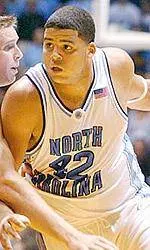
TBD: Sean May, foot, 2002-03 season.
After Sean May notched double-doubles in his first two collegiate games, it looked like North Carolina had found the latest in a long line of talented big men. He perplexingly was ineffective in wins over Vermont and Florida State, but the reason for his problems became clear after the Heels traveled to New York for the ECAC Holiday Classic. After examining his sore left foot, team doctors determined that he was probably playing with a stress fracture. That left him with three options -- have surgery immediately, put the foot in a protective boot and hope it healed but still running the risk of a break, or continuing to play and tempting fate. May chose the latter, and one night later fate stepped in against Iona when he landed awkwardly and broke his fifth metatarsal. Exactly where on this list the injury belongs won't be clear until the season progresses and the Heels show how they will handle the loss of their big man, but it's a good bet to wind up somewhere in the top ten.