University of North Carolina Athletics
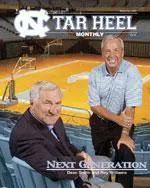
THM: Familiar Coach Returns Home
November 13, 2003 | Men's Basketball
Nov. 13, 2003
Tar Heel Monthly is the premier magazine devoted to the stories and personalities behind UNC athletics. Click here for subscription information.
The following is the cover story from the most recent issue of the magazine.
By Adam Lucas
The first thing you need to know about Roy Williams is this: he's not kidding about the putter.
When the North Carolina head basketball coach speaks in public, he's fond of noting that one of the only things that's been with him longer than his wife, Wanda, is his golf putter.
It sounds like a neat throwaway line, the kind a coach comes up with over dinner and then uses at booster club meetings for the rest of his career. It is not expected to be true, not in the year 2003, when any number of companies would love to fill Williams's golf bag with the newest, shiniest, most technologically advanced equipment. All on a complimentary basis, of course.
So while the sentiment about his putter is appreciated, no one really expects it to be true.
But it is. Williams, who is an obscenely good putter, especially for someone who doesn't get to play golf during the basketball season, uses a putter that he estimates is 50 years old. A heavy, offset-blade model made by a company that doesn't exist anymore, Kroydon, he's been using it for 34 years. The average golfer misses one putt and starts shopping for new equipment. Roy Williams misses a putt and puts his putter back in his bag, confident that it will come through the next time.
"That putter is ugly as homemade sin," says one of his close friends and frequent golfing companions, Cody Plott. "It's not just old. It's rusty, it's got that old blade. But he can flat putt the ball."
It's an exaggeration to say that you can learn everything you need to know about Roy Williams by looking in his golf bag. But if you don't learn something from looking at that putter, imagining all the newer, gleaming versions he's turned down, then you're missing an important part of Williams's character.
You can't talk about Roy Williams without mentioning the Coca-Cola story. Other people--well-meaning people, but people who don't always know the whole story--have told it so many times by now that it has reached required status. You know the type. It belongs right up there with Michael Jordan being cut from his high school basketball team, with Dean Smith being hung in effigy, and with the Roy Williams calendar story, which we'll get to later.
So as not to waste time, because we've got a lot to cover before we come back around to that old putter, here's the short version: Roy Williams's family didn't have a lot of money when he was born in Marion, NC. Sometimes when the neighborhood kids were finished playing basketball, they'd stop at a local service station and get a Coca-Cola. Roy couldn't always afford to buy one, and years later, after he had become the head basketball coach at the University of Kansas, he stocked his refrigerator with the beverage as a reminder of where he came from.
Great story. Classic story. But because of the way it's told by some folks, slightly deceiving. Some versions makes it sound like Roy Williams grew up wearing shoes made out of cardboard, that he sat on his front porch and stared wistfully into the North Carolina mountains, thinking that if only he could drink a Coca-Cola, he might be a happy boy.
It didn't happen that way. In his circle of friends in Asheville, where his family moved when he was eight, no one exactly had Coca-Cola on tap.
"There were times that all of us went over to that service station and drank water," says one of Williams's best friends from high school, Walt Stroup. "The first time I read that Coca-Cola story in an article and the writer made it sound so bad, I thought, 'What the hell are they talking about?'"
"After paying the electricity bill and rent and water and food, there was not a lot left over," Williams said. "But as far as I was concerned it was a great place to live, and I appreciated what we did have."
What he did have was a home that was less than a mile from Biltmore Elementary School. It wasn't always a happy home, and if you ask him about his family he'll tell you first about his mother, Lallage Williams, who quit school after 10th grade to work in a cotton mill and then spent over 20 years working in the Vanderbilt Shirt Factory.
If you prod him, he'll talk about his father, Mack Williams, known to most everyone in Asheville as Babe. Babe battled alcohol and lost: lost his family, lost his wife, and for a time, lost his son.
Friends tell you that Roy Williams gets his overwhelming sense of loyalty from Dean Smith. But it's hard to believe it didn't first start forming as he watched his mother work during the day and then come home at night and iron clothes for ten cents an item, earning money that would occasionally be thrown away by his father on alcohol rather than Coca-Colas. Can you forget that? Do you want to forget that?
Today, Roy and Babe Williams do talk. Despite his son's efforts, Babe never saw his son coach a game at Kansas. Not because he didn't want to, but because after flying through a storm from New York City to Asheville on an especially bumpy flight, Babe Williams swore that if he ever made it to the ground, he'd never get on an airplane again.
So he didn't. But don't think he's not proud of his son. Of all the pickup trucks in Asheville, North Carolina, there's only one that sported a Kansas Jayhawks license tag. And this summer, when his son came back home to Chapel Hill, Babe Williams went out to his truck--it's not so easy to walk now, what with his back problems--and changed the Jayhawk tag to a Tar Heel one.
"I could've helped Roy more than what I did," is what Babe Williams says is his regret about his son's childhood.
But a funny thing happened. Roy turned out to be pretty good at helping himself. He and his buddies had a sport for every season, and when the weather turned cold, he and Walt would walk over to Biltmore Elementary and shovel snow off the asphalt court. They'd start out wearing jackets, sweaters, and long-sleeve shirts, and slowly shed a layer of clothes with each game as the competition grew more heated.
You ask Walt for the scouting report on Roy as a basketball player, and he just laughs.

 |
|
"Roy was a good player, very tenacious," he says. "Whatever it took to win, within the rules, was what he tried to do. I'm about four inches taller than he is, and he'd do anything and everything to try and stop me. I'd come away with my arms just as red as could be."
Most everyone who knows Roy Williams well has a story just like that. When they tell you about him, they'll mention loyalty first, and then, right after that, they'll talk about his competitiveness.
Here is what they don't talk about: they don't talk about his competitiveness ever causing a problem. Someone like Roy Williams, someone who will defend you so hard your arms turn red, you expect to find someone he has wronged, someone he has stretched the rules with, someone with whom his competitiveness became a problem.
Walt Stroup isn't that person, and he doesn't know of anyone who is. He thinks it might be because of Williams's self-deprecating sense of humor, the one that never seems to let Roy Williams get too impressed with the magnitude of being The Roy Williams.
During one T.C. Roberson High School game against a crosstown rival, Williams took a handful of shots in the first half and left them all short. While warming up for the second half, his first couple of shots also hit the front of the rim.
Seeing an opportunity to needle Williams as only close friends can do, Stroup sidled up next to his buddy.
"You're a little short tonight, aren't you?" Stroup asked.
And this is what Roy Williams, the ultimate competitor, the person to whom it is such an abomination to lose that he chastised Carolina players for losing a pickup game this summer, said:
"Yep. About 5-foot-8."
Hearing him tell it now, Roy Williams can almost convince you that he wasn't a very talented basketball player. He'll tell you he was short, tell you he was slow, tell you that the only dunking he did was a dirty uniform into a laundry basket.
He'll probably leave out the part about how he held the Roberson High School single-game scoring record for 17 years. One night in 1968, he scored 35 points against Owen High, his future employer, a record that would stand until 1985.
"He was very smart, very intelligent on the floor," says his high school coach and close friend, Buddy Baldwin. "I respected him so much because of how hard he played. He knew a lot about the game even then."
Matter of fact, Roy Williams knew a lot about most everything. The country-boy act plays big to the national media, but it sometimes disguises the fact that Williams is exceptionally intelligent. A Morehead Scholarship nominee as a high schooler, he planned to be an engineer before falling in love with coaching.
If the love affair began at Roberson, it bloomed in Chapel Hill. Williams played on Bill Guthridge's freshman team during the 1968-69 season, hitchhiking back and forth between Asheville and Chapel Hill when he had time to go home. His playing career ended after that season, but his coaching career was just beginning. When friends came to visit--at the time, Williams was living in the basement of a church and cleaning the church as part of his rent--he'd take them to Carmichael Auditorium, where he spent most of his afternoons watching the Tar Heels practice and keeping statistics.
After finishing his master's degree at Carolina, he spent five seasons as the head coach at Owen High School. During the summer, he worked Carolina's summer basketball camp, an annual event that is as important for networking as it is for skill development.
Usually, the more senior members of the camp staff were assigned the head position in a gym, a responsibility that requires significant organizational skills in addition to highly developed coaching abilities.
After one year, Roy Williams was the head of a gym.
"It only took us one year," Dean Smith says. "After that we moved him right up to the choice position of having his own gym."
Williams joined Smith's staff in 1978 as the third assistant, a position approximately as glamorous as Madonna's secretary's maid. But it was coaching, and not just any kind of coaching, but coaching at the University of North Carolina. So he uprooted his wife, Wanda, from her respectable teaching job and took the $3,000 per year position.
During one of Williams's first months on the job, Smith returned from a trip to Grandfather Mountain Country Club, where he had played the country club's golf course.
"What a great course," he told his new assistant. "I don't think you could break 80 there."
A few weeks later, Smith was in the office when he got a call from Roy Williams, who had just finished playing a round of golf at Grandfather Mountain Country Club.
"I shot a 79 from the back tees," he told Smith. "I needed a par on that last hole and I think I was more nervous than I've been in some games."
You can't tell the story of Williams's early years in Chapel Hill without telling the calendar story. It seems quaint now that a member of a high-powered coaching staff at North Carolina would supplement his income selling team calendars, but in the late 1970s, ESPN wasn't invented yet and Nike was just some struggling shoe company that was sucking Converse's dust.
Williams did sell a lot of calendars, but the way it's told sometimes, it makes it sound like he abandoned his wife, Wanda, and their family, stuck a few calendars in his trunk, and drove like a madman all over the state to make a dollar. His extensive people skills enabled him to make more than a dollar, especially by the mid-1980s, but he also made time for his family. Maybe it was the memory of that dark-haired woman ironing shirts in the evenings, or maybe Roy Williams just genuinely likes his family.
"A lot of people ask me, 'What was it like never getting to see your dad?'" says his son, Scott, a Carolina basketball letterman. "But he went out of his way to see us. He was actually a bigger pain in the tail than a normal dad, because whenever he was in town we had to have dinner together at a specific time. My mom fixed dinner, and we sat down at the table. That was our family time. And every summer we'd take off to the beach. The quantity may not have been there but he really stressed the quality of our time."
After ten years, after selling thousands of calendars and coaching numerous junior varsity games for the Tar Heels, Kansas athletic director Bob Frederick hired Roy Williams to replace Larry Brown. Jayhawk fans were so overjoyed with the decision that they...scoffed.
"We'd just won a national championship and now we've got this southern boy from the mountains of North Carolina who nobody had ever heard of to be our coach," says Scot Buxton, Williams's former neighbor in Lawrence and close friend. "There was a lot of concern about him."
The concern made its way to the newspapers, where a couple of KU boosters made disparaging comments about Williams that he believed might have cost him the services of at least one highly-touted recruit. His team went 19-12 in his first season, a respectable record for a team saddled with probation, but nothing to make anyone start building a statue.

|
|
He had been a head coach before, had been fairly successful at Owen and had turned the Carolina junior varsity into a team that gave more talented squads fits. But he had never been the head coach at Kansas before, and while he was prepared for strategic decisions like when to press and how to run a practice, the level of interest in his program took him by surprise.
"When I was coaching the JV team, there was nobody in the stands except a few girlfriends of the players," he says. "I could make any dumb move and not read about it in the paper because nobody cared. At Kansas, they cared about how I walked out on the floor before the game started. They cared about the length of the shorts, the color of the shoes, they cared about everything. It was night and day."
Eventually, they started caring about Roy Williams. It didn't totally happen that first year, although he scored big points by bringing students who were waiting for tickets pizza or doughnuts. It wasn't the kind of publicity stunt some coaches pull, the kind where they know there is a television camera around and just happen to stop by with a slice of pizza. It was just a friend bringing friends something to eat.
His second year in Lawrence, Jayhawk fans began to notice something about their new coach: he won. A lot. In November of his second season, KU stunned an LSU team that featured Shaquille O'Neal and followed that up with wins over UNLV and St. John's. The Jayhawks won their first 19 games and finished 30-5, and all of a sudden everyone in Lawrence loved the no-name guy from the North Carolina mountains.
How popular was he in the state of Kansas? It wasn't unusual for fans to ask him for an autograph following a round of golf--while he was getting out of the shower. Seriously, it happened.
It's hard to know what's more surprising: that someone would want an autograph from a sopping-wet Roy Williams, or that he graciously signed it. It didn't surprise Buxton, who has never seen Williams decline an autograph request. To his neighbor, it didn't come as any great surprise that Roy Williams would unfailingly do the right thing, almost to the point of being a little unbelievable.
One day during the late summer of 1998, Williams and Buxton were preparing to go for a jog, a standing appointment they kept during most of his KU tenure. The Mark McGwire-Sammy Sosa home run battle was raging, and much of America had become fascinated with the financial value of the eventual record-breaking baseball. Some memorabilia experts thought the ball that broke Roger Maris's single-season homer record could be worth more than a million dollars.
Around the country, the debate about the baseball raged. Should the lucky fan who caught it return it to the player, or should they sell it? That was the question Buxton posed to Williams as they began their workout.
"That would be a tough decision," Buxton said. "What would you do if you caught it?"
The Kansas coach gave him a funny glance.
"Well, that wouldn't be a hard decision," Williams said. "I'd give it back."
Give back a million-dollar baseball? Hand it over with no financial gain?
"I just looked at him like, 'Wait a minute,'" Buxton says. "But that's the kind of guy he is. That's exactly what he would do, he would give it back."
Doing the right thing forms the core of what Williams is about. So it seemed obvious that when Bill Guthridge retired in July of 2000 that Roy Williams would be the next North Carolina basketball coach.
At least, it seemed obvious in Chapel Hill. It had long been assumed that Williams was the heir apparent, and now the Tar Heels were calling him home. Pack the suitcases, sell the house, because Chapel Hill is the greatest place on earth and the University of North Carolina is the greatest basketball program in the world.
Isn't it? Hey Roy, isn't it?
What no one at Carolina understood was that there were at least as many people who felt the exact same way about Kansas. Jayhawk fans had been steeling themselves for this moment for several years, sure Carolina would eventually come calling, but in Chapel Hill it was considered a fait accompli that Williams would return.
His close friends knew better. He spent the Fourth of July holiday with Lee King, a close friend and business associate, and the duo played several rounds of golf near Williams's vacation home in Isle of Palms, SC.
"Our conversation was about Carolina and Kansas all the way around the golf course," King says. "He was very torn about the right decision to make. But the timing wasn't right. When he flew back when he still wasn't decided, we shook hands and I told him that whatever decision he made, it was fine with me. And then I went back and told my wife, Sarah, that he wasn't going to take the Carolina job."
King, a longtime Carolina fan, was right. But not everyone took the decision as well as he did. Even some members of the Tar Heel basketball family were miffed that Williams had turned down what was assumed to be his dream job.
What they didn't realize, what they may still not realize, is that Williams had two dream jobs--the University of North Carolina and the University of Kansas.
Three years later, everything has changed. Williams comes to work in a light blue golf shirt instead of a royal blue one. Some of the relationships with those he angered three years ago have been mended, while some of the relationships he had with people in Kansas--but none of his good friends, like golf buddies Buxton and Randy Towner--have been fractured.
You can look forward to the Roy Williams era, can rejoice at the sight of him on the sidelines on Nov. 22 in the season opener against Old Dominion. But what you need to understand, at least for a second, is that you are watching a man who had to make the hardest decision of his life on two different occasions--and made the tougher choice both times.
In 2000, Kansas fans were somewhat resigned to the fact that he might leave, while Carolina fans fully expected him to return. He chose the hard way.
In 2003, Kansas fans fully expected him to stay, having convinced themselves that he was head Jayhawk for life. Carolina fans, meanwhile, never seemed to consider Williams a real possibility until very late in the process. Even Tar Heel athletic director Dick Baddour recognized the perils of pursuing the prodigal coach.
"I knew what the home run would be," Baddour says. "I knew that Roy was the best. But I didn't know what the answer would be. I felt that although there could be a personal down side for me if we went after him and he didn't come, the University could only gain by us going after Roy."
The University has Roy now, a fact made clear by the popular t-shirts circulating around Chapel Hill that read "Got Roy?" on the front and "We do" on the back. Circumstances had changed in Lawrence, and the Kansas that he couldn't leave in 2000 wasn't the same place in 2003. The same friends who suspected he might stay in 2000--although they are quick to point out that they were never sure until he said it himself--wondered if the timing might be right on this occasion.
"I was with him when he found out Matt [Doherty] was leaving," says Alvamar Country Club golf pro Randy Towner, another close Williams friend who lives in Lawrence. "We were in the coaches' locker room and had just finished working out at lunch. Someone called to tell us, and the look on his face was like, 'I've kind of got to go.'"
And now he's back, and will never have to make such a gut-wrenching decision again. He's made his last move, unless he retires to the beach, and the only item on his agenda is coaching the University of North Carolina basketball team. There's not much suspense about what will happen. He is quick to point out that the Tar Heels lost 36 games over the past two years and is fond of saying, "Ol' Roy's not that good."
ut ol' Roy is that good. He will have Carolina winning a lot of games very soon. The program may not win the way he's used to winning this season, but it will win. And at some point during his career in Chapel Hill, they may win the one thing that has eluded him so far: a national championship.
There are those who think that Roy Williams will never win a title. Just this summer, a columnist wrote that he would never win the NCAA Tournament, that he was too emotional, that his teams could sense that he wanted to win too much.

|
|
Truth is, that might have been accurate six or seven years ago. Williams admits that he was obsessed with the idea of a national championship during most of the 1990s. But a loss to Arizona in the 1997 NCAA Tournament had a profound effect on him. The Jayhawks spent most of the season ranked number one in the country, racing out to a 22-0 record and entering the NCAA Tournament at 32-1.
Kansas had the best team in the country that year.
And lost.
And maybe Roy Williams learned something from that year.
"After that season, I talked to a lot of coaches and asked them what I was doing wrong," Williams says. "To a man, they all laughed and said, 'Roy, you're 34-2. You're not doing anything wrong.' But in college basketball, you lose one time and you go home. That year was the biggest study of myself and my philosophy that I've ever done."
He still wants to win a national championship in the worst kind of way, still lets losses eat at him. But he's gained some perspective, gained the same kind of perspective Dean Smith had to learn during the 1970s. In college basketball, it helps to have good players. But it also helps to have a little bit of luck, and without both, you can't win a single elimination tournament.
For those who don't think he'll win one, let's go back to the golf course.
Picture this: 12 guys sitting around a dinner table in the late 1990s. They are gathered for what was known informally as the Tar Hawk Open, a gathering of some of Dean Smith's closest golfing buddies and Roy Williams's closest golfing buddies. It is a mixture of Tar Heels and Jayhawks, held in May usually somewhere in the mountains of North Carolina.
As it usually does with golfers and fishermen, talk turns to individual exploits. More specifically, it turns to hole-in-ones. Of the dozen men, over half have hole-in-ones. Towner has so many he has lost count, but he thinks it is eight or nine. Heck, even Lee King's wife, Sarah, has one.
Roy? He's got the big goose egg. The majority of the people in his circle have accomplished the feat, which requires a significant amount of skill paired with an equally significant helping of pure luck. For Williams, though, the two have never converged.
Until August 22, 2001.
"He hit a beautiful shot on the 2nd hole at Alvamar," says Towner, who was playing with Williams that day. "It went about ten feet beyond the hole and backed up and went right in the hole."
So what did Williams do after reaching, for just a moment, the peak of the golfing world? Did he throw his club in the air and race around the fairway? Did he shout, "I'm the man!"
"No, he didn't do any of that," Towner says. "I think when we got around to the sixth green, where he lived, he might have told Wanda."
And the next year, when his friends assembled for the Tar Hawk Open, and the 12 men gathered around the dinner table to talk about their golf exploits, and the talk turned to hole-in-ones again, he had only a simple declaration to make:
"I'm off the list."
He was the 11th out of 12 friends to pull off the feat.
ut he did it.
And maybe the worst thing about that hole-in-one?
For one of the first times in his life, he didn't get to use his putter.
Adam Lucas is the publisher of Tar Heel Monthly and can be reached at alucas@tarheelmonthly.com. To subscribe to Tar Heel Monthly, click here.