University of North Carolina Athletics
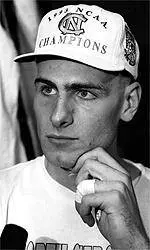
THM: Looking Back At 1993
March 30, 2003 | Men's Basketball
March 30, 2003
As the college basketball world gathers in New Orleans this week for the Final Four, Tar Heel Monthly--the premier magazine devoted to the stories and personalities behind UNC athletics--takes a look back at the ten-year anniversary of the 1993 national champion Tar Heels, who also won their title in the Crescent City. The story contains exclusive recent interviews with Dean Smith, Bill Guthridge, Eric Montross, and several other key participants in the championship.
The following story appeared in the April edition of the publication. Click here for subscription information.
By Adam Lucas
North Carolina's quest for the 1993 national championship almost derailed in Hawaii.
Not when the Tar Heels lost to Michigan in the semifinals of the Rainbow Classic in Honolulu. That was just a minor detail. The near catastrophe happened a few days earlier when UNC senior leader George Lynch went parasailing, an activity that involves being tied to a parachute and then being tethered behind a motorboat in the ocean. The theory is that when the boat takes off, the parachute causes the person to take flight, soaring behind the boat. That was the theory. What actually happened was that Lynch got a mouth full of the salty Pacific Ocean.
"George almost drowned on that trip to Hawaii," Bill Guthridge, who was an assistant on that 1993 team, says with a wry smile. "He was in the water trying to do one of those parasailing things and they kept pulling him behind the boat, but he couldn't come up. He drank a lot of water."
So after surviving a close encounter with the ocean, was it really such a chore to navigate through the choppy waters of the ACC and then through East Carolina, Rhode Island, Arkansas, Cincinnati, Kansas, and Michigan on the way to a national title?
The seeds for Dean Smith's second national championship were planted in St. Moritz, Switzerland. That's where Smith had been invited by a business school professor named Jerry Bell to give a lecture at a management seminar during the 1992 offseason. While there, Bell gave the legendary coach a tape of a previous speaker, who told his audience that he had lost weight by looking at a doctored photograph. The picture showed the speaker's head with an in-shape body superimposed over his current, out-of-shape body.
It didn't take long for Smith to realize how that strategy could be applied to coaching. The 1993 Final Four was to be held at the Superdome in New Orleans, the same site that hosted Carolina's 1982 championship victory.
"I noticed that someone in our office had a photo of the scoreboard after the 1982 championship win with, 'Congratulations North Carolina, 1982 national champions' showing on the scoreboard," Smith says. "It dawned on me, let's put that in everybody's locker. We won't tell anybody, just our team. We changed the 1982 to 1993 and marked out Georgetown's name so the opponent wasn't visible and the players had that waiting for them when practice started."
Even without photographic trickery, it was clear that the Tar Heels were going to field a stellar team for the 1992-93 season. High-scoring Hubert Davis was the only senior lost from the previous year's team, and a highly-touted recruiting class that included Eric Montross, Brian Reese, Pat Sullivan, and Derrick Phelps would be juniors. That group had already been to one Final Four as freshmen on the 1991 team that was carried by seniors Rick Fox, Pete Chilcutt, and King Rice.
This team, too, had strong senior leadership. George Lynch had nearly averaged a double-double (13.9 points per game, 8.8 rebounds per game) as a junior, and steady point guard Henrik Rödl provided height and versatility in the backcourt. Seven-footer Matt Wenstrom had started one game the previous season and also provided invaluable practice work for Montross. Point guard Scott Cherry would later play a key role in the national title game.
Mix in a streaky sophomore shooting guard named Donald Williams, perpetually underappreciated seven-footer Kevin Salvadori and a little-known floppy-haired freshman named Dante Calabria, and it was clear that the Tar Heels had plenty of firepower. But what excited the coaching staff was the squad's defensive potential.
"Usually, your better defensive teams have juniors or seniors," Smith says. "There was a strong junior class that year, and Phelps was great defensively, and George has made a living in the pros by playing defense and rebounding."
For one of the very few times, Smith unveiled his team to the Tar Heel fan base at one of the Midnight Madness events that were growing in popularity across the country. The NCAA set October 31 as the first official day of practice, which meant that teams could technically begin practice at midnight on that day. In 1992, that fell on a Friday night, which meant fans and players could enjoy Midnight Madness without fear of having to awaken early the next day for class. With that prerequisite filled, Smith allowed the event to be held in the Smith Center.

 |
|
It began ordinarily enough, with the seniors grabbing the microphone to say a few words. Until, that is, Rödl stepped to the front. Playing off the Halloween theme and with his slight German accent, the senior guard proclaimed, "This team is going to be scaaarryyy."
Everyone in attendance broke up laughing. Even now, ten years later, it still makes Rodl's teammates laugh.
"That was all Henrik and his corny German humor," says Travis Stephenson, who played two seasons for the Heels as a walk-on. "The way he said it was what made it so funny. You just had to hear him say it."
There wasn't much time for humor once the team finished Midnight Madness. The season opener, December 1 against Old Dominion, was just 30 days away, and the month of December also included the Tournament of Champions in Charlotte, road trips to Butler and Ohio State, and the post-Christmas trip to Hawaii.
The Tar Heels cruised through the early part of their schedule at 8-0 going into the game with the talented Wolverines, who returned all five of their "Fab Five" freshman class that had advanced to the national championship game against Duke the year before. It was a clash of styles just as much as a clash of teams--Michigan under Steve Fisher was much more star-oriented, while Carolina relied on more of a team concept. "Anybody that knows basketball will admit how much more talent Michigan had than we did that year," Stephenson says. "Look at how many NBA stars came off their team versus the one or two from our team still in the league. But we didn't have stars. We had a team."
It showed in the final boxscore, as just two Wolverines scored in double figures (Chris Webber with 27 and Jalen Rose with 22) while five Tar Heels (Phelps with 15, Montross with 14, Williams with 13, Lynch with 12, and Reese with 10) reached that mark. The balanced scoring didn't help earn a win, however, as Rose scored on a last-second basket to provide a 79-78 victory.
The Tar Heels began their ACC campaign with five straight double-digit victories, including a 33-point thrashing at NC State and a 28-point dismantling of Maryland. After a close four-point win at Seton Hall, Carolina was set to host Florida State on Jan. 27. The Seminoles' most loquacious player was a point guard named Sam Cassell, who had memorably deemed the Smith Center fans a "wine-and-cheese crowd" following FSU's win in Chapel Hill the year before. The 1993 squad may have been one of Pat Kennedy's best in Tallahassee, as it featured Cassell, Charlie Ward, Doug Edwards, Rodney Dobard, and Bob Sura. The 'Noles would finish second in the ACC regular-season race that year, a full two games ahead of third-place Duke, and advance to the final eight in the NCAA Tournament.
They backed up that talent with plenty of talking, and when they took a 45-28 lead into halftime against the Tar Heels, Cassell could be heard boasting that he was insulted that Carolina would try to assign Rödl to guard him.
"One of the things Coach Smith instilled in the team and all of us was that the game is never over," Guthridge says. "Former players have mentioned that the confidence that Coach Smith had carried over to the players. We knew that we were never out of it and had the ability to come back."
Even though Pat Kennedy had killed some pregame time thumbing through the section of the Tar Heel basketball media guide devoted to comebacks, it didn't look like he would have the chance to witness one first-hand. The Seminoles built their lead to 21 points with 11:33 left, and even after Rödl--who had moved into the starting lineup and would stay there for almost a month--hit a three-pointer with 9:21 remaining, it only trimmed the deficit to 17 points.
What happened next vaulted the game from normal regular-season ACC contest to legendary Tar Heel lore right next to the classic 1974 "8 points in 17 seconds" comeback against Duke.
First, Smith called a timeout to suggest the possibility to FSU that a comeback was imminent. They didn't seem to care, as Edwards scored on a follow shot to bump the lead back to 19.
But fifteen straight Carolina points would follow, beginning with back-to-back three-pointers from George Lynch and Donald Williams that cut the Seminole lead to 73-60 with about 8:30 remaining, prompting Kennedy to call a timeout of his own. Rödl subsequently sank another trifecta to narrow the gap to ten points and then made a steal and hit Phelps for a basket to bring the deficit under ten for the first time in the half.
Timeout, FSU.
By that point the momentum was so strong that it was cascading out of the Smith Center stands onto the court. Hearing Smith in the huddle was a challenge.
Montross drew a foul from Doug Edwards and Kennedy picked up a technical foul. After the free throws, Williams sank a basket to pull the Heels within 73-69 with 6:52 left, having knocked 17 points off the deficit in less than 150 seconds.
FSU drew a breath when Carolina missed three easy layups and Cassell followed with two free throws to push the lead back to six points at 75-69 with 5:21 remaining. With the lead at 75-74, a Tar Heel trap forced Edwards to call his team's final timeout.
It paid off, as he scored on another follow shot to make the FSU lead 77-74. It would be the last points that they would score.
Montross scored in the paint, and with just under two minutes remaining the Seminoles nursed a one-point advantage. Charlie Ward ran into a trap from Phelps and Rödl at midcourt and tried to desperately fling the ball across the court to Bob Sura. Only one problem: George Lynch was already there. Lynch stepped in the passing lane, picked off the pass, and dribbled in for a thunderous two-handed dunk that gave Carolina their first lead of the half.
Williams made four free throws down the stretch to seal the victory. A mammoth photograph of Lynch's dunk, with the crowd and Carolina bench behind him in wide-eyed, arms-raised awe, still hangs at one entrance to the Smith Center.
"Making that comeback took a lot of practice time," Lynch says. "We'd have practiced for two and a half hours, and Coach Smith would give the blue team a 20-point lead up on the scoreboard and let us play the game. If the starters came within six points within a certain amount of time, the blue team had to run. If they made it a 30-point lead, then we had to run. It was always fun and games during practice, but he was preparing us for games like that."
Just how much momentum did that history-making comeback earn the Heels?
None. They proceeded to lose their next two games, falling 88-62 at Wake Forest and 81-67 at Duke.
"We were flat as pancakes in Winston-Salem," Smith says. "That had to be our worst game."
The Tar Heels snapped out of the funk with a 104-58 victory over NC State, a team that in those days was an even better cure for a losing streak than the Washington Generals. That win set them up to cruise through the rest of the regular season, with all seven ACC wins coming by double figures. More noteworthy than the scores was a subtle lineup change made on Feb. 21 in Charlottesville, as Donald Williams replaced Rödl in the starting lineup and had an unspectacular two-point performance.
The sophomore from Garner slowly heated up, contributing 13 points in a 10-point win in Tallahassee and 27 in the final game of the regular season, an 83-69 win over Duke.
Those two wins sent the Heels into the ACC Tournament as the top seed, where they dispatched Maryland in the first round and Virginia in the semifinals. But the win over the Wahoos wasn't without a price: a hard foul by Jason Williford knocked Derrick Phelps out of the game and the next day's championship game, which was won by Georgia Tech.
Williams shot 4-of-18 in the championship game and 3-of-12 from beyond the three-point line, and the general feeling in Chapel Hill was that if this team was going to live up to their billing in the NCAA Tournament as the top seed in the East, Williams would have to catch fire.
The players, of course, had no problem visualizing themselves as the national champions. All they had to do was look in their lockers, where the doctored scoreboard photo still remained.
"It was something that motivated you," Lynch says. "On Christmas break when we were in Chapel Hill and everybody else was gone, it reminded you why you were here."
Carolina opened with a pair of easy wins in the opening rounds over East Carolina and Rhode Island in a friendly environment at Winston-Salem's Lawrence Joel Coliseum. Arkansas put up a typically tough fight in the round of 16, as the game was tied at halftime and never decided for good until Lynch took advantage of the overplaying Razorback defense to fire a pass to Donald Williams for a backdoor layup late in the game.
Cincinnati was to be the opponent in the regional final, and brash point guard Nick van Exel proclaimed before the game that he didn't find the Tar Heel tradition to be anything special. He then proceeded to back up the talk, hitting 6-of-13 three-point attempts and tallying 23 points.
"Early on, Van Exel was hot out of his mind," Guthridge says. "But when they're making three's like that early, you know they're not going to keep making them."
Especially if defensive wizard Derrick Phelps is assigned to guard them. Phelps harassed Van Exel into an average second half, and the Heels eventually closed the gap and made it a tie game with 0.8 seconds left. No problem, right? Just diagram a quick play, toss the ball in bounds, drop it in the hoop, and head home with the win. All in the amount of time that it takes to blink.
And all of that almost happened. Except that instead of dropping the ball in, Reese tried to dunk it, and the ball clanged off the back of the rim. No matter-Carolina won the game in overtime. As Smith would later point out, it appeared as though Reese's shot came after the buzzer and should not have counted. Officials probably made an error by signaling that it would have counted, so it's better that he missed it. Otherwise, Carolina fans would have been subjected to taunts of, "Yeah, but Reese's shot shouldn't have counted" for the past decade.
After declining to cut down the nets at the Meadowlands in New Jersey, the Heels advanced to New Orleans for the Final Four. The Crescent City is normally an area where almost anything goes, but the amount of spitting going on with Carolina and Kansas in town was above normal even by New Orleans standards. The expectorating stemmed from a 1982 tradition that for good luck, team members should spit in the Mississippi River. Roy Williams had imported the ritual to Kansas, so both teams were spitting as much as they could.
"Pat [Sullivan], Scott [Cherry], and I did some serious expectorating at that river," Stephenson says.
The more seasoned Guthridge knew that the spitting could be overdone.
"Spitting is a one-time thing," he says. "You do it only for the championship game."
After the Tar Heels had dispatched Kansas in the national semifinal to set up a meeting with Michigan, the river would prove to have even greater significance. Montross's father, Scott, was a Michigan graduate. This disturbed Guthridge, who decided that something must be done to cleanse the elder Montross of his maize-and-blue leanings. Although Scott Montross could frequently be seen in the stands during Carolina games wearing a light blue sportcoat, it was determined that he needed to be baptized a Tar Heel.
On short notice, however, there wasn't time to line up a baptismal pool. Which is how it came to pass that on Monday morning, Scott Montross and Guthridge were out on a morning jog, which had become a ritual for them on the mornings of road games. Longtime friend of the program Bill Miller accompanied them, and Guthridge suggested that the trio take a path that would lead them by the river.
"We're running and Coach Guthridge says, 'We're pulling out all the stops for this game,'" Scott Montross says. "We have to baptize you as a Tar Heel. But to get to the river, you had to go through all these Coast Guard barricades, and of course we were unauthorized. I climbed down the ladder into the river, and Miller and Guthridge baptized me as a Tar Heel. Sirens were blaring, horns were blowing, and people were yelling. I jumped out of there and we ran like scared rabbits. But Bill Guthridge was always prepared. He knew exactly how far away the authorities were and how much time we could take for the benediction before they would be on to us."
At least, that's what Montross thought. A decade later, Guthridge can finally tell the truth.
"We hadn't done any planning at all," he says. "We were lucky Scott didn't get arrested. He was the one in the water."
No baptism was necessary for Kansas head coach Roy Williams and his youthful assistant coach, Matt Doherty. When Stephenson was on a quick trip to the aquarium on Sunday, he ran into Doherty and Williams, who had been defeated by the Heels the night before. Stephenson could have been excused if he had missed them--with their Carolina shirts and Carolina buttons, they blended into the sea of regular Tar Heel fans, which was exactly what they were on that day.
oth men rooted hard for the Tar Heels on Monday night against Michigan. It's difficult to imagine in this era when freshmen and sophomores are counted on to contribute immediately, but ten years ago it was still somewhat of a novelty for young players to have a sizable impact on a major Division I team. That's what made Michigan such a glitzy topic for the media. Their baggy shorts, bald heads, and black socks endeared them to a nation of unaffiliated basketball-watching kids.
Even some future Tar Heels were captured by the youthful Wolverines.
"I was a big Fab Five fan," sophomore Jawad Williams says. "They were young. They weren't that much older than me. Nobody expected much of them but they were these young guys doing big things."

|
|
y now, the game has been burned in the memory of all Tar Heel fans. Lynch's alley-oop dunk, his audible punctuation mark captured by the CBS cameras. Montross's battles underneath with Michigan's Juwan Howard. And a certain shooting guard who had struggled earlier in the year catching fire and hitting a combined 10 of 14 three-pointers in two games in the Final Four.
"Donald was so hot," Eric Montross says. "I didn't fully appreciate how hot he was until I watched the film and saw just how clutch those shots were. When you're out there in the heat of the moment you think, 'That's a great shot, thanks for hitting it.' You don't have time to sit there and appreciate it."
Fans of rival schools love to say that Chris Webber handed the championship to the Tar Heels with his ill-fated timeout. The parties involved know better.
"There's never been a worse walk than when Webber got that rebound and traveled," Smith says. "Then they don't call it and we have him in a beautiful double team and there was no place for him to go. We had two fouls to give. Lynch and Phelps could've reached in and fouled him but they knew they had him. He had no one open."
"He traveled first, so that should've given us the game," Lynch says. "Whether he called it or not, we were up with fouls to give. We had a three-point lead and were a well coached team. We weren't going to make a mistake."
And when Lynch says it, you have to believe it. After cutting the nets with scissors that were sent by a fan back at the beginning of practice back in October, the team made their way back to the team hotel, the Inter-Continental. Awaiting them was a sea of Carolina fans the likes of which were probably only rivaled by Franklin Street on that evening. Fans stood and waited in every available corner of the multi-floor lobby, filling staircases with Carolina blue pom-poms and shouting spontaneous cheers.
Then, the team arrived.
"It was massive people all the way up and down the stairs," Stephenson says. "It's almost like a dream. I watch award shows and hear them talk about it being surreal. That's one of the few times in my life where I can use that word and be accurate. When we were cutting down the nets, you float up the ladder and realize you're at the goal. And seeing all those people at the hotel, everybody was yelling and screaming, it was almost blurry."
The players and coaches celebrated their championship in different ways. Many players hit Bourbon Street, where they marveled at a collection of humanity that included Dick Vitale and several of the Michigan players, including Chris Webber. Dean Smith had to tape an interview with ESPN's Roy Firestone and then quietly took a cab back to the hotel, where he was joined by a group of several close friends that included Roy Williams and Christopher Fordham. Bill Guthridge, in his typical low-key fashion, went to Bourbon Street, but instead of joining in the festivities, he stopped at Ben & Jerry's and got a chocolate chip ice cream cone.
"It tasted pretty good," he says, and he could be talking about either the ice cream or the feeling of being on top of the college basketball world.
The Tar Heels returned to a raucous Smith Center welcome the next day, leaving behind several hundred Rams Club members who were stranded overnight in the New Orleans airport after their plane needed mechanical attention. With a cargo of giddy Tar Heel fans, it was perhaps the most congenial overnight delay in aviation history.
Meanwhile, Rödl was repeating his "Scaaaarrrry" prognostication for the celebrating fans at the Smith Center. Ten years and a lengthy NBA career later, Eric Montross still knows what made that 1993 team national champions.
"Person-for-person, we weren't more talented than Michigan," he says. "But our team and our concept of how to play was invincible."
Adam Lucas is the publisher of Tar Heel Monthly and can be reached at alucas@tarheelmonthly.com. To subscribe to Tar Heel Monthly, click here.