University of North Carolina Athletics
COUNTDOWN TO KICKOFF: For Reid, Image Isn't Everything
August 21, 2003 | Football
Aug. 21, 2003
Tar Heel Monthly is the premier magazine devoted to the stories and personalities behind UNC athletics. Click here for subscription information.
The following is the cover story from the most recent issue of the magazine.
By Adam Lucas
It is time to expose Dexter Reid as a fraud.
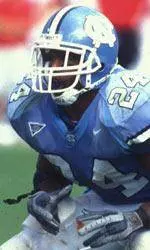
The Norfolk native has spent four years in Chapel Hill cultivating an image. He's got the braids. He's got the tattoos. He's got the arm-waving, full-throttle style on the football field. He is easy to stereotype.
Dexter Reid doesn't mind if you stereotype him. Matter of fact, he'll help you. Standing in the Kenan Football Center one warm summer afternoon, he is posing for photos that will be seen by thousands of people.
"C'mon, Dex, give us a smile," the photographer says.
"Naw, man, come on," Dexter says with an easy smile. As soon as the photographer raises his camera again, Dexter scowls. He is serious. He is intimidating. If you are a quarterback or a wayward wide receiver, he looks like he would enjoy smashing into you at a very high rate of speed. He looks exactly, well, exactly how he wants to look. He looks exactly the way he wants you to perceive him.
Every year, photographers try to snap a photo of Dexter Reid with a smile for his picture in the Carolina football media guide. Every year, they wind up with the same all-business scowl. The braids. The intimidating stare.
Here's the thing, though. You know those braids? The ones that make him look like such a tough guy?
He cried when he got them. Thought he had disappointed his mother.
"He knew I hated braids," says his mother, Kim Reid. "His senior year in high school, he left here one day, took my car, and was gone six hours. When he came back he had braids. He was crying, I was crying. He called his sister and she called here saying, 'Dexter doesn't want you to think he's a hoodlum because of his braids.'"
Truth be told, though? You could have found some people in Chapel Hill who thought Dexter Reid was a hoodlum after his first year in the Carolina football program. Not just because of his hair. Reid entered Carolina at a time when discipline wasn't one of the overriding characteristics of the squad. Of the 24-man recruiting class of which he was a part, nine players left Chapel Hill for one reason or another before exhausting their eligibility. Some left of their own choosing, but more than a few found trouble and then found their position on the team in jeopardy.
Dexter Reid is no better than some of those guys. He'll tell you that. He's no better than some of his friends from that class who never made it to their senior year.
"Those first couple of years of college, my class was off the chain," Reid says. "Some of the guys from '99 who are still here, like Derrick Johnson and Rabbit [Waddell], we joke about it. When another year starts, we say, 'Well, we're still here.' We made it back another year."
Define "off the chain," Reid is asked. He relays the story of how he and some teammates would leave practice on Thursday afternoon, go to a club Thursday evening, leave the club at 3 a.m., go home and watch a DVD, and then arrive at Kenan Stadium for 5 a.m. conditioning drills Friday morning. Sleep? No need, man, not when you're part of the class of '99.
Dexter Reid knows you might call that being a hoodlum. He's the first to admit that he wasn't always the best role model during those first two years. But he never got his name into the police blotter like some of his teammates, never did anything that would embarrass his mother. Still, that perception of Reid as a wild man has been difficult to shake over the rest of his Tar Heel career. Somebody wants to learn about Dexter Reid, they see the brash attitude on the field, the fast-talking safety who sports a new tattoo referencing himself as "Virginia's Finest," they don't need much more information to make a decision on his character.

 |
|
Nothing new, really. When he was in middle school, his rec league football coaches wanted to nominate him for player of the year. Nomination required at least a 2.0 grade point average.
"I got a call from this lady," Kim Reid says. "She said, 'I owe you an apology. Dexter is such a jokester and is never serious, and I didn't think he had a 2.0 grade point average. But I called his school and they told me they couldn't give out his exact GPA, but that it was well over 2.0.'"
When Kim Reid tells this story, she puts the emphasis on the word "well." And then she says, "She said she was shocked that he had it. But that's just Dexter."
Does it shock you that Dexter Reid is an intelligent individual? Would it surprise you to learn that he was a regular member of the honor roll in high school? After all, he's got those braids, those tear-inducing braids. Do smart people wear braids?
"People have different perceptions of me," he says. "Some people like Dexter for the way he carries himself. Some people don't like him for the way he carries himself. But I don't get too far up or down. If I get beat for a touchdown, I'm at the same level. If I'm in some article, I'm at the same level. If I get an award, I'm at the same level. Outside factors don't control who I am. I've seen too many people who had it all have it taken away in the blink of an eye."
Dexter Reid never had it all. Growing up in Norfolk, or as he calls it, "the 757" (for the Norfolk area code), presented obstacles. The Reid family wasn't wealthy, and Kim Reid had to sacrifice certain things in order to be able to buy Dexter the new pair of Air Jordans he always seemed to want. When her son began to show the first flashes of athletic prowess, her first thoughts weren't of NFL riches or a new car, but of the fact that he might be able to earn a scholarship and get a college degree without student loans hanging over him at graduation.

|
|
Norfolk is a Navy town, and while there are some of the scenic settings you'd expect from a town located on the water, there are also some areas where you wouldn't want to be alone after dark.
"That neighborhood is trouble, point blank," Dexter Reid says. "It's not the worst place to grow up, but it's far from being a decent place to grow up. I love it, but I don't even go home that much because it's trouble waiting to happen."
So Reid had more than just football to adjust to upon arriving in Chapel Hill. The idyllic college town is a different world from the occasionally rough-and-tumble Navy town. He ran the streets at night like a Norfolk kid, then got up in the morning and played football like an NFL kid. He played in every game as a freshman, picking up three double-digit tackling games. He earned the starting free safety position as a sophomore and hasn't relinquished it yet, and heading into 2003 the only name that's guaranteed to be on the starting roster for the season opener against Florida State is Dexter Reid.
The recklessness he occasionally showed off the field was what endeared him to coaches on the field. Put Dexter Reid anywhere in the vicinity of a football, and he was going to find it. If someone had the misfortune of carrying that football, he was going to tackle it.
Defensive coordinator Dave Huxtable has several question marks on his defense this year. But when asked about Dexter Reid, his response is immediate.
"If I had 11 Dexter Reids, we'd be the best defense in the country," he says. "I can't say enough good things about him. He is an all-around football player and brings great leadership to our defense."
Sure, he might be able to snow the assistant coach, but not the big man, John Bunting, right? Surely this fiery coach would clash with a player who is known for being on the edge of being out of control.
ut that's just it. Reid is on the edge of out of control-not out of control. And that's the way a certain ex-linebacker named John Bunting played the game.
"Very soon after meeting Dexter Reid it became apparent to me that he had something special to give," Bunting says. "The guy has the heart of a lion."
"I do think we've got a lot in common," Reid says. "That guy is all football. He loves football. He talks about football all the time, and I love that. He's excited every time you see him. He's fired up. I love that."
Dexter Reid is all football now too. The wild man who used to close down Chapel Hill clubs has been retired. The 22-year-old Reid hasn't had a sip of alcohol since the weekend of his birthday, March 18, and says--in a way that makes you believe it--he won't touch the stuff again until the Tar Heels have played their last game.
The player who once considered college life a seven-day weekend has mellowed to the point that some people are starting to consider him a little snobby. Never goes out anymore, they'll say about Dexter. Always sitting at home. Can't even get him to go out during the summer.
"I basically cut off my social life. It's been hard for some people to believe. 'Dex doesn't party anymore?'" he asks rhetorically with a wide-eyed glance. "That's hard for people to believe who knew the other Dex."
The last remnants of the other Dex were laid to rest with last year's 3-9 season. Understand that this is a man who does not like to lose. This is a man who, according to former teammate and fellow Virginian Kevin Knight, was the first person he had ever seen talk trash at a high school track meet--while in the starting blocks immediately before races, Reid would provide a running commentary on the inferiority of the other competitors.
Usually, he won those races. He's been used to winning ever since he first began playing sports, and he was a successful football, track, and basketball athlete at Granby High School. College hasn't been quite so easy, and that's why he doesn't exactly know how many tackles he's had at Carolina, but he is well aware that since he joined the program, the Tar Heels are 20-27.
As soon as the 2002 season was finished, he went into a Kenan Football Center computer lab and printed the numbers "3" and "9" as big as could be accommodated by a sheet of paper. They're taped up in his locker today, a reminder of a season he doesn't plan to repeat.
If it takes working out a little harder to avoid 3-9, Dexter Reid will do it. If it takes being harsh on some teammates earlier this summer who he felt weren't committed to offseason conditioning, Dexter Reid will do it. And if it takes giving up part of his social life, becoming a hermit in his offcampus apartment and redefining "wild night" to include simply watching a couple of DVD's from his extensive collection, Dexter Reid will do it.
"Sometimes people will call me a loner now," Reid says. "But my whole focus is on school, football, and gaining weight. If it doesn't have anything to do with those three things, then Dexter Devon Reid isn't trying to hear about it."
That's the truth at the core of Dexter Reid. He makes friends easily, can meet you at a party one night and quickly have you feeling like you've known him for years. He also loses friends easily. He doesn't suffer fools and has no problem isolating himself if it's in his best interests.
This is, then, the part of the story where Dexter Reid's father enters the picture. He's named for him, that much we know. Dexter Reid is actually Dexter Reid, Jr., named for his father, who was a successful basketball player at Virginia Tech. His father is quoted extensively in newspaper stories during his son's recruitment, usually referred to as "former Hokie star Dexter Reid, Sr."
"He's not pushing Virginia Tech," the younger Reid said in a July 30, 1998 Roanoke Times article. "He's behind me whatever I do."

|
|
Somewhere in those words, there's the wishful thinking of a 17-year-old. Somewhere around that time, his relationship with his father was beginning to crumble. Finding out what caused the fallout isn't easy, and it's open to interpretation.
Reid, Jr., says he hasn't spoken to his father in years. Reid, Sr., who still lives in Norfolk, says he talked to his son this past Christmas.
Reid, Jr., says he doesn't care if his father attends any games this season. Reid, Sr., says he plans to attend several.
"To this day I don't know what happened between them," Kim Reid says. "I don't know if it's because we divorced [the couple divorced during Reid's second year at Carolina]. He was there for Dexter all the way through high school. When Dexter got ready to go to college, something changed. He won't discuss it with me, and my ex-husband won't say what's wrong."
"My brother had this thing about his dad being a great basketball player, and Dexter didn't want to be in his shadow," says Reid's sister, Kelli, who is four years older than Dexter. "He felt like Dad was really pushing Virginia Tech, and that he didn't show any interest in what he did during the recruiting process until it came time to visit Virginia Tech. That hurt him."
Asked about his son's decision to attend Carolina, the elder Reid says, "Going to Carolina was his choice. It's four years he has to live with."
When Reid is asked if his father will attend his Senior Day game against Duke this year, there is a nine-second pause. Count it out. It is a long time.
"Can you ask that question a different way?" he says.
Would you want him to attend that game?
An eight-second pause.
"I have mixed feelings about that," he says. "I wouldn't ask him to come. I wouldn't care if he was there. I don't expect anyone to be at my games other than my mom. There were three different stages in my relationship with my father. I'm not going to sit here and knock him because there was a great stage. Then at one point in time there was a shaky stage. And now there is a stage where I just don't care."
That's what Junior says. Senior's viewpoint is different. Hearing him talk, you get the feeling he hasn't heard the conviction in his son's voice, hasn't seen the way his son fully thinks through his answers on the subject.
"I don't think our relationship got difficult," Reid's father says easily. "It is just a lack of seeing each other. Sometimes a kid just has to grow up."
Whether it's been four years or four months since they've spoken, what his father may not know is that his son has indeed grown up. He gives his mother a card every Father's Day, his way of thanking her for playing both roles over the past three years. Kim Reid was walking through the Kenan Stadium gates minutes before kickoff of a 2001 home game when her cell phone rang. It was Dexter, calling from the locker room to find out where she was. His usual sweep of the family section for that familiar face had come up empty, and he was concerned. Reassured that she was safe and would be in her seat shortly, he went out and played his usual stellar game.
His final season for the Tar Heels will begin on August 30 against Florida State. But he's already made a contribution that will last beyond this season. Last winter, John Bunting and the Carolina coaching staff were in the midst of putting together a recruiting class that will form the backbone of the next five years. They revamped the recruiting process, putting more emphasis on the "Carolina experience." Three years ago, only a coach eager to court trouble would have paired any high school teenager with Dexter Reid. But when players came to Chapel Hill for their official visits last winter, they were frequently entrusted to one Dexter Devon Reid by Bunting, a move that was not without careful consideration.
"Dexter Reid has grown emotionally and mentally the way any mother or father or head coach would marvel at," Bunting says. "He has matured here. His willingness to give of himself on the football field has now transferred over to off the football field. I think he's going to be a great citizen and a great leader both on this football team and when he leaves Carolina."
Dexter Reid, social director extraordinaire and loner. It might be time for a new image.
And Dex, your mom says start with the hair.
Adam Lucas is the publisher of Tar Heel Monthly and can be reached at alucas@tarheelmonthly.com. To subscribe to Tar Heel Monthly, click here.