University of North Carolina Athletics
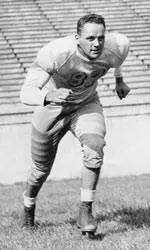
CAR-O-LINES: Severin's Big Play vs. Duke May Have Topped Career
August 29, 2003 | Football
Aug. 29, 2003
By Rick Brewer, Sports Information Director Emeritus
Not often is a football player's entire career made memorable by a single play.
And that's certainly should not the case of an All-America.
Former Carolina end Paul Severin may come as close to that as anyone. That's despite the fact the Associated Press named him a first-team All-America in both 1939 and 1940.
Of course, a player has to be a great all-around performer to gain such national recognition. Severin was just that throughout his Tar Heel career. When his name is mentioned, however, longtime Carolina fans point to one play that may have been the highlight of his career. But, it's for another reason he's in the spotlight this weekend. Severin is one of eight players having their numbers honored by the University.
Four decades ago criteria for actually retiring a number in any sport was set as winning one of the National Player of the Year awards.
Considering all the players who compete in football, that's difficult for anyone to achieve. That led to the decision of finding a way to honor other deserving players.
A plan was implemented to "honor" certain jerseys. A player had to be a consensus All-America or the Atlantic Coast Conference Player of the Year to fall into that category. Defensive end Julius Peppers is being honored today under that set of rules.
Still, some of the greatest performers in school history were left out. Earlier in the year Athletic Department and University officials agreed to expand the "honored" section in two additional ways. Anyone named to the ACC's Silver Anniversary Team last fall would be included. That added tailbacks Amos Lawrence and Kelvin Bryant.
Also to be included was anyone who was chosen as a first-team All-America by the Associated Press. The AP team is the most prestigious of all the post-season squads. That change in the criteria means Severin, center/linebacker Irv Holdash, end Bob Lacey, offensive tackle rian Blados and offensive lineman Harris Barton will join that select group of Tar Heel standouts.
It has been six decades since Severin starred at Carolina. Of the 26 players whose jerseys have now been honored, only George Barclay (1934) and Andy Bershak (1937) played here before Severin.
A 6-0, 185-pound end from Natrona, Pa., Severin was a standout both offensively and defensively. He led the Tar Heels in scoring in 1939 with 40 points and then had 15 receptions for 185 yards as a senior.
ut, it was on defense that he made what is regarded as the biggest play of his career. The fact it came against a heavily favored Duke team probably has a lot to do with that.
The Blue Devils were ranked 12th in the nation when they came to Chapel Hill in 1940. Duke was 5-1 and a 13-point favorite over Carolina. After a promising start, the Tar Heels were 4-4 and had lost their last three games.
Duke had dominated the game, but had only a 3-0 lead in the third quarter. That's when Blue Devil halfback Steve Lach broke through a hole at left tackle at his own 26 and cut back into an open field.
Severin, coming from his end spot on the opposite side of the field, somehow was able to chase down a faster player at the Carolina 17. Lach had ripped off a 56-yard run, but not reached the end zone. The Tar Heels then stopped Duke on the next four plays to halt what would have been a knockout drive.
Carolina eventually won the game 6-3 in the closing moments when Jim Lalanne completed a 10-yard touchdown pass to Joe Austin on a fourth-down play.
ut, that would have meant nothing if it had not been for Severin. UNC coaches later said films showed Severin had actually been knocked down as Lach was starting his run, but got up to make a spectacular play.
"They said I was knocked down, but I'm not sure about that," said Severin a few years ago. "I do know Lach had about a 10-yard lead and I was not going to let him score."
The following week his touchdown catch set up a 10-7 win over Virginia.
Severin had first gained national attention as a junior with great performances against Tulane and Penn.
The Tar Heels were 4-0 and 14th in the country when they faced the Green Wave in New Orleans. Tulane was 3-0 and ranked fourth nationally.
Carolina trailed 14-0 with less than eight minutes to play. Lalanne and Severin then teammed up for 47-yard scoring pass. Lalanne later threw 25 yards to Severin for another touchdown.
"We could have won that game, but missed a field goal with two minutes left," said Severin.
The following week Carolina crushed unbeaten and16th-ranked Penn, 30-6, at Franklin Field. The Quakers took an early 6-0 lead. Severin then had two straight scoring catches as the Tar Heels took complete control of the game.
"After finishing school I wanted to get into coaching," said Severin. "Jim Tatum and I talked about working together after World War II. But, he decided to take the head-coaching job at Oklahoma. So I went to Florida with Ray Wolf, who had been my coach at Carolina."
Severin later took the head job at Randolph-Macon, winning three conference championships in seven seasons. But, he finally gave up that job to go into private business in Virginia.
"The funny thing is I may be better known as a golfer than as a football player," said Severin. "I guess it's only natural that people know more about what you've done in the 1970's than before World War II."
Severin won the North-South Seniors championship at Pinehurst in 1976 and the Richmond Seniors Tournament five times.
Of course, it's for a great football career that Carolina will honor him Saturday. For some, simply a game-saving play against Duke 63 years ago would be enough for such recognition.