University of North Carolina Athletics
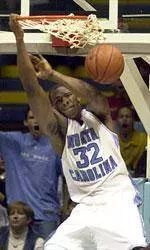
THM: A Real-Life Rashad Story
January 6, 2004 | Men's Basketball
Jan. 6, 2004
Tar Heel Monthly is the premier magazine devoted to the stories and personalities behind UNC athletics. Click here for subscription information.
The following is the cover story from the most recent issue of the magazine.
By Adam Lucas
This is a story about Rashad McCants, so you know what to expect.
There will be the description of his phenomenal basketball abilities, and there will be the quotes from some of his old coaches describing him as "moody," and there will be the current teammates struggling to get through to him, and there will be McCants rolling his eyes and frowning.
There will be all of those things. But there may also be a little bit more.
You're not going to know Rashad McCants any better at the end of this story, because he'll tell you right now that he's hard to get to know. "I don't really open up to a lot of people," he's saying. "People are going to think things regardless of if they're true or not. I'm always going to have the perception of being arrogant or cocky. I'm not going to change the way I act so I'm not going to change the way people think about me."
So he's not going to let you get to know him, and he's certainly not going to let some writer with a tape recorder and a notepad get to know him. He is Rashad McCants, and he knows that writers write what they want to write, and more often than not when he reads about himself the stories contain words like "temperamental."
So he might roll his eyes when you're talking to him, might stare off into the distance rather than look you in the eye.
Does that mean that you know him?
Tell you what. You decide.
Without basketball, there is no Rashad McCants. He has been so good at the game for so long that his entire identity is wrapped up in 94 feet of hardwood. Says so right there in his baby book, right there in the phrase James McCants wrote to describe his son shortly after Rashad was born on September 25, 1984. Most parents write about their baby's smile, about hair color or crying or having a parent's features. Not James McCants. James McCants knew something about his son, and this is what he wrote in that baby book:
"The next Michael Jordan."
His father will tell you now that he was just kidding around. But doesn't it have to mean something? Days after his birth, before he could dribble or dunk, Rashad McCants was basketball. Basketball was Rashad.
You want to stump people about Rashad McCants, ask them what he would be if he wasn't a basketball player.
"Hmm, I don't know," says his father.
"I don't think I can imagine that," says Devan Allen, one of his closest friends. "Rashad has always been a basketball player."
It's true, he has. As a kid, his dad would take him to the gym three times a week. James would be on one end of the basketball court playing basketball with the adults. Rashad would be on the other end playing with the kids. By the time his son was 12, James McCants told Rashad that he was too good for the other kids, that he had to play in the men's game.
Not everyone agreed. McCants was cut from his eighth-grade team at Asheville Middle School. Not put on the junior varsity--outright left off the roster. The family got him transferred to Erwin Middle so he could play hoops there, but he missed the tryout deadline by one day. That year he played rec league basketball, the equivalent of Barry Bonds moonlighting in a church softball league.
"I've still got film footage of that," his dad says with a smile. "He was flying over everybody. He took over the place. I told him right then, 'No more playing with kids for you.'"
Rashad McCants, age 13, was no longer a kid.
This came as no surprise to those who watched him play basketball, who knew just by looking that this player was a man. The frame McCants has now, the one that lets him play equally as effectively in the paint as on the perimeter despite standing just 6-foot-4, didn't just happen in college. He's been that strong since early in his high school days. That's an asset, another part of the package that enabled him to dominate most high school competition. But when a 15-year-old looks like a man, plays like a man, and has muscles like a man, he must be a man, right?
Not always.
"When he first came to us he was 15 years old," says Rod Seaford, the president of the Charlotte Royals AAU organization, a team McCants played for during two summers. "He was a baby and he looked like an Adonis. He looked like he does now. He had the body of a professional athlete at the age of 15.
"He was a man physically, so the expectation is that he's going to act like a man. We had to keep reminding ourselves that he was going to make mistakes and that he was a typical kid, even though he didn't look like one."
McCants played one season for the Royals while still living in Asheville and playing for Erwin High School. At Erwin, head coach Van Allen suddenly found himself blessed with a player who could play every position on the floor. As a freshman, McCants came off the bench during the first couple weeks of the season, but eventually earned a starting position. When Allen designed the Erwin full-court press, he designated his star freshman as the last man back, a position usually occupied by the center. On paper, it looked a little silly. During games, it looked like genius.

 |
|
"We'd let him roam the back of the press back there," Allen says. "The other team would think they had a layup, and he would send it back and then we'd be on the fast break. That was just incredible, because I'd never seen anyone who could do that. He had great timing."
His freshman season, McCants blocked a staggering 62 shots. He blocked over 100 during his two-year Erwin career, but was struggling in an environment that didn't value basketball as much as he did. He was all basketball, all the time, and Erwin was all basketball for about two months out of the year. Offseason on-court workouts were discouraged, which for McCants was like oxygen deprivation.
He played a summer with the Royals, during which his parents or another relative drove him from Asheville to Charlotte every Saturday and Sunday for practice for eight straight weeks. A teammate on that squad was Wes Miller, a point guard who had just completed his first season at New Hampton Prep, a prep school in New England.
"It's very intense there and it's not that well-known to the public," Miller says. "But I think it's the best high school basketball league in the country. There are six to eight teams every year with eight or nine Division I players on their team."
Workouts are encouraged, not discouraged. Basketball and books are two of the only releases in what can otherwise be a solitary existence. Miller and McCants roomed together for two years, and this is where you're supposed to read that the suburban white kid from Charlotte who spent all four of his high school years at private schools had trouble getting along with the moody--remember, he has to be described as moody--black kid from Asheville.
So what happens?
They click immediately and become close friends.
Explaining their friendship is baffling from the outside but simple from the inside. "They both love the game so much," says Miller's father, Ken, who hosted McCants in his home on numerous occasions. "They both have a real passion for it."
We love players who want to win, don't we? We love to watch them dive on the floor, scrape their elbows, scrap for rebounds against bigger players. We love them. We call them "competitors" or "warriors." Carolina history is full of them--George Lynch, Shammond Williams, Michael Jordan.
Add Rashad McCants in that category and something just doesn't seem right. Lynch, Williams, Jordan...and McCants?
McCants isn't a "competitor." He's a "challenge." Didn't you watch the tape from last year? Didn't you see him sitting on the bench with a towel over his head? We have already labeled him. The judgment is made, the verdict read.
Only there is this problem, and the problem is that the people who know him best say we are wrong.
"I coached him for three years," says Cliff Knight, the Charlotte Royals head coach during McCants's tenure with the team. "I can see how he can be misinterpreted. The biggest thing you have to understand about his personality is that he wants to please everybody. He wants someone to be happy with everything he does. When he thinks he's not pleasing people, he's like most teenagers--he sulks. That's what teenagers do. I had a whole team of them last year."
Rashad McCants a people-pleaser? This is unexpected. But then you watch this year's Tar Heels play and he is handing out a career-high eight assists in the season opener and regularly passing up shots--almost to a fault--to try and get his teammates involved. He doesn't always completely understand yet which situations call for a pass and which ones require a shot. But he is learning. And trying.
This is not the time to rehash the 2002-03 season. But let it be known that there is no doubt--none at all--that McCants was made well aware that he was not pleasing people last year. And what happens then? He sulks.
"Watching on TV, I thought he looked great at the beginning of the year," Miller says. "But as the season went on he just didn't look comfortable."
How often, Wes, have you seen Rashad McCants not look comfortable on a basketball court?
"Never."
efore you strain yourself applying the halo, understand this: Rashad McCants is not perfect.
He has the habit of doing some maddening things. He rarely looks reporters in the eye when they question him after a game. He stares straight ahead, picking a spot on the floor and becoming intently focused on it. There is occasional eye contact, but it is usually when a reporter asks him a question he doesn't like and he gives the offending writer a look like he has just suggested that McCants take up ballet.
It does not take reporters long to make a judgment--on this year's team, Sean May is the "designated quotable player" and Raymond Felton is the "designated great story"--so McCants became the "designated moody player." There are games when he scores over 20 points and is left largely alone by the press in the postgame locker room while large crowds gather around May, who has a gift for speaking plainly to reporters.
Sometimes even McCants's closest friends tell him he needs to tone down his act.
"I've told him that there are times he is out on the court when he acts like a jerk," Devan Allen says. "He'll miss a couple shots and then he starts pouting."
What does he say when you tell him that?
"He knows it."
Rashad McCants knows what you think of him. He knows his facial expressions provoke all sorts of discussion. He knows some of his teammates struggled to relate to him during his freshman season. He is not oblivious, despite the perception that he lives in his own world. What happens, though, is that he almost refuses to help that perception.

|
|
"When it comes to battle, it shouldn't come down to whether they like me when I'm on the court," he says. "They know what I'm capable of. It shouldn't matter whether I smile after I pass them the ball."
This is the problem. Others see a different Rashad McCants, a fun-loving kid who Ken Miller fondly recalls was great with kids and a close buddy of one of Miller's younger sons, Matt, who is six years younger than McCants. But you're not going to see that Rashad McCants. If you try, he'll make sure to close you off.
Pee Wee Gash is telling you a story. It's about six years ago and Gash, a former teammate of McCants at Erwin who now plays for Buzz Peterson at Tennessee, is at the movie "Titanic" with McCants and several other buddies. "Titanic," with its sweeping love story and tinkly piano music, was not exactly designed for 16-year-old males. So while on screen the ship is sinking, right at the exact moment it cracks in half and plunges into the icy ocean, Gash and his friends are laughing. Probably not your reaction to that scene, but you're not a 16-year-old male.
"He's pretty sensitive about certain things," Gash says. "When you watch a movie with him, it will touch him for real. At 'Titanic,' we were all laughing. And I looked over at him and he was really quiet. He looked like he was about to cry."
See, this is good stuff. This is the kind of story that you can use to demonstrate that Rashad McCants is a real human being with feelings. This is a part of Rashad McCants that people need to know about.
So the next time you see him, you ask him about it. Ask him what he thought of the movie "Titanic," ask him if it affected him at all.
"Nah," he says with a dismissive shrug. "I thought it was boring."
Which is why you ask Gash again--are you sure the movie had an impact on McCants?
"Yeah," Gash says. "I looked over at him during that scene and he said, 'I just can't believe what's happening.'"
This is Rashad McCants. This is a person who has been expected to be a basketball legend since he was a baby in a crib, a person who has looked like a man since before he took driver's ed. This is a person who does not have feelings, or at least any that do not pertain to the game of basketball. His game. His life.
He has trust issues, as he freely admits.
"You can't trust most people," McCants says. "You'll get burned, and I know that from experience."
At Erwin, McCants was the typical high school basketball star--known by everyone, a popular student, more friends than a kid with bubble gum for the entire class. When he left for New Hampton, he discovered he didn't have quite as many friends as he thought. Close buddies, like the starting quarterback for the football team, didn't talk to him for two years after his transfer. You know how it feels when a close friend suddenly disappears from your life, how it makes you wonder if you wasted all that time with them? What happens if a whole school suddenly disappears from your life?
If you're Rashad McCants, you remember it. You retreat within yourself. You don't let anyone get to know you, even teammates on one of the most popular college basketball teams in the world. Experts will tell you that one hallmark of a person with trust issues is a person who does not make regular eye contact, fearful of engaging with someone who might burn them. So maybe you don't look strangers in the eye quite as much.
You keep a close circle of friends that rarely changes. You are rarely jovial when you are in unfamiliar circumstances. You play basketball, the one thing that has always made everyone love you, except for those few months during the 2002-03 season. You make nice gestures, but you do them in ways that are not seen by the general public.
"Last year, all I wanted was to see the Duke-Carolina game," says Devan Allen. "It was right before my birthday and I really wanted to see that game. But I never said anything to Rashad about it. The Tuesday before the game at Cameron, he called me and asked if I want to go and left me these great tickets behind the bench."
Rashad McCants knows that there are those people out there who only want to get to know him in order to get a basketball ticket or an autograph they can sell on eBay. His teammates know it, too. But for the most part, their immediate assumption upon meeting someone new is that this new person wants to be a friend. McCants is different. For him, his first thought is that this person wants to take advantage of him, and until they prove otherwise--which is a lengthy process--he's going to assume the worst.
Underneath that distrustful veneer, there is rumored to be an engaging, friendly person. Those who know him well talk about his sense of humor and his loyalty. "I've done this for a long time," says Burgess McSwain, Carolina's associate director of the academic support center, who has been involved primarily with the basketball team for over 20 years. "He's one of the easiest kids I've had to work with. He is very polite and very bright."
It is Ken Miller who stuns you, who provides an unconsidered explanation for why McCants keeps that side of himself hidden. It's not something we want to hear, because in a way he's blaming me, and he's blaming you.
"For any kid to get the kind of attention from adults that he has gotten is amazing," he says. "All these young kids who are supertalented have to put up a front to survive. The media and all the recruiting information people want to know about them has gone bizarre over the last couple of years. More than anything, he's probably a reflection on the rest of us."
ut it can't be us. We are normal. We are just, you know, being a fan. It's the other guy who is weird.
This is a story about Rashad McCants, so you know what to expect.
Don't you?
Adam Lucas is the publisher of Tar Heel Monthly and can be reached at alucas@tarheelmonthly.com. To subscribe to Tar Heel Monthly, click here.