University of North Carolina Athletics
Lucas: The Other Side
October 19, 2004 | Men's Basketball
Oct. 19, 2004
By Adam Lucas
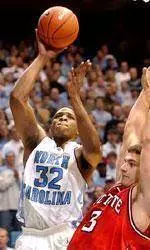
Rashad McCants had just made the biggest shot of his life. North Carolina was hosting Connecticut in front of 21,750 boisterous Smith Center fans. The game was tied at 83 with under a minute left, and Roy Williams called for a set play named "Long Beach." If it worked, there was a good chance McCants would be open for a three-pointer.
It worked, and the sophomore made the shot with just 6.2 seconds left. It gave him 27 points and gave the Heels their tenth victory over a top-ranked team.
The Carolina locker room was raucous. Media gathered in the adjacent players' lounge, and players slowly filtered in to do their postgame interviews. Most of the members of the regular rotation were already in the interview area when McCants emerged from the locker room. This was who most of the reporters were waiting for.
But he walked toward the exit. And with a wave, said, "Nah, I'm not talking today."
Watching one of Carolina's most talented players in many years walk toward the locker room door prompted one simple reaction: "That's no surprise."
He'd put together a roller-coaster freshman year, going from superstar to substitute in a matter of months. Sometimes he sat on the bench with a towel over his head. Sometimes he didn't give high fives when he came off the floor. Sometimes he simply didn't do the type of public housekeeping we've come to expect from a Carolina basketball player.
Messages to his cell phone would frequently go unreturned. He went through an entire season without ever calling some people intimately involved with the program by their name.
It was a difficult year for everyone involved, and there wasn't much time to delve into McCants's personality. The conclusion was simple. Player frowns. Player is difficult. No time to prove otherwise. No one knew he'd hurt his back during one of the best practices of his life before the Duke game at Cameron Indoor Stadium. No one knew he grew so frustrated with a variety of factors surrounding the team that out of the view of his coaches and teammates, he cried during one mid-season practice.
The trend continued during the first part of his sophomore year. Roy Williams sent him to the locker room during a game against UNC-W--the first time in Williams's coaching career he'd ever disciplined a player in that fashion--and benched him on multiple occasions against Kentucky. The loss to the Wildcats fired up the same articles that had been written the year before, the ones that included words like "temperamental" and "moody."
Behind the scenes, however, something happened that altered McCants's behavior: Roy Williams passed the test.
Every Carolina player knows they are in a fishbowl. They don't outwardly compare it to a prison, but they realize their every move is magnified, understand that some acquaintances will try and get to know them simply because they are Tar Heel basketball players. On a campus of peers, they are idolized.
Most players assume the best upon meeting someone new until the strangers prove otherwise. McCants does the opposite--he assumes the worst until someone proves worthy of his friendship. It's a defense mechanism that can make it difficult to relate to him. It requires effort, and many people aren't willing to put in the time.
Roy Williams was. And when McCants realized his head coach had nothing but the best of intentions--McCants even said it was only the second time in his life he'd had a coach who he felt cared about him regardless of the number of points he scored--something changed in the talented player.
After the loss to Duke in the Smith Center on Feb. 5, it was McCants who took charge of a somber postgame locker room, going from player to player to provide a word of encouragement as many of his teammates hung their heads. It was McCants who stood up at the team's annual basketball banquet and said to a room of strangers, "I know that I can be hard to be around, but I want you all to know that I'm a good kid," a stunning pronouncement from someone who'd never shown much interest in testifying about his character.
And it was McCants who adopted rising sophomore Reyshawn Terry as his pet project, constantly trying to convince Terry, who was overwhelmed as a freshman, of his significant potential. At virtually every pickup game this summer, whenever Terry made a positive contribution, it was quickly followed by loud commentary from his own personal cheerleader: "Yeah Reyshawn, I see you!" McCants would shout. "He's taken me under his wing," Terry says. "He's trying to make me a better player and I'm trying to get where he's going."
There are other signs of progress. Although he wasn't enrolled in summer school, McCants stayed in Chapel Hill this summer for the sole purpose of spending more time with his teammates. One day, without warning, he wandered into the sports information office and for the first time in his life, spent nearly an hour chatting with surprised staffers who before that day weren't even sure he knew their name. He began returning cell phone messages, began calling people by name.
Once he trusts you, he has one of the most winning personalities on Carolina's entire team. He can be charming, witty, and insightful--all qualities his friends described during his freshman year that seemed to be impossible. For many people, the problem is that getting to those layers takes too much time. He does not smile and say, "Have a nice day." He does not spout needless platitudes. If he is happy, he smiles. If he is mad, he frowns. He makes it perfectly clear where you stand with him at all times, something that should be a welcome bit of honesty but can be disheartening to those not on his good side. He is a challenge, which is part of the reason--in addition to his prodigious basketball talents--Sports Illustrated recently came to Chapel Hill to do a large feature piece on him for their basketball preview issue.
But a worthwhile challenge. Just last week, after a Late Night with Roy Williams rehearsal, he stood in a Smith Center tunnel and spoke disappointingly about his performance in a pickup game earlier that day. "Come on, I was terrible," he said. "My shot was off and I wasn't doing any of the little things."
The refreshing thing was that it wasn't a case of the prettiest girl in the class saying she looked fat just to fish for a compliment. It was a stark evaluation by someone who values the same in return from his friends. If he asks how he played, he wants the truth and will scoff if you provide anything else. As he turned to leave, he offered one more comment. "You know, when I leave here, I don't know what people are going to think of me. But what I really hope they remember about me is that I wanted to win more than anything. That's all I want. That's all I care about. I just really want to win."
Later in the week he would be given the option of skipping the team's annual media day. His paternal grandmother had passed away, and he could have returned to Asheville to be with his family. But he was adamant about attending the media session, something--if they were as bluntly honest as McCants--his teammates might have taken the opportunity to skip.
That's the setting where he offered a comment that's likely to follow him around the ACC this year, as he quoted his uncle--it's worth remembering that McCants himself didn't make the prison comparison, his uncle did--on the rigors of playing basketball at Carolina. They are comments that rightfully wounded a fan base used to their heroes returning their adulation.
Roy Williams and McCants addressed those comments Tuesday afternoon in a startlingly frank press conference. What kind of person is McCants? Before he began, he admitted in front of the largest press conference media gathering in recent memory, "I'm nervous."
Most people would be. Few would admit it. The facts are that he gave a ten-minute interview that was torpedoed by two sentences. Some fans will write him off for that transgression, and this isn't meant to criticize those who make that decision. But it is meant to tell those folks that they'll miss out on one of the most unique and insightful individuals who has played at Carolina in the past couple of decades.
After that Connecticut game, he waited, with perfect timing, for most of the media to stare at his back. Waited long enough for the thoughts to form in their minds: "Here we go again."
Then he spun on his heel, flashed a megawatt grin, and said, "Nah, I'm just kidding."
And he sat in the players' lounge and talked for nearly a half-hour, long after his teammates had gone out into the chilly day to accept the cheers of their admirers.
Adam Lucas is the publisher of Tar Heel Monthly and can be reached at alucas@tarheelmonthly.com. His book on Roy Williams's first season at Carolina, Going Home Again, is now available in bookstores. To subscribe to Tar Heel Monthly or learn more about the book, click here.