University of North Carolina Athletics
Keys to the Season: Leadership
November 10, 2004 | Men's Basketball
Nov. 10, 2004
This year's Tar Heel Monthly basketball preview includes a five-part "Gateway to St. Louis" series focusing on the five keys for this year's team to reach the 2005 Final Four in St. Louis. One of those stories is reprinted below. To subscribe to Tar Heel Monthly and receive the basketball preview, click here.
By Adam Lucas
At the conclusion of last season, Roy Williams was plainspoken with his team about what had gone wrong. The triple-overtime home loss to Wake Forest. The collapse at Florida State. The last-second defeat at the hands of Georgia Tech in the ACC Tournament.
"At the end of the season, I brought up all those things," Williams says. "I want us to remember all those mistakes and the effect they had on us. I'm hopeful they'll sit back and think about how silly that was. That way, we gain something from it."
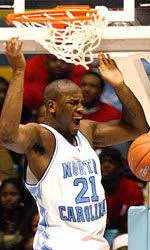
They'll also gain something a Carolina basketball team hasn't had in three seasons--senior leaders who will be on the floor at key moments. No Tar Heel senior has averaged more than 1.7 points per game since the 2001-02 season, but it's a safe assumption that each of the Jackie Manuel, Melvin Scott, and Jawad Williams trio will surpass that figure (walk-on C.J. Hooker is the squad's fourth senior).
Their points will be valuable, but it's their leadership that will set the tone for the coming year. If they sacrifice, the rest of the team is likely to follow their lead. If they're selfish, that's likely to be emulated as well. This is a unique group: they've been through more losses than any group in the modern era of Carolina basketball, and their first two years were considerably more rocky than many of their counterparts.
But the memories of 8-20 don't seem to have scarred them. Instead, they've served as motivation. They've seen the world from the bottom of the Atlantic Coast Conference, and they're intent on going out with a view from the top.
"My goal for this year is simple," Jawad Williams says. "I want to win as much as possible. We want to have that story written about us about how we've turned the program around."
It's easy to be skeptical about those, "All we want to do is win" proclamations. After all, this is the same team that consistently mentioned the need to buy in to Roy Williams's teachings last year, but seemed more willing to talk about it than actually do it. We've heard it for a year. Now we want to see it.
If offseason pickup games are any indication, it may be more than just talk this season.
"I've seen a change in Jawad in pickup games," David Noel says. "When it's game point, it doesn't matter to him who is taking the shot as long as the ball goes in. If the shot is missed, he just says, `Hey, let's get back on defense and get a stop so we can get the ball back.' There's no more, `Hey, why did you take that shot?'"
Williams has two capable senior classmates. But Scott is more suited to comic relief, more of the type of person able to interject humor into any situation. Manuel is a lead-by-example player, the type who'd rather pick up a floor burn diving for a loose ball than call a team meeting. So the vocal role has always fallen to Williams, even when he wasn't entirely comfortable with that responsibility.
He struggled as a freshman, initiating some public discussion of Carolina's chemistry, but seemed to mature as a sophomore. Matt Doherty frequently used Williams as a sounding board and representative of the players. When there was tension--even if it didn't involve him--it was frequently Williams who was summoned to talk about it.
"Those two years were a real learning experience for me," Williams says. "I'm still not a big talker, but there are things we can't let slide anymore. I'm going to try and be more vocal. It's my last year, and I want to go out with a bang."
That vocal leadership is exactly what his teammates may need. Even Williams himself may not realize just how much they respond to him, how much they need the occasional tongue-lashing. This Carolina team has its most potential if he's willing to cede the role of superstar scorer to a teammate and thrive in the capacity of senior sage. He'll still get plenty of points, of course. Don't forget that this is the same player who averaged 12.6 points per game and 5.4 rebounds per contest as a junior while battling a medley of frustrating head injuries.
But the Heels have other players who can score. Their requirements of Williams are simple: channel the spirit of George Lynch and will the team into the Final Four. That means taking what has occasionally been an incongruent group of individuals and melding them into a cohesive unit.
He'll have some help. Manuel and Scott both embark upon their senior campaigns with a renewed sense of how they can help the team.
"Last year, we might have shied away from the leadership role," Scott says. "As a senior, it's a big responsibility. You're a little nervous and scared because it's your last year. You want to win to give yourself an opportunity to play basketball beyond college. When you're a freshman, sophomore, and junior, you never think about it being over. You always have another year. We can't say that now. If we don't lead, I don't know who will."
The trio will essentially have the same pieces as last year to work with, as all seven members of the regular rotation return. They'll be joined by freshmen Quentin Thomas and Marvin Williams, the foundation of Roy Williams's first recruiting class at Carolina.
Both players arrived in Chapel Hill in time to enroll in the second session of summer school and were immediately brought into the exclusive fraternity of Carolina basketball players.
"Jawad, Jackie, and Melvin are great leaders," Marvin Williams says. "Since the day we stepped on campus, they've taken us under their wings and showed us around. They got us in the weight room early, they've even had us over to their place and cooked for us."
There's a difference between off-court leadership and on-court leadership. The seniors are likely to carry much of the burden off the court. On the court, Roy Williams demands so much of his point guard that Raymond Felton will be another essential cog.
At times last season, Felton became a vocal leader. He did it in the Georgia Tech game at the Smith Center, did it in the second half of the win over NC State in Chapel Hill. His contributions were subtle and sometimes as subtle as simply clapping his hands on defense. But the team responded to them, and Felton himself noticed the change.
"It started with me and once I did it the team followed," he said after the State game.
The team will follow him again if he repeats that performance this year, ideally on a more consistent basis.
"I'm not a senior," Felton says, "but I'll still be a guy who lets people know. Jawad can be quiet sometimes. I can't see myself being quiet."
That's what his head coach wants. From almost the day he was hired, Roy Williams's message to his team has been simple: winners get the awards and rewards. He's said it in practices, said it after games, talked about it endlessly with the media.
At times during his maiden season with the Heels, it seemed his players were suspicious of the notion. Winners get the awards? But what about the leading scorer, what about the guy who makes the most spectacular dunk?
"At Kansas I was fortunate because for 13 of the 15 years I was there it was as much of a team as could be imagined," Williams says. "But it's hard for Jackie, Jawad, and Melvin to go through two seasons and lose 36 games and still buy into a team aspect. When you're not having success, you try to gain something individually."
So it was almost melodic to listen to Jawad Williams talk about his goals for his senior campaign. There was no speculation about All-ACC honors or the number of points per game he might score. He didn't mention his NBA Draft position, didn't talk about the future riches that are coming his way when he signs his first NBA contract. Instead, he said he had one simple goal: "If we win, we'll get the awards and rewards. That's what happens when you win as a team."
It sounded suspiciously like something his head coach might say. Or, more importantly, something a leader would say.
Adam Lucas is the publisher of Tar Heel Monthly and can be reached at alucas@tarheelmonthly.com. His book on Roy Williams's first season at Carolina, Going Home Again, is now available in bookstores. To subscribe to Tar Heel Monthly or learn more about the book, click here.