University of North Carolina Athletics
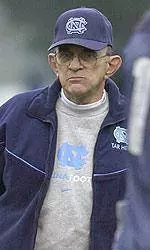
The OC: Tranquill's Seen it All
November 2, 2004 | Football
Nov. 2, 2004
Tar Heel Monthly is the premier magazine devoted to the stories and personalities behind UNC athletics. Click here for subscription information.
The following story originally ran in the October issue of the magazine.
By Adam Lucas
Unexpectedly, he laughs.
You approach Carolina offensive coordinator and quarterbacks coach Gary Tranquill with a bit of trepidation. You have seen his practice field blowups, have watched him tear into an underperforming quarterback. There are times his hat goes flying in anger. You keep an eye on the hat. If the question angers him, you want to be able to dodge the hat.
But he laughs. He has just been asked about the hazards of being an offensive coordinator, about the way any fan competent enough to operate the television remote with one hand while sipping a drink with the other hand believes they are capable of calling plays. It is suggested to Gary Tranquill that, just perhaps, some fans think they could do his job at least as well as he does.
"I got a letter from a dentist last year," Tranquill says. "It was the week after the Wake Forest game. There was a key fourth-and-1 in that game. If we make a first down, the game is over. If we kick the field goal and make it, the game is over. We go for it, get the first down, and win the game.
"This letter starts off, `Did you see something I didn't see to make that call?'"
Gary Tranquill leans back in his highback leather chair, the one with the interlocking "NC" embroidered on the back. He takes off his hat, and suddenly you are concerned the hat may be coming your way at a high rate of speed in the near future. But he just holds it in his hand, rubbing his head with his other hand. And laughs.
"Did I see something he didn't see? Well, the guy is a dentist. I sure hope I saw something he didn't see."
This is life as an offensive coordinator. Your job security is tied to your boss. You can have the greatest offense in college football history, but if your team doesn't win enough games, you're likely to be looking for employment elsewhere. Every fan in the stadium on Saturday afternoon thinks they know everything about your job. Wait--they don't think they could do your job. They know it. After all, it's just calling plays. It's pretty simple: throw the bomb. Pass the ball. Unless it's intercepted. Then you've got to run it, got to control the clock. Come on! Not a draw play!
Life as a coordinator is prone to flashes of brilliance. Tranquill used to carry around a yellow legal pad with him at all times, and occasionally he would fill an entire legal pad in a day with inspirations for plays. An X here, an O there, suddenly you've got something that might win a game later in the season. Now he's got a computer program, PlayMaker Pro, that has taken the place of some of the legal pads, but he's not always sitting at the computer.
"He'll write on a napkin or an old envelope or something," says his wife of 40 years, Shirley. "Before I throw away a piece of scrap paper at the house, I always have to make sure there aren't some x's or o's or little arrows written on it."
Shirley Tranquill is a regular at Carolina football practice. Coaches' wives quickly learn if they want to see their husbands in the daylight, they need to learn to appreciate the practice field. Shirley has a master's degree in being a coach's wife. She has followed her husband through 11 different coaching stops, places as diverse as East Lansing, Columbus, and Annapolis. Some wives don't unpack their boxes for at least a year after arriving in a new town, wanting to make sure the move is at least semi-permanent. Not Shirley. She unpacks right away, eager to make a home.
The man she sees on the practice field is different from the one who comes through her front door every night.
"He doesn't throw his hat at home," she says with a laugh. "He is very calm."
Her husband is a voracious reader, has read almost a dozen books on the Middle East in the past year as he tries to gain a better understanding of the conflict in that part of the world. He is also a devoted fan of the chef Emeril Lagasse, as talented around the grill as he is in front of a chalkboard.
He's even been known to show off his grilling talents to his quarterbacks. They're welcome at his house for cookouts--if they're willing to, as NCAA rules dictate, pay for their meal. It is a side of himself he doesn't show on the practice field. Watching him coach the quarterbacks or instruct the offense, you'd never imagine he would open his home to these same college kids who seem to frustrate him so deeply. Make a mistake in a drill, and he's likely to yell, in his own unique way of advising you to find a new hobby, "Come on, you plumber!" But then he might have you over for a steak.
Landon Mariani walked onto Carolina's team straight out of Freedom High School, where he had been a proficient passer. Most of his Tar Heel career was spent on the sidelines, where he was responsible for signaling in the plays to the starting quarterback before every snap. On the practice field, though, he was treated just like a starter. Which meant Tranquill barked, "Come on, Mariani!" thousands of times over the past three years. There were people in the Carolina football program unaware the backup quarterback even had a first name. They thought he was, like Madonna, able to go by just one name--Mariani.
But when he wanted to pursue an offensive video assistant position that had opened with the Heels, Mariani found he had an unlikely ally--Gary Tranquill. The Tar Heel offensive coordinator kept constant tabs on the hiring process, regularly updating his former pupil. UNC received over 500 resumes for the position, as entry-level spots are golden in the coaching community. "I'm working on that for you," Tranquill would say. And before the season started, the work paid off, and Mariani got his first big break in the coaching business.
The former backup endeared himself to Tranquill during hours of meetings during his career. When meeting with the offense, Tranquill is likely to fire out a handful of trivia questions. They're not just football. They may have to do with current events, might be related to military history. He expects answers. No, he expects correct answers. But most college kids don't have an encyclopedic knowledge of the past 60 years.
"Kids don't know anything about their sport," Tranquill says with a sigh. "They don't know anything about the history of football, and they don't know anything about history. We'll watch tape and something will come to mind. `Who was George Gipp?' `Who played George Gipp in the movie?' I would say none of our quarterbacks would know the answers to both of those questions."

 |
|
It doesn't take them long to learn. Quarterbacks watch ESPN with a special interest--they love the "Did You Know" segment on SportsCenter because it provides them with trivia ammunition against their position coach. Occasionally, they'll try to stump him. Usually, it doesn't work.
Gary Tranquill knows his career is coming to an end. He almost retired last year, but couldn't bear the thought of leaving the game after such a disappointing season. After 43 years in coaching, he has been involved in just nine losing seasons--seven at the Naval Academy and the past two at North Carolina. John Bunting has juggled some staff duties to prevent Tranquill from going on the road recruiting, a perk he's earned during his career.
Although he doesn't have to go on the road recruiting, is able to review quarterbacks on video tape and in person at football camps, his time is not ill spent. He designs plays constantly and still scripts the first 15 plays of a game. It's not an inflexible script--if the third play of the game is third-and-11 and the third play on his script is a power off-tackle, he'll deviate--but it provides the foundation for his offense.
"I always have a fourth-and-one call, one run and one pass," he says. "I have my first short yardage call, my first goal line call, my first third and 3-6 call, my first third and 7-11 call. It's not, `Hmmm, it's 4th and 11, what are we going to do?' I already know what we're going to do. It's not like I'm going to draw one up in the dirt. There's no hesitation. Boom, this is it."
|
2004 ACC TOTAL OFFENSE
1. Virginia, 465.4 yards/game 2. Carolina, 392.8 yards/game 3. Wake Forest, 383.0 yards/game
|
When he's making the calls on gameday, he has plenty of weapons. His office shelves are stacked with binders, all crammed full of plays he's run over the past four decades. After earning Little All-American honors as a dual-threat quarterback at Wittenberg, Tranquill got his start in coaching on the defensive side, experience he says helps him design his offense with an eye toward how opponents will react. He has a reputation for inflexibility, brought with him to Carolina the dreaded football tag of "conservative," but has proven it to be inaccurate. In 2002, his Tar Heels led the ACC in passing. Under his tutelage, Darian Durant has secured every major UNC quarterback record.
Never a fan of two quarterbacks, he used the dual-QB system to perfection in 2001, when Durant and Ronald Curry thrived while sharing time. When the Heels were without a reliable fullback last year, Tranquill designed an offense featuring two tailbacks, and suddenly the ground game blossomed.
"There are a lot of things you like to do as a coach that you can't do because of your personnel," he says. "That's part of coaching. The quarterback has to feel comfortable with it. If he doesn't, you don't call that play. I was a quarterback and called my own plays, and I know I called what I felt good about executing."
For that reason, he values feedback from his quarterbacks. He'll bark at them on the practice field, but if they fire back at him and explain why they made a mistake, he'll file it away and remember it when he's calling plays for them the next Saturday.
That's what happened on that fateful call against Wake Forest, the one that earned him the letter from the dentist. He wasn't calling plays in a vacuum. He weighed the consequences of a missed field goal, or worse, a blocked field goal. In a couple of seconds, he'd evaluated all the options. Going for it was the right call, even with the game in the balance.
"It's pretty simple," he says. "If it's third and nine and we gain 11 yards, it's the greatest call in the history of the game. If we gain eight yards, it's not worth crap."
And he laughs. He puts his hat safely back on his head.
Adam Lucas is the publisher of Tar Heel Monthly and can be reached at alucas@tarheelmonthly.com. His book on Roy Williams's first season at Carolina, Going Home Again, is now available in bookstores. To subscribe to Tar Heel Monthly or learn more about the book, click here.