University of North Carolina Athletics
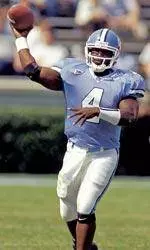
THM: Maturity Brings Singular Goal for Durant
July 22, 2004 | Football
July 22, 2004
Tar Heel Monthly is the premier magazine devoted to the stories and personalities behind UNC athletics. Click here for subscription information.
The following is the cover story from the August 2004 issue of the magazine.
By Adam Lucas
Here is the reaction when Carolina's rising senior quarterback, the man who owns every passing record ever made in Chapel Hill, walks into a Franklin Street restaurant:
Nothing.
He sits quietly, undisturbed at a table of his choosing. No overeager fans demand an autograph. The waitstaff does not fawn over him. He is a regular guy. His beard makes him look older than his 21 years. In this college town, where youth is everywhere, he could pass for 30. He looks almost weathered compared to the fresh-faced college kids surrounding him.
The college football season is less than two months away. On fall Saturdays in Kenan Stadium, some of these same people will roar if he throws a touchdown pass, moan if he fires an interception. They will call him by his first name, as though they are buddies, when he makes a great play. "Way to go, Darian!" They will call him by his last name, chastising him, when something goes wrong. "Come on, Durant!"
He seems impervious to all of it. He is the quarterback at the University of North Carolina, has been for what seems like a generation. But he can walk through a mall where his jersey hangs in the window of sporting goods stores, a replica number four jersey in that familiar blue, yours for just $59.99, and never be noticed.
There was a time this lack of attention might have bothered him. Not too long ago, he yearned for the attention, wanted everyone to know that he was the Darian Durant.
Now, well, he appreciates your support, he really does. But he doesn't want to get any special treatment, doesn't want to move to the front of a line in a restaurant or any of the other perks usually afforded high-profile athletes in Chapel Hill. He just wants to sit and eat his sandwich.
Oh, and there is one other thing he wants. He has scheduled his whole year for this one thing.
He wants to win.
The 10-year-old was dominating the basketball game. It looked ridiculously easy for him. He was faster, stronger, certainly taller than everyone else on the floor. There was no mystery to the gameplan: get it to Darian. His team scored 79 points. He scored 76 of them. Even now, he laughs when he thinks about that game.
"I just took over," he says. "I'm not trying to be conceited about it, but it just came easily for me. I was the biggest and the tallest."
You read that correctly. As a kid, he was always the tallest in school. This is a delicious irony for the player who has heard one consistent criticism since arriving in Chapel Hill: he's not tall enough. Durant is listed at 5-foot-11, which makes him at least two inches shorter than seven of the eight ACC quarterbacks that took the majority of their team's snaps last season. The three All-Conference selections--Philip Rivers, Matt Schaub, and Charlie Whitehurst--went 6-foot-5, 6-foot-5, and 6-foot-4.
It's only recently that "the height thing," as Durant calls it, has become an issue. He noticed that other boys were growing past him in high school, that he was no longer the tallest kid on the basketball court, but it didn't seem to matter. He still averaged 20 points per game on the hardwood and played pitcher and catcher in baseball, which his parents think might have been his best sport. And in football, the three-year varsity starter turned Wilson High games into an event in Florence, SC. He passed for 2,100 yards and 21 touchdowns as a junior on his way to finishing his career with 7,241 yards and 69 touchdowns.
He was a well-known prospect in college recruiting circles. He was well-known in Florence, a town with three 4-A high schools that values its prep sports. And he was well-known, he admits, in his own mind. Full of himself, he tried to end one argument with his girlfriend by saying the kind of thing that teenagers say when they fight: "Don't you know who I am?"
Only one problem. His mother, Betty, heard him say it.
"We had a nice talk about that," she says in a way that makes you glad you weren't there to hear it.
"It was a time when I was doing really well, and I just made a mistake," he says. "My mom got me down to earth real quick."
That wasn't all that brought him back to reality. Four games into his senior season, Wilson head coach Darryl Page called a quarterback draw. Durant went straight up the middle, was almost into the secondary. A linebacker grabbed him around his thigh, and as the quarterback tried to wriggle free, the defender's hands slipped down around Durant's ankle. To try and gain a few extra yards, he tried to slip the tackle one last time, which was when he felt a searing pain in his ankle.
Page saw his quarterback go down and, for the first time, not get up. He was on the field almost instantly, finding his quarterback flat on his back in the middle of the expanse of green grass.

 |
|
"Coach, it can't end like this," Durant said. "It can't be over."
The tackle had torn a ligament in his ankle that was connected to his fibula, which ripped a piece of bone off his fibula. He was officially damaged goods, a question mark to some of the bigger schools that had showed interest. He wasn't just a short quarterback anymore. Now he was a short, injured quarterback.
He missed six games. His first game back, he had 72 passing attempts--proving, if nothing else, that his arm was perfectly healthy. North Carolina and South Carolina stayed in touch with him, and he committed to Carl Torbush and the Tar Heels.
He was part of a recruiting class that featured 19 signees; only four are still at Carolina today. One of the departed is quarterback Aaron Leak, the more familiar name to those in North Carolina recruiting circles at the time. Leak had the pedigree, the reputation, and, yes, the size (6-foot-3). Both quarterbacks redshirted their first year in the program, and Torbush's staff raved about Leak's strong arm and athleticism.
Off the field, college was a difficult adjustment for Durant. The prospect of being on the same field with high school super-legend Ronald Curry was somewhat intimidating to him, and he was away from home for the first time in his life. Know this about Darian Durant: he doesn't know how to lie. So when you ask him what his first weeks in Chapel Hill were like, he doesn't bother with the macho, football player answer. He goes straight for the truth.
"I was scared," Durant says. "I was scared of meeting all the new people. That first day, I cried."
His fear manifested itself in a somewhat aloof manner. He'd go out on occasion, take advantage of the Chapel Hill nightlife, but he wasn't really one of the guys.
Slowly, though, he was playing his way up the depth chart. In drills, he wasn't always the most impressive quarterback on the roster. Leak and Curry had cannon arms; Durant's was less remarkable. Curry had extraordinary agility; Durant's was effective, but less poetic. But the coaches began to notice that in scrimmage situations, Durant had a knack for making the right play. It wasn't always pretty, might be more of a wounded duck than a tight spiral, but it seemed to work.
"If you're going to draw up a quarterback, it wouldn't be Darian," Carolina offensive coordinator Gary Tranquill says. "Everybody is looking for a big guy who can run, has a great arm, and completes all his passes. That's not Darian. But a lot of times it's the intangible things that make a great quarterback."
One of those intangibles is confidence. Durant had never lacked for it in high school, but when he arrived at Chapel Hill he wasn't convinced he could play at the Atlantic Coast Conference level. All of a sudden his teammates were players he had read about, players who were supposed to be bigger, stronger, faster, better than him.
He says there was no watershed moment when it struck him. But at some point, he realized it: he was just as good as them. With the realization came an attitude change.
"His redshirt year, he was sort of like, 'Oh please, just give me a chance,'" says walk-on quarterback Landon Mariani, who has been on the practice field with Durant every day for the past four years. "By the next year, he was outplaying Ronald Curry in training camp, and his demeanor changed to, 'How can you not play me?' He got a little cocky."
Based on the results, it was hard not to be cocky. In the season opener, down 24-0 to defending national champion Oklahoma in the first quarter, the Tar Heels eventually fell behind 41-7. Curry struggled, losing two fumbles and completing just 5 of 14 passes. With nothing to lose, John Bunting threw Durant into the game. The chances that he would play had been so remote that his mother hadn't even made the trip to Norman. She was sitting in her living room in Florence, mouth wide open, when her son took the field.
Bam, 26-yard scoring pass to Chesley Borders.
Five minutes later, a one-yard touchdown pass to Brandon Russell. The Sooners actually had to sweat out the closing minutes, all because of the stocky little backup quarterback who didn't seem to realize he was supposed to be scared.
Statistically, he outplayed Curry that season. Durant posted a 149.29 pass efficiency rating, threw 17 touchdowns to Curry's eight. His numbers were made all the more remarkable by the fact that he was putting in a bare minimum of effort.
"I was used to getting by on pure athleticism and talent," he says. "I never had to do anything extra."
So he didn't. He was a stranger to the film room, Carolina's upscale film headquarters where video assistants can break down games in hundreds of different ways. If a conditioning workout was optional, he opted out.
"He used to do anything to get out of running," Mariani says. "They'd be getting ready to start and it would be, 'Oh, my hamstring,' or, 'Oh, I think I hurt my ankle.'"
Remember, he is not the type to give you an answer that sounds good. So when you ask Darian Durant what his March was like in 2002, he doesn't give you the politically correct response.
"To tell you the truth, I kind of enjoyed it," he says.
This is not what you expect to hear. He had separated from Carolina football on Feb. 25 of that year, attended a press conference and told the whole world he was leaving. Bunting said something that day that Durant found odd: the head coach said he would "keep the door cracked open a bit."
"I didn't understand that," Durant says now. "I thought it was over. I thought we were parting ways."

|
|
Maybe the head coach knew his quarterback a little better than he thought. How many times--in any sport--has a player announced his intention to transfer and then come back? It happens very rarely. Usually, by the time the official announcement is made, there have already been endless discussions, plenty of time to think about it. That was true in Durant's case, too. His choice to leave has occasionally been painted as an ill-conceived snap decision.
It wasn't.
"Emotions were up and down the whole time," says his mother. "You'd think you had gotten him to the place where he'd stay, and then a couple days later he was back to where he was leaving. I finally had to leave it up to him. And he could never give you a definitive answer on why he was unhappy. He would just say, 'It's a combination of things.'"
For a month, he was not a football player. No conditioning workouts. No weightlifting. No passing drills with his teammates. He missed the opening days of spring practice.
But then he stepped through that door Bunting had left cracked open. His return didn't immediately heal all wounds. His transfer announcement had sapped much of the momentum from a Tar Heel football program that was coming off a Peach Bowl victory over Auburn and should have, by all rights, been flying high. But when one of the best freshman quarterbacks you've ever had suddenly bolts, it has a way of taking some of the shine off a season.
Regaining that lost momentum proved to be elusive. Some teammates immediately accepted him back; others were more skeptical. He understood their feelings. Ask him what attribute he prizes most highly in a friend, and Durant is quick with a response:
"Loyalty. When you go to war with a guy on the field, he's supposed to have your back. For him to turn his back on you, that's the worst thing he can do."
He had, for a month, turned his back on them. It took an injury--and a recovery--to fully regain his place on the team. After missing four games with a broken thumb, he defied the predictions of doctors and returned to play against Duke in the 2002 season finale. He ran and threw for a touchdown and coolly directed the game's final drive--including a 10-yard strike to Sam Aiken on fourth down--which ended with a game-winning Dan Orner field goal.
Before that day, there may have been some on the Carolina sideline who didn't believe their quarterback was capable of that kind of leadership. Athletes can usually forgive most indiscretions, but quitting is a scarlet letter. On that day, Darian Durant ceased being a quitter. And started being a leader.
The comeback from the thumb injury seemed to provide him with some direction, both on and off the field. Previously an indifferent student, he began paying more attention to his studies. The new focus paid off in an unexpected way last winter, as he boosted his GPA over 3.0 and was selected to the All-ACC Academic team.
"That's better than anything he has done on the field," says his father, Israel Durant. "That's really special. I had been on his case because I told him he could do better. And then one day we were talking about some other things and he just casually told me he had made the All-ACC Academic team."
This spring, the UNC sports marketing staff put together a mini-Tar Heel Town on the Kenan turf before the annual spring game. Players weren't expected to attend. But then, with no forewarning, someone with a number-four jersey and a Sharpie showed up on the end of the field where kids were playing with the mascot and bouncing off an inflatable gym. Darian Durant had been standing at the other end of the field, preparing for the game, when he noticed the kids. He hunted down the pen and ambled, unasked, to greet the fans.
"I just wanted to thank them for coming out," he says. "With the season we had, I knew a lot of fans had drifted away from the program. There wasn't an autograph session after the game and I thought some of the kids might like an autograph."
These days, he's the wise old sage on the Tar Heel offense. He studies film meticulously, has learned from Tranquill how to read the safeties and anticipate the play. Carolina's offensive coordinator still wants his quarterback to improve his game management and decision-making, but says that even in those areas Durant has made great strides since his freshman year.
His struggles have come when he tries to do too much. By the end of last season, he had lost confidence in his defense and felt he had to score on almost every play in order to give the team a chance to win. The result? Ten interceptions and a handful of costly fumbles.
This season, he wants to do more while doing less. He says the installation of a new defensive scheme has maximized the talent, that he no longer feels he has to make every play a big one just to keep the defense off the field.
He organizes the pass skeleton drills for his teammates, making sure of their attendance and reinforcing the importance of the voluntary sessions. Miss one and you're likely to get a phone call from Durant.
In addition to the vocal leadership, he's learned how to make the subtle gestures teammates appreciate. In late May, he stopped by the UNC sports information office to inquire about the upcoming football media guide. Told that the plan was to feature Durant, Chase Page, and Jason Brown on the cover, he made a surprising suggestion: "Let's let someone else be on the front."
So when the guide is released in August, you'll find only Brown and Page on the cover. It seems a little odd to leave the record-breaking quarterback off the front of anything to do with Carolina football. But that's the way he wanted it.
"I wanted it to be more of a team concept," he says. "Chase said he wanted to be able to show it to his kids 20 years down the road, and that was important to him. I've had my time to be on the front of magazines.
"Sure, I enjoyed it, but it really wasn't a big deal. It's not important to me anymore. I've only got one go-around left. And there's only one thing that's important.
"Winning."
Adam Lucas is the publisher of Tar Heel Monthly and can be reached at alucas@tarheelmonthly.com. To subscribe to Tar Heel Monthly and receive next month's football preview issue, click here.