University of North Carolina Athletics
Lucas: Witness to a Rivalry
November 16, 2005 | Football
Nov. 16, 2005
By Adam Lucas
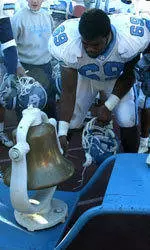
The Victory Bell is the enduring symbol of the Carolina-Duke football series. But in terms of seniority in the rivalry, it ranks a distant second.
The Bell was created in the 1940s by Tar Heel cheerleader Norm Sper. Since then, it's been on the sidelines for six decades of football games. It's an impressive streak--but not as impressive as the one held by Charlotte's Elliott White.
The retired pediatrician will be in Kenan Stadium on Nov. 19 for this year's 92nd meeting in the series. Of course, that's not unusual. Rather, it's exactly where he's been for the past 72 years.
This season marks White's 73rd consecutive Carolina-Duke football game, a streak that began in 1934 (The teams played twice in 1943).
"I was 12 years old when I saw that first one," White says. "I remember it very vividly. Don Jackson threw a pass to Dick Buck and Carolina won a 7-0 game."
You look it up, just to make sure. After all, memories have a way of fading after three-quarters of a century.
And there it is: 1934--Carolina 7, Duke 0. Jackson to Buck for the touchdown.
Tracing White's impressive Tar Heel lineage is like a historical tour. His great great grandfather was John Motley Morehead, who graduated from Carolina in 1817, built Rockingham County's first textile mill in 1839 (the stone walls of the Leaksville Factory remain today), and served as North Carolina's first two-term governor from 1841 to 1845--during which time his vision for the state's transportation system led to the creation of the deepwater port at Morehead City.
His father, William White (class of 1900), and uncle, Joseph Harvey White (class of 1898), both played football at Carolina, and White carried on their love of football even after his father passed away in 1935. In fact, the next year brought what he still remembers as the closest he's come to missing a Carolina-Duke game during the impressive streak.
"In 1936 we took the train from Graham," White says. "The train stopped in Carrboro and I just started running. I missed the kickoff but I did get to see Duke's Ace Parker make his 105-yard kickoff return for a touchdown."
He's seen plenty of memorable moments like that one. Have a discussion about great games in the series with most fans and they're likely to bring up Dan Orner's field goal in 2002 or the 41-40 slugfest in 1994 at Wallace Wade Stadium.
White has an entirely different frame of reference. Sitting with him at a game is like cracking open a Carolina-Duke encyclopedia, complete with footnotes, citations, and some very vivid pictures.
"I sat with him during one Carolina-Duke game after our children were born, and I remember him recalling and describing in incredibly vivid detail players, plays, and scores from past games," says James "Smokey" Edwards, Dr. White's son-in-law (and yet another Carolina grad in the family tree). "It really was fun to sit with him during the game. He truly has an encyclopedic memory."
Edwards got his indoctrination into the family's traditions very quickly. After he married White's daughter, Beverly, the couple moved to Atlanta so Edwards could attend Emory Law School. His first law school test was approaching, the couple was just getting settled, and his new bride had a very important question: what day are we leaving for the Carolina-Duke game?
She had attended every game of the rivalry since she was a little girl and never considered the possibility that the game could be played without her. Eventually, she did miss one--but she eventually forgave her husband, and they've been married for 35 years.
But it would take much more than a law school test to deter Elliott White. In fact, no one knows exactly what it would take, because it hasn't happened yet.
"The best one I've seen was in 1949," he says. "Choo Choo Justice was in his last year, and on the very first play Duke ran off-tackle for a 75-yard touchdown. The game went back and forth. Justice threw a long pass to Art Weiner for a touchdown, Duke ran a kickoff back for a touchdown, Carolina got a safety, and finally Duke had the ball on the Carolina 10-yard-line and Mike Souchak was going to kick a game-winning field goal, but Carolina blocked it and won 21-20."
Check the records, just in case. You know, just to be sure. Memories have a way of fading.
And there it is--Carolina 21, Duke 20. Billy Cox made the 75-yard run for the Blue Devils, Justice threw a 40-yard touchdown strike to Weiner, the Tar Heels blocked a Duke punt out of the end zone for a safety, Tom Powers had a 93-yard kickoff return for a Blue Devil touchdown, and Art Weiner made the game saving field goal block. Many years later, his pediatric work took him on a house call to the home of one of Souchak's relatives, who revealed Duke only had 10 players on the field on that fateful play.
White, amazingly, does not call himself a Duke fan or a Carolina fan. He calls himself a Carolina-Duke football fan. He graduated from Davidson, where he twice had to persuade a professor not to hold classes on a Saturday so he could continue his Carolina-Duke attendance streak. His wife, Shirley--White doesn't do anything for a short amount of time, as they've been married for 61 years--has been his most frequent game partner, but when the weather's bad or she is otherwise occupied lifelong friend Jack Holt has accompanied him.
He's traveled from Tennessee, Alabama, and Texas to see the battle of the blues, including another near-miss in 1950 when a blizzard caused problems making his flight from Galveston to Raleigh. He made the game (which he remembers as a 7-0 Duke win in a clunker of a contest, and of course there's no need to look it up) but delays caused his return trip to take over 24 hours.
White saw the "Shoestring Game," when Duke turned a trick play into a 53-yard touchdown and a 17-13 victory in 1969. John Bunting--who was then a sophomore linebacker--has called that game the first time he cried as a Tar Heel. He saw Don McCauley rush for 279 yards and five touchdowns on 47 carries in 1970 and Mike Voight's 261-yard performance on the same number of carries six years later. He saw the game he simply calls the "Amos Lawrence game," when the talented Tar Heel tailback sparked a 13-point comeback and a 16-15 win in 1978.
And he's done it all without the slightest of fanfare. No free tickets, no halftime ceremony, just a quick call to the respective ticket office each summer to order his yearly pair of seats. Some years he gets great seats, others he's stuck in the corner. But it doesn't matter, because it's tradition.
"When I started going I thought I wouldn't want to miss one," he says. "Now, I don't want to break my record. If they were playing and I wasn't there, well, I guess you'd have to come look for me in a hospital bed."
Adam Lucas is the publisher of Tar Heel Monthly and can be reached at alucas@tarheelmonthly.com. He is the coauthor of the official book of the 2005 championship season, Led By Their Dreams, and his book on Roy Williams's first season at Carolina, Going Home Again, is now available in bookstores. To subscribe to Tar Heel Monthly or learn more about Going Home Again, click here.