University of North Carolina Athletics
Extra Points Wednesday
November 9, 2005 | Football
Nov. 9, 2005
By Lee Pace
The 1978-87 epoch of Carolina football has been overlooked, under-appreciated and often ignored simply because of the star-crossed public persona of its head coach, a bespectacled former math teacher whose hair turned from brown to white during his decade in Chapel Hill. The fact is the Dick Crum era produced the last ACC championship won by a Tar Heel football team. It's fitting that those 1980 Tar Heels be recognized this weekend on the occasion of the silver anniversary of a dramatic goal-line stand at Clemson and a 6-0 record that won the ACC.
The Bill Dooley era is in favor these days because the Old Trench Fighter has achieved elder statesman status, is visible around the program and one of his favored sons, John Bunting, is now running the program.
The Mack Brown era still emits warm-and-fuzzies (no matter what you thought of his abrupt departure for Texas in December 1997) because the program was rock solid and those memories of 21-3 in 1996-97 loomed larger than life during the misery of the recent shanks in the program's history.
The Crum era, however, has been sandwiched in a public relations black hole, despite the fact that Crum won 72 games in 10 years - three more each than Dooley in 11 seasons and Brown in 10 years - and had fewer losses than either. Crum remains the coach with the most victories in Carolina history. He was a very good coach and a good man. Alas, the Ohio native was ham-handed in the fine art of dealing with the many compartments of people in and around a football program at a high-profile Southern institution. His social and political skills were negligible and the demands in that arena beyond what he believed necessary to coach a rough and tumble game. In the end, the program's share-holders sold en masse, and the program lacked the panache to woo schoolboy recruits and the friends to stick thumbs in all the leaky dikes.
That's unfortunate because there were some gifted teams plying their skills in Kenan Stadium in the early 1980s. Crum inherited some fine players from Dooley in 1978 (Amos Lawrence, Ricky Barden, Buddy Curry, Doug Paschal, Ron Wooten and Donnell Thompson, among others). He found a diamond-in-the-rough left by Dooley and polished him into a superstar (Lawrence Taylor). And he added some excellent players in his early recruiting classes (Kelvin Bryant, Brian Blados, William Fuller, Darrell Nicholson and Mike Wilcher come to mind.)
Crum also assembled a top-notch staff of young, talented coaches. John Matsko ran the offense in 1980 and coached the line. Cleve Bryant (quarterbacks), Randy Walker (backs) and Jack Himebach (receivers) rounded out the offensive staff. Denny Marcin was the defensive coordinator and linebackers coach. Larry Marmie directed the secondary, Mel Foels the outside linebackers and Chuck Priefer the line. There's no question that the staff attrition that began after the 1981 and '82 seasons contributed to the gradual slide of the Crum program through the mid-1980s. Today Walker is head coach at Northwestern. Matsko, Marcin, Marmie and Priefer are NFL assistants. Foels is an NFL scout. Bryant is Mack Brown's aide-de-camp at Texas. Himebach is the only one out of the football business.
The 1980 team was Crum's third Carolina edition after taking over from Dooley following the 1977 season. Crum inherited a quality roster from Dooley, but a variety of factors conspired to inaugurate the Crum era with an inauspicious 5-6 season in 1978 - among them an ill-fated switch to the veer offense and Crum's decidedly different background, style and personality from those of Dooley. By 1979, however, everyone was on the same page, the Tar Heels were back to being "Tailback U," and one of Carolina's most storied periods ensued. Crum would post records of 8-3-1, 11-1, 10-2, 8-4 and 8-4 through the 1983 season and notch wins in two Gator Bowls, one Bluebonnet Bowl and one Sun Bowl.
Seven offensive starters and seven on defense returned from a team that was riding a crest of a 17-15 win over Michigan in the 1979 Gator Bowl. The starting offense featured future NFL players in linemen Wooten, Rick Donnalley and David Dreschler, tight end Shelton Robinson and tailback Lawrence. Bryant wasn't a bad backup tailback. The No. 1 defense included linemen Thompson, Calvin Daniels, Paul Davis and, of course, "LT," all of whom would go on to multi-year professional careers. Steve Streater would have been a successful punter in the NFL and perhaps a safety as well if not for his tragic automobile accident that left him in a wheelchair for life.
They were top-heavy with seniors, with 23 on the roster.
"We'd just line up and beat people," says Walter Sturdivant, a senior fullback and today general manager of radio station WCHL in Chapel Hill. "There was nothing fancy about us. We had great senior leadership and we were focused on winning the ACC championship and playing for the national championship.
"To this day, I think that team should have played Georgia in the Sugar Bowl."
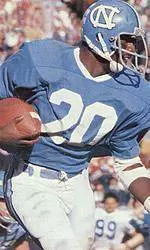
The most famous statistic from this 1980 team was the fact that both Lawrence and Bryant rushed for more than 1,000 yards. Lawrence, a senior, collected 1,118 yards on 4.9 yards per carry. Bryant, a sophomore, tallied 1,039 yards on 5.9 yards per carry.
But here are two fascinating but more obscure kernels from 1980:
"We won with defense and played smash-mouth football on offense," Elkins says today. "That was the right formula for that team. That was our identity. We had great linemen, great running backs. There was no need to do anything fancy."
Still, Elkins reflects on watching the last decade of Tar Heel football and seeing the likes of Mike Thomas, Chris Keldorf, Oscar Davenport, Ronald Curry and Darian Durant throwing for miles of yards and rues his timing.
"We had a great team and I loved it," Elkins says. "But sometimes I do think, `Couldn't we have thrown it just a little bit more?'"
Carolina ripped through its first seven games and climbed to No. 6 in the Associated Press rankings. The offense was productive and efficient, though short on fireworks.
The defense was dominating.
Furman scored two field goals and a long fumble return for a touchdown.
Texas Tech had one field goal.
Maryland had one field goal.
Georgia Tech was whitewashed.
Wake Forest had a field goal and a late-game TD.
N.C. State scored a late-game TD.
East Carolina scored one field goal.
"Our defense shut people down," says Elkins. "We had so much talent over there. There was not a single weakness on our defense."
The defense was built around Taylor, the linebacker who had burst on the scene a year earlier with a scary combination of speed, strength and ferocity. He shed some blockers like straw men. He pancaked others. He pounced on quarterbacks in the blink of an eye. He'd pound your fanny and run his mouth at the same time.
"I saw something from `LT' I'd never seen before," Marcin says. "We were playing at Texas Tech that year, defending the option. He goes down the line, checks the fullback, who didn't have the ball. So then he goes to the quarterback, who does have it. He hits the quarterback, causes a fumble and then recovers the fumble. We called it `The Trifecta.'"
The Tar Heels were primed for a Nov. 1 visit to Oklahoma and hoped they were catching the Sooners in an off year. Barry Switzer's team had lost twice and was ranked 16th. But two early signals were menacing for the Tar Heels' fortunes.
One, Switzer couldn't get Crum's name correct, confusing him with the Louisville basketball coach.
"The first time I talked with Barry, he called me Denny," Crum said. "I thought, well, maybe he just has other things on his mind. But he called me Denny eight times."
Two, the fleet "Famous Amos" was caught from behind on a 61-yard run on the Tar Heels' second offensive play.
"I saw that and said, `We are in trouble,'" Streater says. "That never happened. Amos was never caught from behind."
Carolina played OU close for a half, trailing only 14-7 at intermission and letting two scoring threats dissolve. Tight end Mike Chatham, normally sure-handed enough to have snared eight TDs as a junior, suffered a concussion that no one knew about and dropped a TD pass. Elkins threw an interception. The Sooners, with quarterback J.C. Watts running the Wishbone offense, exploded in the second half. They scored three touchdowns in the third quarter while the Tar Heel offense had the ball for six snaps total.
"One minute it was 14-7 and the next minute it was 34-7," Taylor said. "Everything went wrong that could go wrong."

Sturdivant remembers finishing a block and having his Sooner opponent help him up, all the while laughing.
"I said, `Hey, what's so funny?'" Sturdivant says. "He said, `Man, this is just not your day. We're not this good.'"
Oklahoma collected a 41-7 victory and sent the Tar Heels back to the ACC.
"The good news is, no one got hurt," Crum said the next week. "Our only serious injury is a bruised ego."
The Tar Heels rebounded the following week in Clemson's Death Valley for a 12:30 regional TV appearance. The defense limited Clemson to two Obed Ariri field goals in the first half, and with Lawrence and Bryant each gaining more than 100 yards, Carolina took a commanding 24-6 lead into the fourth quarter. The Tigers found a spark in the fourth quarter, scoring two TDs to cut the margin to 24-19. They were forced to punt with just over three minutes to play, but a short, low kick took a nasty bounce and hit Tar Heel Rocky White. The "fumble" was recovered by the Tigers at the Tar Heel 38 with 3:18 to play.
Clemson drove to the 1 yard-line with less than two minutes to play. Twice the Tigers pounded the middle for no gain. Then they tried a play-action pass and Taylor was unblocked and nailed Jordan for a nine-yard loss.
"The guard forgot to pull and I had a clean shot at the quarterback," Taylor said.
Streater then jumped into the face of each Tar Heel in the fourth-down huddle.

"These are our rings," Streater screamed, looking every Tar Heel in the eye. "No one else is going to get them. Step up, strap it on. They are not going to get in the end zone. Do exactly what you are supposed to do and don't try to do anyone else's job."
"There were only 11 people in that stadium who thought you guys would keep them out of the end zone," the father of sophomore cornerback Greg Poole told his son later. "And those were the only ones who mattered."
Jordan took the snap, rolled out to the left, away from Taylor, was hurried by a six-man Tar Heel rush and threw wide to receiver Jerry Gaillard in the left corner of the end zone. The Tar Heels ran the clock out and had the inside track to win the league title. They dispatched Virginia and Duke the following weeks and collected their fifth ACC title since the league's inception in 1953.
They have not won one since.
"Lord, what a team," Streater says today. "I loved the fellas. That's what I called them, `The fellas.' When we stepped on the field, everyone was on the same page. We'd knock your mouthpiece out. I called it `cow-pasture football,' just a bunch of guys out having fun."
The fellas, some 50 of them, will gather at halftime Saturday to be recognized for the ACC title they won 25 years ago. Crum, retired and living in Ohio, was invited to join them. He phoned Carolina Athletic Director Dick Baddour to respectfully regret, saying he preferred the players get the spotlight. Indeed, it's high time this era of Tar Heel football gets center stage after lurking in the shadows for far too long.
Send your questions about Tar Heel football to Lee Pace at leepace@nc.rr.com . Questions may be used either in Friday's TarHeelBlue.com mailbag or in a special pregame segment on the Tar Heel Sports Network on Saturday. Please include your first and last names and hometown. Individual replies are not possible because of volume of mail received, and names of recruiting prospects and commitments cannot be published on a school-sponsored site until the national signing day in February. The Q&A column will appear each Friday during the season.