University of North Carolina Athletics
Lucas: UNC Basketball Mailbag Dec. 13
December 13, 2005 | Men's Basketball
Dec. 13, 2005
By Adam Lucas
Last week's discussion on finding a formula for a "safe" lead in the closing minutes of a game prompted numerous responses. One of our favorites was from Tar Heel superfan David Culp, who writes:
My parents developed a theory in the early/mid-70s called "points and minutes." The basic premise was that if at any time in the 2nd half, the margin that Carolina led an opponent by was greater than the number of minutes remaining in the game, Carolina would win. This only applied if there were more than five minutes left in the game. I can remember watching many games when, during a particularly stressful situation, one of the three of us would calmly say, "points and minutes," and the other two of us would look, and sure enough, Carolina would be up by eight with seven minutes to play. The tension would immediately leave the room and we would all sit back and relax. Now I don't have any stats to back this up and I'm sure it didn't work all the time, but I would bet that we were 99% accurate - put it this way, I have no recollection of any game that the points and minutes theory didn't work. Unfortunately, once the 3-point shot and the shot clock became a permanent part of college basketball, the theory died. We tried different variations, but nothing came close to matching the success rate of points and minutes.
Does anyone have anything close to "points and minutes" these days? The sanity of a nation of Tar Heel fans depends on you. Maybe you have to know Culp, but the image of a family sitting around the TV sweating out another Carolina game only to sigh with relief when the words "points and minutes" are mentioned is a great one.
Saturday marks the game that Jared and Amy Henry, our Carolina basketball mailbag holiday fans, will attend. They'll be in Sec. 133, row 1, seats 7 and 8. That's the baseline seats nearest the visiting bench. Stop by and say hello if you can, because we'd love to show them some Tar Heel hospitality. Special thanks to Hampton Inn at 54 and 40, Chapel Hill Sportswear, Woody Durham, the Carolina basketball office (especially Eric Hoots), Prime Only steakhouse, Eric Montross, Jones Angell, Steve Kirschner, Capital Style Limo, and the many other people who are combining forces to make this weekend special for Amy and Jared. It should be one of the all-time great Carolina weekends and we'll have more details in next week's Mailbag.
Wes Miller was a recruited walk-on and is off to a great start this season. So I was thinking who are some of the best walk-ons or recruited walk-ons in Carolina basketball history (Charlie McNairy, Brad Frederick, Pearce Landry, etc.)?
Jeremy Hardison, Wilmington
It all depends on whether you count football-turned-basketball players as true walk-ons. In our opinion, they don't really count--a walk-on is someone who is paying his own way, and that wasn't the case for players like Julius Peppers, Ronald Curry, or the ever-popular Jesse Holley (That reminds us that it's time for the Official Holley Update: he's not playing hoops. So the Tar Heels will just have to get by with the group that got them to 5-1.).
So if we eliminate those guys, Pearce Landry probably heads the list. The Greensboro native came in as a Morehead scholar and played a very important role on the 1994-95 team, when he was essentially the seventh man. He started two games that season, averaged over 15 minutes per game, and shot 40 percent from the three-point line. Charlie McNairy also started two games during his senior season, 1997, but his minutes per game were significantly less than Landry's.
The great thing about walk-ons is that they're almost always lifelong Carolina fans who are living a dream. In most cases they have a much greater appreciation for the role Tar Heel basketball plays in the lives of fans than scholarship players. Of course, no discussion of Carolina walk-ons would be complete without a mention of the Everett brothers (Charlie, Jim, and Joe), who still hold the record for most family members playing for Carolina, and Scott Williams (not tall Scott, normal-sized Scott), who can always hold it over his dad's head that he scored way more points at Carolina than his father--8 for Scott, 0 for Roy.
By the way, does anyone remember James Daye? He was a two-year walk-on who graduated in 1986 and gave one of the best senior speeches at the Carolina basketball banquet we've ever heard.
Why don't the Tar Heels (2 words, thank you) wear the same shoes as a team? Is it asking that much? Keep in mind I am not an old fuddy-duddy that sits around in my white trousers and complains about the government, but rather a "young" 37 and it still bothers me to no end. Jeefers.
Against St. Louis, David Noel appeared to be wearing shoes that were more black than white and the rest of the team looked like they were wearing different variations of a mostly white shoe. It looks tacky and the team would look better and more uniform if they all wore the same shoe. With NCAA rules and regulations that don't allow a player to receive a Big Mac without incurring the wrath of the NCAA penalty Czar, there's no way they have individual player shoe contracts, so what gives?
Jeff Johnson, Medina, OH
Until the past couple years, we never realized how much attention people pay to the shoes Carolina wears. Not just the brand, but the style, color, shoelaces, sole pattern, and everything else. We also never realized "Jeefers" was a word, but we kind of like it.
The Tar Heels are, of course, outfitted by Jordan Brand. Every season, the company ships a selection of shoes to Carolina. Players pick the styles and fit that best suit their game. There is no specific "team shoe," because players have the freedom to pick what they like within the Jordan Brand family. Some players change frequently while some hardly ever change. Sean May had a pair of Jordan XIX's that he almost wore a hole in last year.
The specific shoes you're mentioning--the ones that look almost black--are worn by David Noel and Reyshawn Terry. In reality, they're navy, and the model is an Air Jordan retro XIII. Don't bother trying to find them in stores, as they were produced in very limited numbers. The shoe the majority of the team wears--including Tyler Hansbrough and Bobby Frasor--is the Jordan Team Reign.
And as long as we're talking about shoes, we've got to give some credit to Wes Miller. He's the only Tar Heel wearing the Jordan Work'm and we really like them. That particular style reminds us of the Air Jordan II's that used to be the coolest shoes on the block (there, we showed our age, is everyone happy?).
At the end of the Kentucky game, when Carolina had a ten point lead, it appeared that the strategy was to allow Kentucky to come down count unimpeded and score, with no attempt to defend them. I assume Roy figured out that there was not enough time for Kentucky to score enough points to tie or go ahead, and the refs were favoring Kentucky with their calls to such an extent that it was too risky to try to guard them, since a foul would potentially give them points in addition to stopping the clock. Is it true that they were told not to even try to defend there at the end?
Frank Bynum, Charlotte
At that point in the game, Carolina preferred for Rondo to shoot two-pointers instead of three-pointers. So Williams had told his team to prevent the three and not foul. They misinterpreted that as not fouling under any circumstance and allowed the Kentucky guard a clear path to the basket on several occasions. A Roy Williams team will never be told, "Don't try to defend." Chalk it up to a learning process for a very young team, as they simply executed poorly in the closing minutes.
Speaking of dunks from last weeks mailbag, Noel's at UK was nasty. I mean NASTY! It was a game breaker. I yelled so loud I scared my 3-month old daughter and had to walk her around the living room the rest of the game. I was wondering if you would give us your top-5 dunks. I know it's hard, but you guys do well with these types of questions. The ones I recall, and I'm only 28 years old, are Stack's on Cherokee Parks at Cameron, and his on the Virginia Tech guy in the Pepsi Challenge in Charlotte. George Lynch's in the 93 championship game on the inbound lob was great, as well as Rasheed's lob dunk on Duke his freshman year. The ESPN announcer introduced it as "and then it happened." Lastly, Scott Cherry dunking on Duke allows me to rag Devil fans even today about it. I am too young to remember MJ, Worthy, and Smith well, so I know you guys (and girl) can do better than me.
Allen Adeimy, Laurinburg, NC
You're trying to start a fight, aren't you, Allen? We'll be honest: we started out trying for a top five but eventually had to expand it to ten. There are simply too many memorable ones to limit it to five.
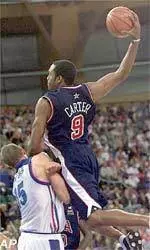
OK, there are three that have to be on this list without any discussion: Jordan's rock-the-cradle at Maryland in 1984, Stackhouse at Duke in 1995, and Vince Carter over Tim Duncan in 1997. We're not accepting any dissenting opinions about those dunks. Jordan's wasn't necessarily on anyone, but it was the first time anyone had really seen anything like that and it punctuated yet another Tar Heel win at Cole Field House over Lefty Driesell. There's no explanation needed on the Stackhouse jam. And to fully appreciate the importance of Carter's slam, you had to live through the Tim Duncan era at Wake Forest, when it seemed that at any moment he might walk off the basketball court and across water. Wake thought they were ascending into the top echelon of college basketball, and Carter's vicious dunk was a vivid reminder that Carolina wouldn't cede the crown easily.
It's worth defining the terms here--what makes a great dunk? Does it have to be over someone, does it have to be creative, does it have to be powerful?
It didn't rate very highly on the style meter, but Dudley Bradley's steal and dunk against NC State in 1979 has to be on here. We'd venture a guess that to Carolina fans of a certain age, this is the Tar Heel dunk they most remember. Carolina had blown out to a 40-19 halftime lead in this game, but State came back and led 69-68 with 10 seconds left. Remember, this was at Reynolds Coliseum, perhaps the toughest place to play in ACC basketball history, so the old barn was rocking. But then Bradley picked the pocket of Clyde Austin and cruised in for the game-clinching dunk, turning the gym from raucous to dead silent in the span of just a few seconds. If this game were played today, in the era of constant replays and national highlight shows, it would be an instant classic. Michael Jordan's dunk against Virginia in 1983 goes in this same category--he stole the ball from Rick Carlisle and soared in for a one-handed game-clincher.
That's five. We'll let you choose one of David Noel's two best--either his transition jam over Casey Sanders during his freshman year or the one-hander against Kentucky on Dec. 3. Either is a worthy choice.
Speaking of Worthy, he has to be on here. The fast break dunk over Sleepy Floyd ("It was Gastonia against Gastonia," as Woody Durham called it) in the 1982 championship game is a classic. It should be mentioned more often in these discussions. In some of these dunks, the dunked-on party tried to get out of the way. Sleepy didn't try to get out of the way. He just got in the way.
We've got three left. Julius Peppers against Wake Forest in 2001 is a requirement, if only because of the reaction inside the Smith Center. As soon as he slammed it through off the pass from Ronald Curry, every fan in the building went, "Whoooo." Then Wake Forest made the mistake of calling timeout, so it was replayed on the giant video boards. And replayed again. And again. Every time it was shown, the "Whooo" got louder and louder.
We'll give Marvin Williams a place on here, but not the one against State or the one against Oakland in NCAA play. Instead, we nominate his power jam over 6-foot-10 Alexander Johnson last year at Florida State. Because it happened in Tallahassee, a lot of people don't appreciate the ridiculousness of this dunk. It happened right in front of the FSU bench, and even the jaws of some of the Seminoles dropped. And we're going back to Carter for number-10, and it's not even a made dunk. It's his miss on a pass off the backboard from Ed Cota against Duke in 1998. Had this play worked, they would've had to repair the Smith Center roof. As it was, it still was one of the most memorable plays from one of Carolina's best teams.
Honorable mention: Rasheed Wallace at Duke in 1994 off the alley-oop, Stackhouse against Virginia Tech in Greensboro (one of the most explosive Carolina plays ever), George Lynch against Florida State in 1993, Antawn Jamison against Roshown McLeod in the 1998 ACC Tournament final, and too many others to mention. We'll try and include a few reader favorites not mentioned here in next week's column.
In the past, I seem to remember that if the ball hit the top of the backboard, that the officials would blow the whistle and call it out of bounds. I can remember two instances this year when that did not occur. Is my memory defective, or has the rule changed?
Roger Gant, Burlington, NC
The ball has to hit the shot clock to be out of bounds. In the instances you're remembering, the ball actually hit the top of the backboard. Here's the twist: if the ball passes over the top of the backboard, it's out of bounds. So the edge of the board is in play, but the airspace above it is not.
Brownlow's Down Low
How often has the AP preseason #1 won the national championship, or even made it to the Final Four? With so many X-factors that early in the
year and prevalence of upsets within the tournament, it'd be interesting
to see how accurate they are.
Mell Perling, Atlanta, GA
Lauren writes: The AP poll began during the 1948-49 season, and it was only a regular season, top-20 poll. It began preseason rankings before the 1961-62 season and shrank down to the top 10 teams. It expanded back to a 20-team poll in the 1964-65 season, and again to 25 teams in the 1989-90 season.
Since the preseason rankings began, the 44 No. 1's included 12 national champions, eight runners-up, and three that made it to the first round of the Final Four. So, about half have made it to the Final Four, which is not bad. The group is rounded out by six Elite 8 finishes and three Sweet 16 finishes. Of the five preseason No. 1's to lose in the second round, Connecticut was the most recent as they were knocked out in 2000 by Tennessee. The Kansas loss to Bucknell last year made them the most recent of the four preseason No. 1's to lose in the first round of the NCAA tournament. Three preseason No. 1's have missed the tournament altogether, the most recent being the 1974-75 N.C. State team the year after their national championship. (Note: Obviously, I'm not counting this year's preseason No. 1, which would be the 45th, Duke.)
Carolina's first showing in the preseason poll was in the 1964-65 season when they were slotted at 13th. The Heels tied for second in the regular season of the ACC and finished with an admirable 15-9 record in Dean Smith's fourth season.
The 1966-67, 1967-68, 1968-69, and 1976-77 Tar Heel teams were slotted in the preseason poll at 9, 4, 2, and 3, respectively. All four Tar Heel teams reached the Final Four. The lowest preseason ranking of a Carolina team that made the Final Four was 13 (1980-81).
The 1969-70 Tar Heels were ranked No. 7 in the preseason poll, but only managed a first round NIT appearance. The 1973-74 Tar Heels were slotted No. 5 in the preseason, and suffered the same fate. In contrast, the 1970-71 Tar Heels were not ranked in the preseason poll, but finished first in the ACC regular season with a 26-6 record and were NIT champions. (This, of course, was back in the day where the NCAA field was a comparatively meager 24 teams, making the NIT a bit more respectable. Also, the Heels lost in the finals of the ACC tournament to South Carolina, so their 52-51 loss left them literally one point away from the NCAA tournament.)
Carolina has been the preseason No. 1 five times. Here's how they did:
1977-78 - The Heels were knocked out in the first round of the NCAA tournament by San Francisco, but they finished 23-8 and were ACC regular season champions.
1981-82 - We all know how this season ended! ACC regular season champs, ACC tourney champs, and NCAA tournament champs. This is the only season that a Tar Heel team with the preseason No. 1 ranking would win the national championship.
1983-84 - The Heels made it to the Sweet 16 of the tournament, but were knocked out by Indiana. They were 28-3 overall with a 14-0 record in ACC play.
1986-87 - Kenny Smith and company went undefeated in ACC play and went 32-4 overall, but one of those four losses was in the Elite 8 of the NCAA Tournament to Syracuse, who would go on to lose in the championship game.
1993-94 - If I've said it once, I've said it a thousand times...that team was a Derrick Phelps concussion away from a repeat. The aforementioned incident cost the Heels a second-round loss to Boston College, ruining their chances to repeat. The Heels finished with a 28-7 overall record, tied for second place in the ACC regular season and had just won the ACC tournament championship.
The 1992-93 championship team was ranked 7th in the preseason, while last year's national champions were ranked fourth.
As for the status of defending national champions - 18 were ranked as the preseason No. 1 the following year, four at No. 2, six at No. 3 and four at No. 4. Four were picked to be No. 5-8, and four were ranked 10th or lower. Now, for the place where the Heels find themselves - unranked following their national championship. They join four other teams: Michigan State after their 1979 championship, N.C. State (1983), Villanova (1985) and Kansas (1988).
Did those teams prove the preseason prognosticators wrong? Well, neither the 1979-80 Michigan State squad nor the 1983-84 N.C. State team made the NCAA tournament the following year. Villanova made it in 1986, but lost in the second round. Kansas was neither ranked nor an NCAA tournament participant in 1989 because of their three-year probation for recruiting violations imposed after their championship.
But don't count the Heels out yet. Carolina is the reigning national champion until a different team is standing on that podium on April 3. I would not dare predict anything for this year's Tar Heel team - but, just so you know, that Villanova team that beat the mighty Hoyas for the championship in 1985 was also unranked in the preseason poll.
Wow, I got a chill just typing that.
Adam Lucas is the publisher of Tar Heel Monthly and can be reached at alucas@tarheelmonthly.com. He is the coauthor of the official book of the 2005 championship season, Led By Their Dreams, and his book on Roy Williams's first season at Carolina, Going Home Again, is now available in bookstores. To subscribe to Tar Heel Monthly or learn more about Going Home Again, click here.