University of North Carolina Athletics
Lucas: Breaking Down the Syracuse Region
March 13, 2005 | Men's Basketball
March 13, 2005
By Adam Lucas
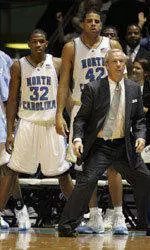
The brackets are out and you're pondering Carolina's potential opponents. To give you a head start on your tournament preparation, we've prepared capsule looks on every team in the Syracuse region. Strengths, weaknesses, records, we've got it all. But first, some words from Roy Williams on the NCAA Tournament:
"I am extremely happy for our team. Earning a No. 1 seed is truly a reward for a fantastic season. I am pleased we are playing in Charlotte because it means more of our fans will be able to watch us in person. Although it sure does give me some problems with all the ticket requests we'll get! The NCAA Tournament is always exciting and we have a huge challenge ahead of us. We don't look at the bracket as a whole. We are focused on the next game and the next opponent. It's a great time for college basketball fans. Our players were excited about the draw and looking forward to the start of the NCAA Tournament. I am extremely happy for our seniors to make it to the NCAA Tournament two years in a row after enduring a difficult first two years. I am proud of them."
On to the rest of the field...
#2 seed: Connecticut
Record: 22-7, 13-3 Big East
How they got here: Connecticut lost 67-63 to Syracuse in the Big East semifinals, their first loss in their last eight games.
Team strengths: Height, height, and height. The Huskies blocked 16 shots against Carolina earlier this year but still lost the game. Rashad Anderson did not play in the January matchup in Hartford against UNC--he played 20 minutes against Syracuse in the Big East tournament and is working his back way into healthy form. Like Kansas, UConn is one of those teams that has a realistic chance to win the national title.
Team weaknesses: Behind Marcus Williams there isn't much ball-handling.
Postseason history: Plenty. The Huskies won the national title last year, went to the Sweet 16 in 2003, and advanced to the final eight in 2002.
Best wins: 81-76 over Villanova, 74-66 at Syracuse, 88-70 over Syracuse.
Storyline: It's one of those situations Dean Smith never liked, an opportunity for a team that lost to the Tar Heels during the regular season to get redemption. Jim Calhoun and Roy Williams are close friends, something that will be played up if they meet in a regional final.
#3 seed: Kansas
Record: 23-6, 12-4 in Big XII
How they got here: Kansas lost two of their last three games, including the Big XII semifinal to Oklahoma State. The Jayhawks started hot but lost 5 of their last 8.
Team strengths: Inside play, behind Wayne Simien. KU is a well-rounded team that is one of the handful of squads with a realistic chance to win the national title.
Team weaknesses: The Jayhawks aren't very deep--the fifth-leading scorer is walk-on Christian Moody.
Postseason history: Plenty. Final 8 last year, national championship game in 2003, Final Four in 2002.
Best wins: 81-70 over Pacific, 70-68 over Georgia Tech, 65-59 at Kentucky, 90-65 over Texas, 81-79 over Oklahoma State.
Storyline: Do you have to ask? This is a CBS special, right up there with the way Indiana was placed into Dean Smith's path in 1997 when it looked like the Tar Heels would have to beat Bob Knight in Smith's Rupp-breaking win. That one never came to fruition. This one might, and if it does it will be an exceedingly difficult game for Roy Williams.
#4 seed: Florida
Record: 23-7, 12-4 in SEC.
How they got here: The Gators climbed up the bracket as they ran through the SEC Tournament. Florida was inconsistent early--including head-shaking losses to Tennessee and Florida State--but has won seven games in a row, the longest current winning streak of any team in the top half of this bracket.
Team strengths: Anthony Roberson is a scorer and Matt Walsh is a versatile swing man. Carolina recruited forward David Lee very hard.
Team weaknesses: Point guard play isn't stellar--no one on the roster has more than 71 assists.
Postseason history: Lost in first round last year, lost in second round in 2003, lost in first round in 2002.
Best wins: 85-54 over Alabama, 53-52 over Kentucky, 68-62 over Alabama, 70-53 over Kentucky (all those wins came in the past 36 days).
Storyline: Florida enters as one of the hottest teams in the bracket. But they'll encounter questions about their postseason toughness until they win a couple games and erase the memories of recent NCAA Tournament struggles.
#5 seed: Villanova
Record: 22-7, 11-5 Big East
How they got here: The Wildcats were one of the hottest teams in the country (8 straight wins) until their Big East tournament upset loss to West Virginia.
Team strengths: Four of their five leading scorers are guards. But they hold a rebounding average of over 5 per game over their opponents and are sticky defensively--opponents shot just 39.6 percent against them this year. All of Villanova's losses (Temple, at Notre Dame, Georgetown, at Boston College, at Connecticut, Syracuse, and West Virginia) are respectable. Forward Curtis Sumpter is the second-leading scorer and a capable three-point shooter.
Team weaknesses: Point guard Mike Nardi is solid but not spectacular. The health of his ankle (he returned to the starting lineup against St. John's after missing some time with a sprained ankle) is important.
Postseason history: Haven't made the NCAA Tournament since 1999.
Best wins: 83-62 over Kansas, 76-70 over Boston College.
Storyline: The Wildcats are likely to be a popular sleeper pick. They are guard-heavy, which traditionally is a solid indicator for the postseason.
#6 seed: Wisconsin
Record: 22-8, 11-5 Big Ten
How they got here: Wisconsin played Illinois close on two occasions and won five in a row before falling to the Illini in the Big Ten tournament.
Team strengths: Tempo, tempo, tempo. The Badgers haven't scored more than 77 points since Dec. 27. Wisconsin is a physical defensive team (opponents scored just 60.7 points per game against them) and a capable outside shooting team (39.4 percent from the 3-point line).
Team weaknesses: The rest of their shots don't fall very frequently. Wisconsin hit just 44.9 percent of their field goals. Their two leading scorers are forwards and guard play is not a strength.
Postseason history: Lost in second round last year, lost in final 16 in 2003, lost in second round in 2002.
Best wins: 62-59 over Michigan State, 76-62 over Alabama, two wins over Iowa.
Storyline: Wisconsin plays a unique style that can be difficult to prepare for. Impatient teams will struggle against them.
#7 seed: Charlotte
Record: 21-7, 12-4 in Conference-USA.
How they got here: A third-place overall finish in a good conference earned them an at-large bid.
Team strengths: The 49ers have some raw talent--Curtis Withers and Eddie Basden both made the all-conference team. Basden is a very tough defender.
Team weaknesses: Charlotte has been extremely unpredictable. They've beaten Cincinnati but lost to Rutgers, ECU, and South Florida. They closed the season on a 3-game losing streak. Rebounding and team defense are not strengths.
Postseason history: Lost in first round last year, missed tournament in 2003, lost in first round in 2002.
Best wins: 91-90 over Cincinnati, 91-85 against UAB.
Storyline: First-round matchup against NC State is another CBS special. The question will be whether Charlotte gets up enough for an in-state ACC foe to solve their recent slump.
#8 seed: Minnesota
Record: 21-10, 10-6 in Big Ten.
How they got here: Five straight late wins and a victory over Indiana in the Big Ten tournament cemented their at-large bid.
Team strengths: Head coach Dan Monson has created a team of overachievers who were picked to finish low in the Big Ten but sported a 20-9 record. The Gophers try to play a tough, gritty style that allowed just 63.9 points per game this year. They led the Big Ten in steals with 9.4 per game. 6-foot-11 center Jeff Hagen is a nice complement to leading scorer (and Charlotte native) Vincent Grier.
Team weaknesses: No one on the roster has an assist/turnover ratio above 1.3.
Postseason history: Haven't made the NCAA Tournament since 1999.
Best wins: 60-50 over Wisconsin, 65-57 over Iowa.
Storyline: Dan Monson is a tournament-proven head coach. Now, can he do it at Minnesota?
#9 seed: Iowa State
Record: 18-11, 9-7 in Big XII
How they got here: A strong finish overcame a 6-game losing streak in January. The Cyclones boast wins over both Kansas and Oklahoma.
Team strengths: Iowa State is guard-heavy, including leading scorer Curtis Stinson.
Team weaknesses: Will Blalock is usually steady but the Cyclones were undone in the Big XII tournament by turnovers--they committed 17 against Texas Tech. Only one player on the roster shoots better than 34 percent from 3-point range.
Postseason history: Haven't made the NCAA Tournament since 2001.
Best wins: 74-66 over Oklahoma, 92-80 over Texas, 63-61 over Kansas.
Storyline: Impressive wins over quality teams but some head-shaking losses. Which is the real Iowa State?
#10 seed: NC State
Record: 19-13, 7-9 in ACC.
How they got here: A win over Wake Forest in the ACC Tournament quarterfinals cemented their at-large bid.
Team strengths: When their offense is clicking--as it was against Wake--State is a beautiful team to watch. Ilian Evtimov has been hot from the perimeter and Julius Hodge is one of the few players in a Princeton-style offense capable of scoring one-on-one.
Team weaknesses: When their perimeter shots aren't falling, they're very beatable. Hodge can sometimes try to do a little too much.
Postseason history: Lost in second round last year, lost in first round in 2003, lost in second round in 2002.
Best wins: 76-68 over Georgia Tech, 53-51 over Georgia Tech, 81-65 over Wake Forest.
Storyline: State has to beat Charlotte first, but then they could be staring at a rematch with UConn, which eliminated them in a controversial finish in 2002.
#11 seed: Northern Iowa
Record: 21-10, 11-7 in Missouri Valley.
How they got here: They're one of the most controversial at-large teams in the field of 65. Their win over Southern Illinois on Feb. 5 probably made the difference.
Team strengths: Northern Iowa will fire away from the perimeter--they made 222 trifectas this season. Three players in the rotation shoot better than 40 percent from beyond the three-point line, led by Ben Jacobson at 45.3 percent (on an impressive 150 attempts).
Team weaknesses: The Panthers didn't finish strong, including blowing a 44-37 lead against Southwest Missouri State in the MVAC quarterfinals. They're not very tall, as 6-foot-8 Grant Stout is their tallest player and best rebounder.
Postseason history: Lost in first round last year.
Best wins: 67-61 over Southern Illinois, 67-66 over Wichita State.
Storyline: Does a 3-point happy team translate into a popular upset pick?
#12 seed: New Mexico
Record: 26-6, 10-4 in Mountain West.
How they got here: Won the Mountain West tournament.
Team strengths: The Lobos are riding a 9-game winning streak and are 9-1 since all-conference forward Danny Granger came back from a knee injury. Granger had 28 points and 11 rebounds against Utah in the conference tournament championship game. Three players shoot better than 40 percent from three-point range, including marksman Troy DeVries at 47.3 percent. The Lobos are balanced--five players average in double figures.
Team weaknesses: At 6-foot-8, Granger is the best inside player.
Postseason history: Haven't been to the NCAA Tournament since 1999.
Best wins: A pair of wins over Utah (65-54 and 60-56).
Storyline: Granger's return makes the Lobos dangerous, but they aren't NCAA Tournament-proven.
#13 seed: Ohio
Record: 21-10, 11-7 in Mid-American.
How they got here: Won the Mid-American tournament.
Team strengths: Ohio closed by winning 8 of their last 9 games. Guard Mychal Green is a versatile scorer.
Team weaknesses: They're inexperienced--the Bobcats haven't been in the NCAA Tournament since 1994--and three of their top four scorers are freshmen or sophomores. Ohio isn't particularly good from the perimeter. They rely on a freshman point guard (Jeremy Fears) who has been erratic, with 111 assists and 102 turnovers.
Postseason history: Haven't made the NCAA Tournament since 1994.
Best wins: Three wins over Buffalo and 63-56 over Miami-Ohio.
Storyline: Can they become the latest team to spring an early-round upset on Florida?
#14 seed: Bucknell
Record: 22-9, 10-4 Patriot League.
How they got here: Won the Patriot League.
Team strengths: They're led by a capable guard duo of Kevin Bettencourt and Charles Lee. Three of the starting five shoot better than 76 percent from the free throw line.
Team weaknesses: No Patriot League team has ever won an NCAA Tournament game. 6-foot-11 center Chris McNaughton is the only real inside presence.
Postseason history: The Bison haven't been in the NCAA Tournament since 1989.
Best wins: 69-66 at Pittsburgh, 61-57 over Holy Cross, 59-43 over Holy Cross.
Storyline: Can the Patriot League finally win an NCAA Tournament game?
#15 seed: Central Florida
Record: 21-8, 13-7 in Atlantic Sun.
How they got here: Won the Atlantic Sun tournament with a 63-54 decision over Gardner-Webb.
Team strengths: The Knights are 12-1 in their last 13 games. Kingsley Edwards and Gary Johnson form a solid backcourt.
Team weaknesses: No one in the regular rotation stands over 6-foot-8 and the Knights aren't a good rebounding team.
Postseason history: Lost in first round last year.
Best wins: 55-52 over Utah State.
Storyline: Is this the 2005 Cinderella story?
#16 seed: TBD, Oakland (11-18) vs. Alabama A&M (16-13) on Tuesday.
Adam Lucas is the publisher of Tar Heel Monthly and can be reached at alucas@tarheelmonthly.com. His book on Roy Williams's first season at Carolina, Going Home Again, is now available in bookstores. To subscribe to Tar Heel Monthly or learn more about the book, click here.