University of North Carolina Athletics
Countdown to Kickoff: Middle Ground
August 17, 2005 | Football
Aug. 17, 2005
By Adam Lucas
Derrele Mitchell spoke cautiously, like a man who knew his time was coming. He was discussing the area of the field that sets receivers apart, the area where only a certain breed of wideout dares to tread: the middle of the field.
It's where many offenses find the biggest chunks of yardage. It's also where defenders make their biggest hits.
"I haven't really taken a hard hit over the middle yet," Mitchell says. "But I knock on wood when I say that. I've got a whole year to go and I know that chance is coming."
It comes more frequently for some than for others. Strength and conditioning coach Jeff Connors can make a receiver bigger. He can make them faster. He can make them more flexible.
But he can't make them more fearless, and that's the main ingredient required for someone willing to venture into the middle of the field.
"You've got to have confidence," says Jesse Holley. "You have to be willing to go in there and lay it all on the line. When you go over the middle you can expect a hit and you have to prepare your mind for it. I know a hit is coming. I don't know when, but I know it's coming. And I have confidence that I can take the hit and keep going. I have no fear going over the middle."
The turf warfare over the area between the hash marks is partly due to the fact that offensive players and defensive players can't seem to agree on who owns that particular section of real estate.
"It belongs to the offense," Holley says. "Why not?"
"The middle belongs to the defense," cornerback Bryan Bethea says. "That's where my help is, that's where I've got my linebackers and safeties."
"Nah," Holley says. "The middle belongs to us. We own it."
That's a debate that will be settled in practices yet to come, as Holley vs. Bethea is one of the most entertaining Tar Heel matchups in any one-on-one practice drill.
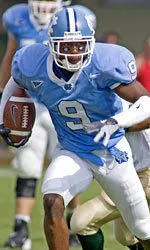
Both are authorities on the topic. Bethea is one of Carolina's most physical cornerbacks, a player who says it's his goal to hit so hard that opposing offenses try to run the ball away from his side of the field. And John Bunting says Holley is Carolina's best receiver over the middle, and the Tar Heel head coach--who has seen plenty of big hits in his four-plus decades in the game--says the shot Holley took last year in the Tire Bowl "is about as hard a hit as I've ever seen."
 |
Countdown to Kickoff: 24 Days
|
On that play, Holley survived a head-snapping blow and hauled in a 17-yard reception that gave Carolina a crucial 3rd-and-9 conversion. But the Roselle, N.J., native doesn't even rank it as the top hit he's absorbed in college.
"We were at Maryland my freshman year," he says, wincing just a little. "I caught a speed in and I think it was Madieu Williams who got me. He hit me so hard in the back that my mouthpiece came out, snot came out of my nose, and my brain went from the back of my head to the front of my head.
"I was laying on the ground and I wanted to lay there. I truly wanted to lay there and say, `Somebody come get me.' But then I figured it was over, so I should get up, go back to the huddle, and do it again. After that I figured nothing could be worse than that."
For the record, Holley made the catch.
Defenders take notice of receivers like Holley who bounce back up after taking a shot. Tar Heel defensive backs always screen film of upcoming opponents, and they pay special attention to each receiver's favorite routes. It takes just one game tape to reveal who is willing to venture over the middle and who prefers to stay close to the relative safety of the sidelines. Size sometimes matters in that equation, as Bethea says he tends to expect a bigger receiver to spend more time in the middle than a smaller one.
Receivers who own the middle can find the playbook opening up for them.
"Your attitude changes, the coach's attitude changes, and the quarterback's attitude changes," Holley says. "The quarterback knows he can squeeze it in there and be confident I'll come up with the catch and take the hit. And Coach is more willing to call those plays because he has a receiver who will go in there. I think Coach Tranquill and Coach Bunting and Coach Brock feel that way about me. They know I will go in there kamikaze and make the catch...You have to take a hit before you have that confidence over the middle. If you don't, you'll be tiptoeing and peeking the rest of your life. I've taken my share of hits. I'm not peeking and I'm not tiptoeing. I'm going to get up and play another down."
Adam Lucas is the publisher of Tar Heel Monthly and can be reached at alucas@tarheelmonthly.com. He is the coauthor of the official book of the 2005 championship season, Led By Their Dreams, and his book on Roy Williams's first season at Carolina, Going Home Again, is now available in bookstores. To subscribe to Tar Heel Monthly or learn more about Going Home Again, click here.