University of North Carolina Athletics
Countdown to Kickoff: The Right Way
August 23, 2005 | Football
Aug. 23, 2005
By Adam Lucas
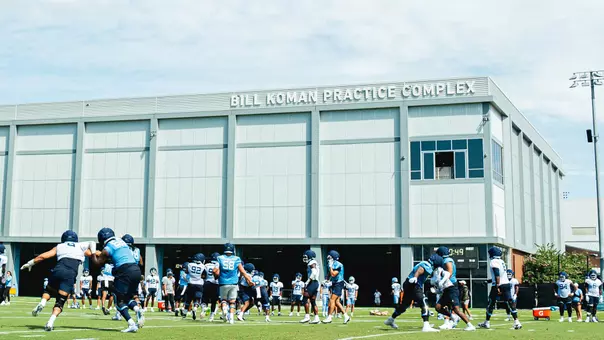
Training camp is essentially a series of instructional lessons repeated over and over again, sometimes at high volume.
But most fans never get to see those lessons. So we decided to ask the experts--Carolina's players, who hear the instruction every day (and sometimes twice a day) during training camp--the right way to do a variety of key football activities. Feel free to use their knowledge to amaze your buddies on game day. Just don't blame us if a coach starts yelling at you.
How to beat a doubleteam
"First you've got to get your sight, which means looking at the offensive lineman's feet. Every offensive lineman thinks they're good, but they're not that good. They have to move and they're not as quick as they think they are. His feet will tell you where he's going. His body will lie, but his feet will tell you the truth.
"Once the ball is snapped you've got to hit the guy you're lined up against. You feel the double team, drop your hips, and sink your butt. If I'm in the B gap, I get in the gap and hold onto that guard because the tackle is going to leave. As soon as he leaves and it's not a doubleteam anymore, shrug or rip off and make the tackle at the line of scrimmage or in the backfield."--Kyndraus Guy
How to block downfield
"You always have to think the play is going to break long. Even if the play isn't coming your way, you run downfield. To get down there, I've got to break his cushion, make him think I'm running a route, get close enough to him, and smack him. I like to use the home crowd to my advantage. If I'm blocking 20 yards downfield and I hear the crowd erupt, that means somebody is coming behind me.
"I look at leverage and look at what my man is looking at. If they're in man coverage, I can just run him off downfield. If he looks into the backfield, I know it's probably zone coverage. Then I have to attack him more quickly.
"When I'm about to make a block, I think in my head: this is going to be on the film session. It's great to go in and level a guy, especially when I catch a linebacker or lineman sleeping. You get credit for knocking over defensive backs, but when you get a piece of a lineman or linebacker, that's a great feeling. Coach Bunting always sees it and uses it in the film session. It's a great feeling when 129 guys see you take out a 250-pound guy. You just sit back and smile."--Jesse Holley
How to prepare for a third down
"If it's third and long you're excited. I look at the defensive line guys like, `Come on, let's go get this quarterback.' If it's third and short you're hunkered down because you know there's going to be a collision. As soon as I approach the line, I'm looking at the stance of the offensive lineman. I want to see if they're light, or if they're going to pull, or if I'm going to get double-teamed. I watch their eyes and hands and look at their splits and feet. Last year I didn't get to play, so I watched a lot of tape. There are a lot of things you can pick up from watching tape on people."--Chase Page
How to block a bull-rusher
"The right way is to get him blocked. You use technique first, but if it comes down to it, do anything to keep him off the quarterback. If it's a big, strong hard-rushing end, you want to set back and see him coming right at you. Then adjust and start cutting him more. Against a quicker guy, you have to be ready to move your feet more. You don't expect that type of guy to want to run into you because they don't have the weight on them, so you have to be ready to move inside or outside. It's all about keeping your base and never bringing your feet too close together or too wide. You have to keep your body in line, don't be hunched over, and have a good center of gravity. A huge part of offensive line is being able to move your feet. Think about it: the defensive lineman is running straight ahead and I'm backing up. It's harder than people think."--Skip Seagraves
 |
Countdown to Kickoff: 18 Days
|
How to set the defense
"We substitute people in and out, and while that's happening I'm looking at what the offense is bringing in. I want to see how many backs are coming in, where the passing strength is, stuff like that. Based on our defense I call where we're setting our front. If we call `strong left' we think the strength of their offense is to the left. Sometimes we'll call two or three defenses at the same time, so we have to be on the same page. I have to make sure everyone is in the right place. Then I start reading my keys. I look at the running backs and which way they're offset. I want to see a hint of where their eyes are looking. If the fullback is looking right, a lot of times he's going right."--Doug Justice
How to pick up a blitzing linebacker
"First, never stop your feet. You have to go meet him. You have to spot it before you can pick it up, so you've got to know your reads and know your man. You want to meet him either at the line of scrimmage or on his side of the line. You don't want to meet him in the backfield. You want to have balance--you don't want to be too square. Stagger your stance so he can't push you back. Meet him head-on, full speed, with no hesitation and good form."--Rikki Cook
How to hold for a field goal
"Kickers want the laces out. It's difficult, because usually if you're the holder you're not in the game, so you have to come in cold off the sideline. The snapper is really whipping it back there, because the sooner you get it, the sooner the kick is away. Greg Warren had learned how to snap the ball so that when I caught it the laces were automatically out. Connor (Barth) wants the ball straight up with no lean at all. If you get it down with the laces out and the ball straight up, he'll put it through 99 percent of the time."--Roger Heinz
How to catch a pass
"It sounds simple, but you've got to see it the whole time. At lower levels, they teach you to make a diamond with your hands. The ball fits into the diamond and can't slip past your hands. At this level, the important thing is to watch it into your hands. It is very important to make the catch before you tuck the ball away. But, once you've made the catch, you've got to tuck it away because there are going to be a lot of hands swiping at the ball. If you don't tuck it, there's a good chance it's going to get knocked out."--Del Roberts
How to play man press coverage
"When the receiver comes out, you look at his split. If he's outside the numbers, it's more than likely going to be an inside route. So you want to take away the inside route, and you line up inside him. Never look at his face. You stay locked on his hips because he can't go anywhere without his hips. You want to play on the balls of your feet. That way you can make sudden moves and be quick. Speed helps, but quickness is everything. If you're playing inside, you have to be confident that you're quick enough to get outside if he runs an outside route."--Bryan Bethea
Adam Lucas is the publisher of Tar Heel Monthly and can be reached at alucas@tarheelmonthly.com. He is the coauthor of the official book of the 2005 championship season, Led By Their Dreams, and his book on Roy Williams's first season at Carolina, Going Home Again, is now available in bookstores. To subscribe to Tar Heel Monthly or learn more about Going Home Again, click here.