University of North Carolina Athletics
The New Blue Heaven Standing Test Of Time
January 18, 2006 | Men's Basketball
Jan. 18, 2006
By Art Chansky, Special to TarHeelBlue.com
The Dean Smith Center has now sat in the southern-most point of campus for more than 20 years, taken for granted as the Tar Heels' basketball home since 1986. But during its construction and maiden years, what we all now know as the Dean Dome was the eighth wonder of the college sports world, a giant flying saucer from a Steven Spielberg movie, painstakingly erected like one of the great expansion bridges.
After Dean Smith's program exploded in the late 1970s, UNC administrators and trustees deemed cozy Carmichael Auditorium, the erstwhile Blue Heaven and home to the original Carmichael Crazies, too small to accommodate the Carolina constituency clamoring to support the Tar Heels with hard dollars, as well as their vocal cords. The state university, with then nearly 100,000 living alumni residing here, deserved an arena where more fans young and old could watch Coach Smith's juggernaut in person.
But the university figured it could not get the money from Raleigh, and did not want to burden the taxpayers anyway. So it embarked on what was then the greatest private fund-raising challenge in the history of college athletics. Smith, himself, led the effort with two since-deceased giants of the university community, Rams Club Executive Secretary Ernie Williamson and Hargrove "Skipper" Bowles, who in 1972 had come within a few votes of becoming the governor of North Carolina.
They called it their "traveling road show" with schematics and models provided by the architects. Coach Smith hated asking people for money, but he knew more fans wanted to see his team play and promised the biggest givers the best seats in the house. They secured pledges of more than $30 million, and appropriately a few months after winning his first NCAA championship Coach Smith donned a hard hat with donors and officials for the honorary ground-breaking. Each of the 21,800 future baby blue seats were reserved before a shovel hit the ground.
More than 150 workers made the ravine near Mason Farm Road their office for nearly four years. First, they blasted 20,000 cubic feet of rock from the hill where the Kenan Center and Kenan-Flagler business school now sit. They moved 150,000 cubic feet of dirt around. They poured more than 18,000 cubic yards of concrete and hauled in 1800 tons of arched steel to stretch across the 250,000 square foot roof. The great octagonal covered 7½ acres and measured 340 feet by 380 feet, the difference to accommodate the rectangular court that was laid over the spring loaded under floor.
Like a sphinx or Great Pyramid, it rose from the massive hole in the ground amidst gasps from people who came over the hill on Ridge Road or motored up Manning Drive. UNC was doing something no one had yet dreamed of in college basketball, an on-campus arena that was bigger than any other such facility and all of those used by NBA teams.
The rest of the ACC felt boondoggled by comparison - Clemson's literal Littlejohn, Georgia Tech's old round house, Virginia's already outdated U-Hall and Maryland's Cole Fieldhouse, which had been there since before Texas Western shocked Kentucky in 1966. The rest of the Big Four paled even more. Wake Forest still played in dark, dingy Memorial Gym, NC State in the elongated wind tunnel known as Reynolds and Duke in an antiquated bandbox they couldn't even fill in those days.
UNC scheduled the opening game for November, 1985, and invited UCLA across the country to play in the inaugural. The first official last game in Carmichael came on February 23, 1985, a 34-point win over hapless Clemson, after which Coach Smith answered a curtain call from the adoring crowd. The Tar Heels were moving to their new home.
That spring and summer, wet weather and construction delays put what was then called the Student Activities Center behind schedule. To everyone, it wasn't the glimmering ode to Coach Smith; nearby residents had groused over the incessant dynamiting, jack-hammering and trucks of all shapes and sizes rumbling to and from the site. Now, the news media was reporting alleged irregularities in the concrete that was poured to form the upper deck.
Faced with finishing the job right, UNC officials postponed the grand opening, and UCLA came to Carmichael instead (the Bruins were blown out by 37 points). They set a new inaugural date for what students had dubbed the Dean Dome, January 18, 1986 - against Duke! Another last game at Carmichael ended on January 4 with NC State coach Jim Valvano pulling Smith over to honor him with his "last basket" there.
"I can't out coach him; I plan to outlive him," Valvano said in what turned out to be tragic irony after his death from cancer in 1993.
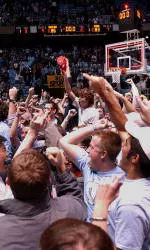
Carolina officially renamed the new arena the Dean E. Smith Center at a black-tie gala the night before the Duke game. The next afternoon, TV announcers Marty Brenneman and Billy Cunningham, both UNC graduates, sat courtside in tuxedos. The crowd settled in, having heard the jokes about bringing their own hard hats in case the concrete didn't hold. It did, of course, and the Tar Heels and Blue Devils played an NCAA Tournament-atmosphere game.
Facing the pressure of losing the opener in their new palace, and to of all opponents, the Heels protected their undefeated record and No. 1 ranking with a 95-92 win that wasn't as close as the score because Duke finished the game with a 7-0 run. Warren Martin had UNC's first basket in the Dean Dome and Steve Hale and Brad Daugherty combined for 51 points. Participants from both teams and attending fans have claimed it has never again been as loud. Tougher times for Carolina's new gem followed, both fiscally and perceptually. When upgrades and improvements were needed, the lifetime seat licenses owned by the relatively few donors who stepped up kept UNC from refinancing the building. Concerts and other events went to newer arenas with better parking and beer sales, killing those revenue streams, and then the state pulled back its annual allocation for maintenance.
And, as the regular seasons settled in, the atmosphere was deemed different than Carmichael. Noise rose toward the Teflon roof instead of bouncing off the concrete wall behind the old student section. The kids, themselves, were less of a factor, many of whom sat in seats mostly up and away from the court. Traffic and parking produced late-arriving and early departing crowds. Some opponents found it a little easier to win there than in the old three-sided gym.
On its 20th birthday, however, the Smith Center is fighting off obsolescence very well, thank you. Matt Doherty and Roy Williams reenergized the crowds over the past five years, the students are closer to the action and new video screens and LED boards are bringing the Dean Dome into the 21st Century. Parking remains a problem, but most fans have discovered that shuttle busses are the best way to and from games.
While some schools have built better, if not bigger, buildings, and others have refurbished and redefined their older gyms, the Smith Center remains a monument to the man whose name it carries and to all of the great teams that created the interest. Because of its size, tickets are easier to find from game to game, allowing even more fans to see their Tar Heels.
To everyone who has had that chance, it has become their new Blue Heaven.