University of North Carolina Athletics
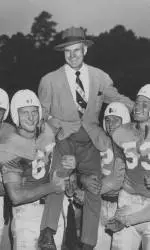
CAR-O-LINES: Justice Was The Major Star But Snavely Ran The Show
October 12, 2006 | Football
Oct. 12, 2006
by Rick Brewer, Sports Information Director Emeritus
They called him "King Carl", "The Gray Fox", "The Dutch Master" and "Mr. Single Wing."
But the title Carl Snavely preferred was a simple one. He liked to be called "Coach."
Considering how disciplined, innovative and organized he was, it was the right profession for him.
Snavely's memory comes up this fall as his 1946 Carolina team celebrates its 60th anniversary. That started a run of four years which most people still call the school's Golden Era of Football. More recent coaches--Bill Dooley, Dick Crum and Mack Brown-- have also had stretches of great success. None, however, have quite matched those seasons from 1946 to 1949.
Some fans regarded Snavely as an unfriendly man with no sense of humor. Perhaps that's because he was a taskmaster on the field, a man who paid such great attention to techniques, fundamentals and detail that he may have seemed to care about nothing but his work.
Those who knew him say that was far from the truth. He enjoyed being around people. He played golf regularly. Unfortunately, he played the game with the same precision he applied to football. His partners said he held everyone up with his slow play.
He may have been his most content at home on Tenney Circle with his wife, Bernice, and Barnaby, a huge balck German shepherd.
Snavely actually coached at Carolina on two different occasions. His first tenure lasted just two years. The Tar Heels were 7-1-1 in 1934 and 8-1 in 1935. He then went to Cornell where his 1939 team was undefeated and ranked number one in the country in some polls.
The following season Cornell was involved in a famous "fifth down" play. The top-ranked Big Red was again unbeaten, but trailed Dartmouth, 3-0, in the final minute. However, officials lost track of downs and Cornell was accidentally awarded an extra play. Cornell scored on that fifth down for a 7-3 victory.
Snavely discovered the mistake in reviewing game films. He asked his players to forfeit the game. They voted to do so and opened the door to Minnesota for the national championship.
When Carolina struggled during the World War II seasons, Snavely came back to rebuild the program. Some said his best coaching job might have actually been 1945, the first year he returned. That was a 5-5 season after the Tar Heels had gone 1-7-1 the previous fall. Three of those losses were by a combined 20 points.
Then came the glory years--32 victories in four seasons and three trips to major bowls. Snavely's teams ran the single wing, an offense as explosive as any of the spread attacks that are used so frequently today.
He had the right combination of players to execute such an intricate set of plays. Their names were well known nationally and still are familiar today--Justice, Weiner, Szafaryn, Powell, Rodgers, Pupa, Hazlewood...
Charlie Justice was the perfect fit to run such an offense. He was more than a triple-threat tailback because in addition to his ability to run, throw and catch, he was also one of the best punters in the nation.
However, make no mistake about it. Snavely was the man in charge.
In those years Snavely faced the unique challenge of blending returning war veterans who might be 21 or 22 years old with entering freshmen. But, those teams had great camaraderie. That was a tribute to the players themselves, but also to Snavely.
Unlike many coaches, Snavely didn't have teams meetings on Sunday or sometimes even Monday. He spent Sunday writing letters to all his players. Each player would find one waiting for him at his breakfast table on Monday, telling him what Snavely felt about his Saturday performance.
Snavely was able to do that because he spent a great amount of time watching game films. When youy hear coaches today say "I can't answer that until I see game film", you can partially blame Snavely. He was one of the first to use film in team preparation.
"I didn't know a thing about movies when I thought of the idea," he once explained. "At first we used 55-millimeter film, but it ran too fast. My first photographer was my wife and she was pretty good at it."
He watched film, day and night, at both the office and home. Friends would say that even on a late-night visit, they would often finding him watching game films with a huge bowl of vanilla ice cream in his lap and Barnaby at his side.
Ice cream was really his only vice. He didn't smoke or drink.
Snavely tried to emphasize to his players there was more to life than just football.
Mike Rubish, an end on those teams from the 1940's once talked about Snavely's concern for his players.
"I visited Coach Snavely after I returned from the war," said Rubish. "He wanted to know how I was doing in school. He said `Players and stars come and go. Get an education. You can't take a scrapbook with you.'"
Despite his interest in his players, Snavely was not a man who handed out praise easily. It wasn't until years after he left Chapel Hill that he called Justice the best player he had ever coached. Even then he hedged a bit saying Chuck Hinkle, who had played for him at Bucknell in 1929, was a close second.
Justice once told the story of the first time he met Snavely in January, 1946.
"Coach Snavely and Chuck Erickson, then an assistant athletic director, met my wife and I in High Point to go to lunch," said Justice. "Coach Snavely asked Mr. Erickson to sit in the back seat with Sarah so we could talk.
"He asked me how much I weighed and when I told him 155, he gave me a funny look. He didn't say another word to anyone else on the trip."
But, Snavely knew the talent Justice had. When a writer asked him how he felt when Justice announced he was coming to Carolina, Snavely gave his famous replay.
"I hope he comes out for football."
"King Carl" definitely had a sense of humor.