University of North Carolina Athletics
Extra Points: Unusual Week In Chapel Hill
October 30, 2006 | Football
Oct. 30, 2006
By Lee Pace
Extra Points
It was surreal week around the Tar Heel football program.
It began with a Sunday night missive from the Athletic Communications Office announcing that John Bunting would no longer be the Tar Heels' head coach following the 2006 season. It continued with a press conference Monday morning with Athletic Director Dick Baddour saluting Bunting's passion, heart and energy but saying it wasn't enough, that he would be looking for new leadership to a football program that had posted a 40-54 record over nine years and across the tenures of two head coaches since Carolina's rise to Top 10 status in 1996-97.
The week evolved with assistant coaches pledging to remain focused and upbeat in trying to send Bunting out a winner and give their players a modicum of pleasure in an otherwise heartbreaking season. "I just want to win a few games for that man," offensive coordinator Frank Cignetti said of Bunting. Added defensive coordinator Marvin Sanders, "Until the gun sounds at Duke, anything can happen. To win four straight in the ACC and finish 4-4 in the league sounds pretty good." Both coaches went home late at night to families with young children devastated their families might soon be uprooted.
Area newspapers were flush with stories speculating on the next Tar Heel coach. Bunting was feted with an outpouring of affection and emotion at his Thursday night radio program at a Franklin Street restaurant, and a boisterous tunnel of fans greeted the team and their embattled coach for their pre-game stroll through Polk Place toward Kenan Stadium. Rival coach Jim Grobe of Wake Forest said he had empathy for a fellow coach, his staff and their families, while at the same time worrying that the Tar Heels had the emotional chip in their favor and suspecting that Kenan Stadium could be a "hornet's nest" on Saturday.
Then finally at 3:30 p.m. Saturday, on a blustery but otherwise pristine day in Chapel Hill, they played football. Those who liked Bunting came to show their support. Those who didn't returned to Kenan Stadium to cheer the program and the players. What a spirited crowd of 49,000 saw was an entertaining game that showed a Carolina team playing loose, with fire and with some promise - but in the end making too many physical and mental errors. The 24th-ranked Deacons ran their record to 7-1 with a 24-17 victory secured with a Jon Abbate interception in the end zone on the game's final play.
"It would have been a great win for our players and great for my coaches," Bunting said. "I am really disappointed that we couldn't have enjoyed those types of rewards that are so fun when you work so hard in a week of preparation."
The Tar Heels' propensity to aid the opposition with turnovers, penalties and mental oversights continued in game No. 8. Quarterback Joe Dailey threw two interceptions. One came at the end of the first half and thwarted a potential Connor Barth field goal opportunity. The second followed on the game's last play when the Tar Heels sent receivers into the end zone corners on a double-fade pass, but Dailey felt something was open over the middle when in fact it was not. The soft spots of the Carolina secondary were exposed for touchdowns, one on a pass off a play-action fake and another on a reverse.
The punt protection operation broke down in the first quarter, with Wake Forest's Alphonso Smith blocking the kick, scooping it up and running for a touchdown. Carolina wasted a timeout in the second half when a field-goal block team member was late to the field; that timeout would have been valuable during the Tar Heels' two-minute drill late in the game. The Heels nailed Wake QB Riley Skinner for a sack in the second quarter, setting up a third-and-20 situation, but the play was nullified by an offside penalty, giving the Deacons a second-and-6 en route to a field goal.
"We came unglued a couple of times and did some things that really hurt us," Bunting said. "The ball was on the ground three times and we couldn't come up with any of them - twice when we forced fumbles and once when they dropped the ball. Turnovers and a blocked punt are hard to overcome."
"Those games are tough, especially that one," added Dailey, who alternated every third possession with Cam Sexton. "We were in that game the entire time. Once again, mistakes hurt us."
There were three elements to the Tar Heel offense that could be significant as the last month of the season plays out - the use of two tight ends, the two-QB rotation and the sturdy and productive effort the last two games of senior tailback Ronnie McGill.
Cignetti made frequent use of two tight-end offenses at Fresno State from 2002-05 and hoped to do so this season with Jon Hamlett and Richard Quinn, but Quinn's shoulder blade injury in August shelved that idea, and a hand injury to Rock Wells in the Virginia game further diluted Carolina's tight end inventory. With the Tar Heels struggling to get consistent performances from Dailey and Sexton in the passing game, Cignetti and the offensive staff decided last week to move red-shirt freshman tackle Andre Barbour to tight end and pair him frequently opposite Hamlett. The strategy helped the Tar Heels open room for McGill to eclipse the 100-yard mark at halftime and to control the ball for nearly 19 minutes. It also allowed Barbour to sneak into the right corner of the end zone for a one-yard passing score after a fake hand-off to McGill over the middle.
"We've been a little hamstrung at tight end all year," Bunting said. "I'm proud of Andre and the way he played. He had a blast. It helped us a great deal with the run game, and of course he had the big touchdown. Several times in practice I'd be over on the defensive field and I'd hear hollers and screams from the offense. I'd look over and he had the ball. He was practicing his dance and he even spiked it a couple of times. We had to remind him when did score, to hand the ball to the official."
McGill has rushed with power and determination for two weeks in a row, exciting his teammates on the sidelines by breaking numerous tackles. He ran for 71 yards at Virginia and then for 117 against the Deacons. Against Wake Forest Saturday, the cut-back run that is a staple part of the Tar Heels' running attack showed up better than it had all season.

"Having Barbour on one side gives us another good run blocker," McGill said. "At lot of runs we ran to one side and then cut back to the other. With him over there, it gave us a little better push on the backside. It improved my ability to make the cut-backs."
"Ronnie played extremely well," Bunting said. "That's two weeks in a row. He's a powerful running back with a tremendous amount of heart and soul. We had going what we wanted in the first half, and I wanted to come out in the second half and do some of the same things. That's what we anticipated doing. We gave up that long drive. We gave up a lot clock in the third quarter."
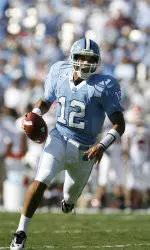
Dailey started the season at quarterback, gave way to Sexton in game three against Furman, then returned for the second half of the Virginia game. With neither quarterback able to seize the position, Bunting and Cignetti decided to alternate them against Wake Forest, Dailey getting two series followed by Sexton with two. Dailey played five series, directing the offense to 161 yards of total offense, while Sexton played four, leading the offense to 77 yards of production. Each quarterback presided over one touchdown drive. Bunting said Sunday he anticipates a similar use of the quarterbacks Saturday when the Tar Heels travel to Notre Dame.
"If we'd come out with a victory, it would have been a terrific use of the quarterbacks," Bunting said. "As it was, I think both handled it well. We will continue to work with Joe and Cam. And we will continue to work with every position on the offense to eliminate the mistakes and breakdowns. The problems of an offense are never the problems of the quarterback alone."
The soap opera elements of the week were long forgotten as the Tar Heels took possession at their 20 yard-line with 3:49 to play, needing a touchdown and point-after to tie the game. Now it was football, pure and simple, and the home crowd roared its lungs out when Hakeem Nicks gathered in a Dailey pass for a 44-yard gain to the Deacon three yard-line with under a minute to play. The proper storybook ending would have had the Tar Heels tying on the game's last play, then winning in overtime and bathing their coach in Gatorade afterward. But nothing in this star-crossed 2006 season breaks the Tar Heels' way.

"We get right to the doorstep and we're denied," receiver Jesse Holley said. "It's like getting to the basket and Shaq comes over and blocks it."
In the end, the "L-word" popped up in both teams' post-game press conferences.
"I look at it like this: Luck meets preparation," Wake's Abbate said. "When you're prepared, sometimes you get lucky."
Defensive tackle Kyndraus Guy said the Tar Heels played better and with more intensity than Wake Forest, that they played with more focus than any point during the season. Prompted for a reason, then, that Wake Forest left with seven more points on the scoreboard, Guy was quick with a response: "Luck. Luck. They've got a four-leaf clover in their shoes or something."
A bizarre ending to a surreal week.
Send your questions about Tar Heel football to Lee Pace at leepace@nc.rr.com. Please include your first and last names and hometown. Individual replies are not possible because of volume of mail received, and names of recruiting prospects and commitments cannot be published on a school-sponsored site until the national signing day in February . The Q&A column will appear each Friday during the season.