University of North Carolina Athletics
Chansky: 75 Years Worth Of Living
February 28, 2006 | Men's Basketball
Feb. 28, 2006
by Art Chansky, TarHeelBlue.com
CHAPEL HILL -- Dean Edwards Smith turns 75 Tuesday. Three-quarters of a century and still going strong, looking grayer but great and, ironically, with a better chance each year of shooting his age (albeit on a very good day from the senior tees).
Such a force in life, and meaning so much to so many people, each of the 75 years Coach Smith has been on Earth means something special. So here goes:
1931 - born to Vesta and Alfred Smith in Emporia, Kansas.
1932 - said his first word (and it sounded strangely like "da- da- da-fence").
1933 - took his first step (and according to rumor it was a step and slide).
1934 - attended his first practice with Alfred, the coach at Emporia High.
1935 - rode his first bike and, of course, it had training wheels.
1936 - read his first Chip Hilton book, which his father left by his bedside.
1937 - played his first game of table tennis on his way to a junior championship.
1938 - attended his first Wednesday night service at Emporia's First Baptist Church.
1939 - moved out to the sleeping porch in his house so ailing Grandma Edwards could move in with the family.
1940 - beat sister Joan to get the extra allowance their parents paid for who had the better report card.
1941 - sat silently with his family and listened to FDR on the radio after the Japanese bombed Pearl Harbor.
1942 - worked with his family at the Red Cross Center preparing CARE packages for the troops.
1943 - endured personal tragedy when his best friend Shad Woodruff died from a virulent form of polio.
1944 - witnessed bigotry when a black player on the Emporia team, Chick Taylor, was refused service at a restaurant.
1945 - met Dick Hiskey, a boyhood chum who would go on to head the Chemistry Department at UNC and be the faculty athletic representative.
1946 - moved with his family from Emporia to Topeka, where Alfred quit coaching but kept teaching.
1947 - threw his first touchdown pass as Topeka High's sophomore starting quarterback to Adrian King, a gifted black split end who later won a state championship in hurdles.
1948 - got "dressed down" by sister Joan because he was acting too big for his britches.
1949 - graduated from high school and earned an academic scholarship to Kansas.
1950 - made the KU freshman basketball team and played for Dick Harp, who would later become one of his assistants at UNC.
1951 - sat on the bench all season for the Kansas varsity and began studying Coach "Phog" Allen's methods.
1952 - got into the NCAA semifinal against Santa Clara and helped salt away the win by running a delay game similar to Four Corners.
1953 - graduated from Kansas and entered the Air Force.
1954 - met Bill Guthridge's sister, JoAnne, while on leave from the service.
1955 - met Bill Guthridge, who was then a junior at Parsons (Kan.) High School.
1956 - met Bob Spear, who coached the Air Force service team and then went with Spear to start a program at the new Air Force Academy.
1957 - shared the same hotel suite with Spear and Frank McGuire at the Final Four in Kansas City.
1958 - watched Kansas State and sophomore guard Bill Guthridge upset Kansas in double overtime, and laughed when Wilt Chamberlain stepped over Guthridge who was trying to draw a charge on the 7-foot Stilt.
1959 - left Air Force to join McGuire's staff at North Carolina.
1960 - helped integrate a Chapel Hill restaurant along with Reverend Bob Seymour and a black theology student.
1961 - succeeded McGuire, who left UNC to coach the Philadelphia Warriors and Chamberlain.
1962 - suffered his only losing season ever (8-9) as a head coach.
1963 - beat Kentucky and one of his idols, Adolph Rupp, for the first time and invented the "Four Corners" offense.
1964 - finished 12-12 when he admittedly made junior star Billy Cunningham a "one-man team."
1965 - was hung in effigy by UNC students, then upset eighth-ranked Duke three days later in Durham.
1966 - signed Charles Scott as the first black scholarship athlete at UNC.
1967 - won his first ACC Championship and reached his first Final Four.
1968 - hired Bill Guthridge to replace Larry Brown, who went to play for the new ABA.
1969 - won his third consecutive ACC regular-season and tournament championships and went back to his third straight Final Four.
1970 - won less than 20 games (18-9) for the last time in his coaching career.
1971 - settled for the NIT tile after losing the ACC championship game to South Carolina on a last-second basket.
1972 - returned to the Final Four for the fourth time in six years.
1973 - hated the new rule change that allowed freshman eligibility (and still hates it).
1974 - engineered a comeback for the ages: eight points down with 17 seconds left to play against Duke (and won in overtime 96-92).
1975 - gave a freshman named Phil Ford more rope than any first year player he ever had (Ford was MVP as Carolina won the ACC Tournament championship).
1976 - coached the U.S. Olympic Team (with four UNC players) to the Gold Medal in Montreal.
1977 - led an injury-plagued "team of destiny" to the ACC Championship and Final Four in Atlanta, where it lost to the "coach of destiny" and old friend Al McGuire of Marquette.
1978 - turned down the New York Knicks coaching job despite a blank check offer from Sonny Werblin, president of Madison Square Garden.
1979 - won the ACC championship with a team led by senior Dudley Bradley, whose career scoring average was four points.
1980 - won his 400th game against The Citadel in Charlotte.
1981 - signed a relatively unknown high school player from Wilmington named "Mike" Jordan.
1982 - in his seventh trip to the Final Four, and in the year he is inducted into the Naismith Hall of Fame, won his first national championship on freshman Jordan's 15-footer from the left wing.
1983 - surprised defenses by firing up the most experimental 3-pointers in the ACC, including 12 from 6-10 center Sam Perkins.
1984 - forced Michael Jordan to turn pro a year early, like he had James Worthy two years earlier.
1985 - Without Jordan, still finished first in the ACC regular season.
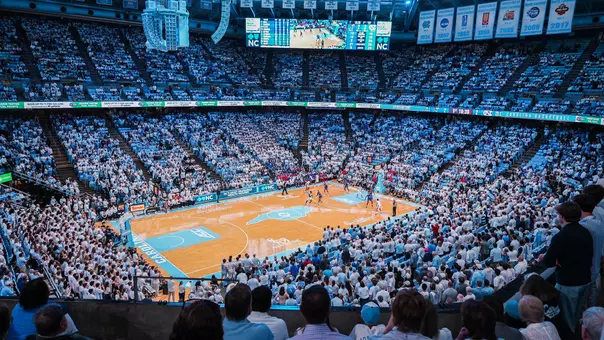
1986 - agreed to let his name grace UNC's new $36 million Student Activities Center that opened with a 95-92 win over Duke on January 18.
1987 - led his second team in three years (also 1984) to an undefeated 14-0 record in the ACC.
1988 - landed the Kansas coaching job for his little-known assistant Roy Williams.
1989 - reclaimed the ACC Tournament title for first time in eight years with a dramatic win over Duke in Atlanta.
1990 - lost more than 9 games (21-13) for the first time 26 years.
1991 - drubbed Duke for the ACC Championship and returned to the Final Four for the first time in eight years.
1992 - lost his mother Vesta at the age of 95 nine months after losing his father, Alfred, at 93.
1993 - won his second national championship in New Orleans with a team that embodied his philosophies of unselfish offense and determined defense.
1994 - earned his 800th career victory over Wake Forest in the semifinals of the ACC tournament and, a day later, his 12th ACC championship by beating Virginia.
1995 - took a six-man team with three guards and no center and went back to the Final Four, his 10th.
1996 - beat Duke for the sixth- and seventh-consecutive times, running his career record against the Blue Devils to 58-34 (it wound up 59-35).
1997 - set a new record for career wins (879), won his 13th ACC Championship, reached his 11th Final Four and then retired a week before the new season was to start. Sports Illustrated named him Sportsman of the Year.
1998 - left a great team to his successor Guthridge and joined the Tar Heels in the Final Four at San Antonio as a broadcaster for CBS.
1999 - actively campaigned against the death penalty laws in North Carolina.
2000 - named one of the seven best team sport coaches of all-time by ESPN SportsCentury.
2001 - turned 70 years old and shot a couple of golf rounds in the 70s.
2002 - attends 50th anniversary reunion of 1952 NCAA champions at his alma mater.
2003 - went back to Kansas and got Roy Williams to come this time.
2004 - stayed out of it while Williams made it his own program.
2005 - attended the Final Four in St. Louis and visited the Tar Heels' locker room after their national championship win over Illinois.
2006 - taped a video PA for the Smith Center, urging Tar Heels to "make some noise."
Happy birthday, Coach, and thanks for the memories.