University of North Carolina Athletics
Lucas: For Starters
November 10, 2007 | Football
Nov. 10, 2007
By Adam Lucas
RALEIGH--Carolina did not lose Saturday's game at NC State when T.J. Yates's fourth-down pass bounced to the grass out of the reach of Hakeem Nicks.
No, the Tar Heels lost it earlier--much earlier.
In the wake of the 31-27 defeat, much will be written about the final drive. DVR's will be paused, rewound, and replayed across the state. Maybe opportunities were missed, like a wide-open Brooks Foster with 30 seconds left that would have been a touchdown if a difficult throw could have been completed but instead went short to Zack Pianalto. Maybe some contact went uncalled, but NC State fans would tell you that in a similar instance pass interference went uncalled on Carolina's Fuzzy Lee at Carter-Finley in 1995. Maybe the use of the clock could have been different.
Maybe all those things are true. Maybe. But there's no "maybe" about this statistic:
In the last two months, the Tar Heels have had four games come down to the final two minutes--Saturday's defeat, a 21-15 loss to South Carolina, a 17-10 defeat at Virginia Tech, and a 22-20 home loss to Virginia. In those games, there have been a bevy of late-game plays that didn't go Carolina's way. One reception here, one tackle there, one two-point play here, and maybe the Tar Heels are still in bowl contention.
But here's a more telling statistic: in those four games, Carolina's first half deficit is a combined 68-23. The combined first quarter deficit in those games is a daunting 41-0.
Makes it pretty clear why those late-game heroics are needed, doesn't it?
"The long and short of it is that we played very poorly in the first half," Butch Davis said. "We almost didn't give ourselves a chance to be in the ballgame. We didn't play well offensively, defensively, or on special teams."
NC State's rushing defense entered Saturday ranked dead last in the Atlantic Coast Conference and 100th out of 119 teams in the nation. Opponents were averaging a whopping 4.6 yards per carry.
Carolina mustered exactly 12 yards on 20 carries and had -5 yards on 11 attempts in the first half.
"They were doing a good job of shedding blocks and bringing the blitz," Yates said. "I thought we were doing an OK job of executing but they were just fighting harder."
At some point, it'll be time to pass judgment on Yates's first season as a college quarterback. When that evidence is weighed, it's worth remembering that his performances have come with a nonexistent running game. Imagine for just a moment how effective some of the play-action passes favored by John Shoop might be if defenses respected the Carolina ground attack.
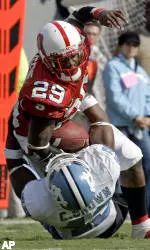
Now, back to reality. At the same time the Tar Heels were having trouble jump-starting the run, State was motoring up and down the field on the back of their third-string tailback, Jamelle Eugene. Eugene's previous career high rushing effort was 112 yards and he had less than 500 yards this season. But on his way to 159 yards, he had 91 and a pair of touchdowns by halftime.
The Pack made a savvy move by turning to a series of stretch plays--at times, it seemed that 150 of Eugene's 159 yards must have come on plays to the perimeter--to establish their ground game.
"They did a good job of scouting us," said Hilee Taylor. "We have a front seven that is aggressive and the stretch play is a finesse way of running and stretching until you find a hole. Their running back was a good running back and we tried to do too much. I'm pretty sure when we watch film we'll see we got out of our gaps. The play takes so long to develop that you have a tendency to sneak your eyes in the backfield and then you're out of position."
Indeed, film is likely to reveal several missed opportunities. But the bottom line is this: Carolina didn't run the ball well enough to win. They didn't stop the run well enough to win. Combine those struggles with a perplexing tendency to commit penalties only at the most crucial times--a lineman lined up in the neutral zone on a key third down and a block in the back negated a 20-yard gain two plays before a game-changing State interception--and it's somewhat miraculous the Tar Heels had a chance to win.
At some point in Davis's tenure, these types of close games will go the opposite way. Eventually, the Tar Heels will be the team that makes the last big play of the day at the end of a game.
But not until they're more effective at the beginning.
Adam Lucas most recently collaborated on a behind-the-scenes look at Carolina Basketball with Wes Miller. The Road To Blue Heaven will be released on October 1. Lucas's other books on Carolina basketball include The Best Game Ever, which chronicles the 1957 national championship season, Going Home Again, which focuses on Roy Williams's return to Carolina, and Led By Their Dreams, a collaboration with Steve Kirschner and Matt Bowers on the 2005 championship team.