University of North Carolina Athletics
Senior Appreciation: Wes Miller
March 4, 2007 | Men's Basketball
March 4, 2007
By Adam Lucas
Wes Miller is one of us.
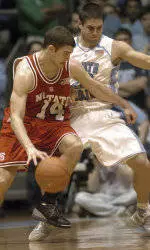
This is remarkable on many levels. At its most basic, it's true because he stands just 5-foot-11. At any function where the Tar Heels meet the public, he's almost always one of the most approached players. His head doesn't scrape the stratosphere like some of his teammates, and for that reason it's easier to talk to him. He plays like most of us like to imagine we would play if we were on the team--a lot of heart, a lot of intensity, and a jump shot that's just like the ones we used to take.
He is one of the few Carolina players who can walk the Chapel Hill campus without being constantly stared at or questioned about the upcoming game. He can even occasionally walk down Franklin Street without a parade of, "Hey, that's Wes Miller!" squeals.
More than perhaps any other player, he understands what it means to play in the Atlantic Coast Conference. He grew up with a courtside seat at league games and ACC Tournaments. He watched games on Raycom and saw Dick Vitale evolve from a color commentator to an icon. He shot jumpshots in his driveway and didn't go inside until he made 10 in a row. He wore his school's colors to school on the day after big wins.
It's a story familiar to almost every kid who has ever grown up in North Carolina. It's just that Miller's story begins--and ends--a little differently.
Anyone born and bred on Tobacco Road knows that allegiances are cast in blood. So what is Miller--who will, if he's pressed, admit to being a childhood fan of Randolph Childress, one of the greatest Carolina-killers of all time--doing wearing argyle?
He's doing what quintessential Carolina players do. He's thanking the passer, he's leading by example, and he's playing floor-burning defense.
He's also proving people wrong. Constantly.
Make a list of all the things he can't do:
He can't play college basketball. Not at the major Division I level, anyway. He attended prep school at college basketball factory New Hampton, where the talent level is so consistently high that it's very difficult for a player with high potential to fail to be noticed. He drew some sniffs from ACC schools, including Carolina, but ultimately decided he was tired of battling his way up the playing time ladder and enrolled at James Madison.
He can't play at North Carolina. No way, no how. After just one year at JMU, he missed the basketball-crazed atmosphere he remembered from home. He knew he'd eventually play at James Madison, but would he love it? And would playing big minutes at a fringe school be as fulfilling as a minor role at a powerhouse?
Miller wanted to find out. His path fortuitously crossed with assistant coach Joe Holladay shortly after Roy Williams returned to Carolina. Miller brought his father, Ken, to Chapel Hill and the pair sat down with Williams for over two hours. By the time the meeting broke up, there was little question that Miller would become the newest Tar Heel.
"It just felt right to me," Miller says. "It was so impressive how much time Coach Williams was willing to give us when there were no guarantees."
Not even a scholarship guarantee. Miller had grown up thinking he'd pay for the privilege of playing in the ACC--now he'd actually be doing it.
The move drew miniscule attention in a world where any addition or subtraction to the Carolina basketball roster is highly scrutinized. A 5-foot-11 walk-on from James Madison? Sounds like practice fodder.
For two years, he was. He guarded Raymond Felton every day in practice as Felton blossomed under Williams's tutelage. Along the way, something happened--the player who arrived at Carolina with the shooter tag developed into a complete player. He moved his feet. He stayed in front. He harassed Felton for two hours every day.
No one else saw this. And so when the NBA Draft severely depleted the Tar Heels before the 2005-06, few onlookers considered Miller an option. He can't play major minutes at this level.
See? Another can't.
Except that he could. And not just major minutes, but starting minutes. He fit perfectly with the 2006 team, a bunch of overachievers that made a habit of surpassing expectations.
That perfect fit was part of the reason little was expected of him this year. There was too much talent, too many scorers. In hindsight, it seems a little silly. A player who won the team's defensive award as a junior was suddenly going to fall out of the rotation as a senior under a coach who prizes defense more highly than almost anything else on the court?
But still, there were doubts. The first couple months of the season were challenging. Miller's shot wasn't falling and he was having trouble finding a clear role. That's heightened the importance of his defense, which he describes thusly: "I want to bother people."
Since recommitting to providing a defensive energy boost after the calendar flipped to 2007, he's been a part of some of Carolina's most tenacious on-court moments over the past two months. The formula has been simple: Miller comes in the game, the intensity heightens.
That single-minded focus means he hasn't spent a lot of time pondering the end of his home career. The ovation he'll receive when his name is announced in the starting lineup will probably take him by surprise, and it will be the grandest roar anyone who once wore a Randolph Childress jersey has ever received in Chapel Hill.
He will stand at center court today as something he probably thought he'd never be.
He will stand at center court as a Tar Heel. And as one of us. Adam Lucas's third book on Carolina basketball, The Best Game Ever, chronicles the 1957 national championship season and is available now. His previous books include Going Home Again, focusing on Roy Williams's return to Carolina, and Led By Their Dreams, a collaboration with Steve Kirschner and Matt Bowers on the 2005 championship team.