University of North Carolina Athletics
SPRING NOTEBOOK: O-Line Pulling All The Angles
April 16, 2007 | Football
April 16, 2007
by Lee Pace
Noting the Tar Heels through spring practice:
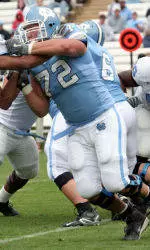
The basic blocking scheme for the Tar Heel offensive front has changed from a zone-blocking system in 2006 to one that uses man-to-man principles and features all five linemen pulling in various situations.
The system has the Tar Heels giddy over the prospects for next fall. "Pulling" calls for a lineman to leave his gap and sprint toward the play-side looking for someone to block. Sometimes they'll run downfield to find a linebacker or safety; on other plays they are looking to "trap" a defensive lineman who has intentionally been allowed to cross the line of scrimmage unfettered - until he's slobber-knocked from the side by a pulling blocker.
"The O-line is more pumped up than ever," says center Scott Lenahan. "We finally get to go out and pull. Most people probably don't know this, but a lineman's dream is to pull out on the edge and run over a little DB, to waylay a linebacker. That's pure football to us."
The "pulling guard" is well-known in football nomenclature and was popularized during the 1960s era of the Green Bay Packers and their famous pulling guards of Jerry Kramer and Fuzzy Thurston. But the Tar Heels in the system of new line coach Sam Pittman will pull any of the five players, including the center and tackles.
The roots of Pittman's system run to a previous coaching job when the offense's personnel dictated a 1-back attack. Without a fullback to serve as a lead blocker, they used pulling linemen.
"We essentially found a fullback from the offensive line by pulling him," says Pittman, who joined Butch Davis's staff from Northern Illinois. "It's worked out well for us. Fortunately we have guys who can run here. We'll pull everybody--guards, tackles, the center."
The pulling mindset contrasts from the blocking scheme employed last year that was built around zone blocking and reach blocking, which sometimes involved trying to get to the outside shoulder of a defender who was already outside the blocker. Pulling gives the blocker a better angle as he's generally coming at a defender from the side.
"You don't want to reach a wide nose guard when we can down block him and pull the center," says Pittman. "That does not make sense to me. We don't want to play into their hands, to give them the advantage. It's worked for us in the past and it'll work here as well."
Lenahan agrees. "We love the angles coach Pittman creates with pulling," he says. "It gives us the best advantage. Like I said, we love the chance to leave our feet and knock the crap out of someone."
SQUIB KICKS - Davis says if any one player has had an outstanding spring, it's been place-kicker Connor Barth. "If there are any sure things in life, they are death, taxes and Connor Barth," Davis says. "He's been as good as any kicker I've ever been around." Barth will take on added import because the college rules will change in 2007 to have kick-offs occur at the 30 yard-line instead of the 35. Davis notes that when the NFL changed that rule in 1990, the average field position following kick-offs changed from the 22 to the 35 yard-line.
* Davis was asked following Saturday's scrimmage about the Tar Heels' young but fast linebackers corps. He answered that speed and inexperience apply across the board to the entire team. "If we're not the youngest team in college football next year, I'll be shocked," he said. Of the two first-team units on the field Saturday, there was one senior on offense (Lenahan), and three on defense (Hilee Taylor, Kentwan Balmer and Durell Mapp). Carolina has only 10 scholarship seniors on the roster.
* Davis and the coaching staff saved the last of its allotted 15 spring practices for Monday. One reason is that the coaches want to take about an hour on the field to give the players specific instructions on what to focus on during voluntary summer workouts, which are conducted in groups of varying size but without any coaches present. Davis said the quarterbacks, receivers and defensive backs cannot throw-and-catch enough the next three months.
"I think one reason we struggled catching the ball early this spring was that our guys might have gone three months without catching a ball," Davis says. "If a receiver is not catching a hundred balls a day, he's not trying. He's not going to be good enough. You've got to practice your craft. It's like any motor skill--the more you do it, the better you'll get."