University of North Carolina Athletics
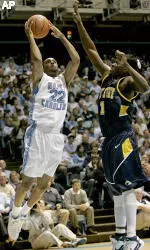
Lucas: Ellington's Eye-Catching Night
January 2, 2008 | Men's Basketball
Jan. 2, 2008
By Adam Lucas
The first time Wayne Ellington made a wow-worthy play on Wednesday night, Roy Williams had to catch it out of the corner of his eye.
Ellington heaved in a 25-foot jumper at the halftime buzzer to provide Carolina's 44-32 halftime margin over Kent State. The shot was nice, of course, but it was also an impressively disciplined play; many players would have caught the inbounds pass with four seconds left and jacked up a desperation shot upon reaching midcourt. Ellington resisted that urge, instead dribbling the length of the floor, giving a slight hesitation move that sent Mike McKee soaring right past him, and then knocking down a more manageable shot just as time expired.
"It's longer than people think it is," Ellington said. "I saw three or four seconds and I knew I had time to get down the court. Most guys would have fired it up from long distance. But I knew I had some time to get a better shot."
Sounds like the kind of savvy play that would impress the head coach, right? Well, not exactly. By the time Ellington's shot was dropping through the net, Williams was already halfway down the tunnel to the Tar Heel locker room. A series of first-half defensive miscues--the Golden Flashes shot 50 percent for the half, the first Carolina opponent in a month to hit half their field goals in the first half--had worn the Hall of Famer down, and a bungled last 30 seconds that included a turnover and a defensive breakdown finally snapped his patience.
"I turned around and saw it," Williams said. "It didn't make me any happier. We couldn't execute a simple deal. If we go for the last shot we're supposed to get it. You don't give a team a dunk on the other end and then rely on a 35-foot shot."
OK then.
Nobody ever accused Williams of being easy to please. But it wouldn't be long after he stormed down the tunnel that his sophomore from Philadelphia was making him smile.
Ellington was coming off a 2-for-10 performance against Valparaiso. What was remarkable about that outing was the way it affected him--as in, not at all. Last year, bad shooting days had a tendency to snowball on him. He shot 3-for-9 in a loss at NC State and then made more than half his field goals just twice in Carolina's final 16 games.
This time, his 2-for-10 was followed by an 8-for-11. Ellington and fellow sophomore Ty Lawson had a heart-to-heart after the Valpo game (Lawson was 2-for-6 with four turnovers and three assists) and came to a simple conclusion: "We weren't anywhere near the best of our ability," Ellington said. "For this team to be its best, we had to step it up."
Ellington's method for returning to the best of his ability is easily noticeable on the stat sheet--the only one of his eight field goals that was a 3-pointer was his halftime buzzer-beater.
His first basket was a swooping drive down the lane for a layup. His second was a 17-footer off a screen. Before the night was over, he'd made shots off one dribble, two dribbles, and no dribbles. When the Golden Flashes tightened up to prevent another midrange jumper, he knifed past them into the lane. When they sagged back, he swished another one over their heads.
"Getting some easy shots early always helps me," said Ellington, for whom that 17-footer probably counted as an easy shot. "If a 20-footer comes to me and I'm open I'll take it, but I like to get in the lane or get an easy bucket on the break. When I can do that early, it always helps me get going."
He also found time to play perhaps his best defense of the year, as Kent State's guards shot a combined 7-for-29. When the coaches grade film late Wednesday and early Thursday, he's likely to be in the running for his second defensive player of the game award. Yes, he had just one steal, but his off-the-ball presence was stellar and assistant coach Jerod Haase complimented Ellington on his defense in a happy Carolina locker room.
And while everyone else was paying attention to Ellington's scoring, his head coach did finally take notice of the wiry sophomore. Late in the second half, after he'd piled up his 17 points, Ellington was wide open on the right wing for a three-pointer. He looked at the rim for just a second, then saw Marcus Ginyard flashing through the lane. The pass arrived perfectly but Ginyard missed the shot. Tyler Hansbrough, predictably, was there for the tip-in.
As the Tar Heels got back on defense and everyone else in the crowd of 20,356 was marveling at two more of Hansbrough's game-high 25 points, Williams stood up and--in true Carolina thanking-the-passer fashion--pointed at the player who had made the play possible. Not Ginyard. Not even Hansbrough. This time, his eyes were locked on Ellington. You could almost hear Dean Smith citing assists "the way we keep them" as Williams stood and singled out Ellington.
The coach, as usual, saw everything.
Everything that was important, at least.
Adam Lucas most recently collaborated on a behind-the-scenes look at Carolina Basketball with Wes Miller. The Road To Blue Heaven is available now. Lucas's other books on Carolina basketball include The Best Game Ever, which chronicles the 1957 national championship season, Going Home Again, which focuses on Roy Williams's return to Carolina, and Led By Their Dreams, a collaboration with Steve Kirschner and Matt Bowers on the 2005 championship team.