University of North Carolina Athletics
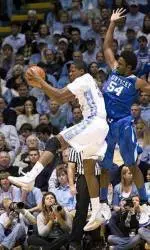
Lucas: Defensive Denials
November 19, 2008 | Men's Basketball, Featured Writers, Adam Lucas
Nov. 19, 2008
By Adam Lucas
At Monday's Roy Williams press conference, a significant chunk of the afternoon was devoted to dissecting how Carolina might defend standout Kentucky post player Patrick Patterson.
With Tyler Hansbrough out--and even with Hansbrough, Patterson scored an impressive 19 points in a foul-plagued effort last season--the assumption was that the duty might fall to junior Deon Thompson.
And yes, the Tar Heels did match up Thompson against Patterson on certain possessions during Tuesday's 77-58 victory. They also used freshmen Ed Davis and Tyler Zeller. That trio drew the majority of the physical assignment against Patterson, who finished with 19 points but was virtually invisible in the first half, when he attempted just three shots and the Tar Heels zipped out to a 16-point halftime lead.
But the most important defenders on the 6-foot-9 Patterson might have been 5-foot-11 Ty Lawson and 6-foot-4 Wayne Ellington.
For the first 8:30 of Tuesday's game, it was Lawson and Ellington who completely controlled the game with defensive pressure. With Williams signaling a variety of trapping, ball-hawking defenses--first it was a halfcourt trap, then a three-quarters trap, and finally just plain old vanilla halfcourt harassment--Carolina raced to a 13-2 advantage in the first five minutes and 25-6 by the time Lawson found Ellington with a sky-scraping alley-oop.
How good was that stretch? Even Williams, who is usually Scrooge-like with his defensive evaluations, called it "fantastic."
"Our pressure had a big effect on them," Ellington said. "Defensively, our assignments were to get out and pressure the ball and play great help on Patterson in the lane. Everyone came out with intensity, and we were just having fun out there playing Carolina basketball."
Even when the Tar Heel defense didn't result in a Wildcat miscue--and 28 times, it resulted in a UK turnover, more than any UNC opponent in almost a year--it dictated their offense.
Take a possession midway through the first half, when Williams signaled for a half-court trap. As the Wildcats advanced the ball to the midcourt line, the rangy Ellington deflected an attempted cross-court pass. The ball trickled out of bounds. No turnover was charged, but now Kentucky had to inbound the ball over 50 feet from the basket with just 25 seconds remaining on the shot clock. After even more pressure, and the ball never going inside the paint, the possession ended with a rushed jumper that clanged off the rim.
"We used all the defenses we have," Lawson said. "It really bothered them. You could tell that it got to the point they didn't want to bring the ball up."
All those arms and intensity on the perimeter made the difficult job inside marginally easier. To eliminate Kentucky's favored high-low pass to Patterson, the Tar Heel big men fronted him for most of the evening. It's a strategy with a small margin of error. Lose contact with Patterson or let him slide across the lane and set up on the opposite block--as he did to Zeller on one occasion in the second half, pinning the freshman on his hip--and it's an almost automatic two points. ut the Wildcat guards never seemed comfortable with the idea of throwing the ball over the lengthy Zeller and Davis. On one of the rare times they did try to feed the post, arching the ball over Zeller, Ellington swooped in from the back side and picked off a steal.
"My job isn't to get the steal when I'm fronting him," said Davis, who was Patterson's AAU teammate and exchanged good-natured trash-talking text messages in the days leading up to the game. "The helper comes in and get the steal. He's so big and strong, if he gets the ball on the block he's going to score. So we wanted to keep him from getting the ball in the first place."
The strategy worked well enough early to allow the Tar Heels to "meander," as Williams put it, through the second half. That relative calm was shattered when Zeller was hammered on a breakaway by Kentucky's Ramon Harris, who may be about to take his place next to LSU's John Tudor in the Tar Heel injury pantheon.
Carolina players were somber about the fate of their freshman, who was taken straight to the hospital for further evaluation.
The verdict on his injury could impact the way the Tar Heels defend future post standouts. But it doesn't change the fact that sometimes, the best post defender is a player who will never be invited to the late, great Pete Newell's Big Man Camp.
"When the guards are putting on that ball pressure, it makes it so much easier," Thompson said. "When they're pressuring, their man doesn't know what to do. That lets us get in the passing lane and get a deflection. It changes the way we play defense."
Adam Lucas is the publisher of Tar Heel Monthly. He is also the author or co-author of four books on Carolina basketball.