University of North Carolina Athletics
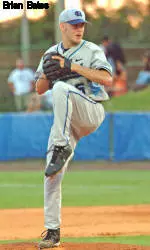
Lucas: Bates Bounces Back
March 19, 2008 | Baseball
March 19, 2008
The following story originally appeared in the March 2008 issue of Tar Heel Monthly.
By Adam Lucas
Mike Fox looked out at the Boshamer Stadium mound during the fall of 2006 and wondered what assistant coach Scott Forbes had seen in Colin Bates.
Forbes had spotted Bates during a Myrtle Beach tournament the previous summer. He filed glowing reports, and two days later the Bates family drove from Myrtle Beach to Chapel Hill for a quick campus tour.
"I walked through campus with him for probably five or ten minutes," Fox says. "Three days later, he was a Tar Heel...Coach Forbes loved him on the mound, but I really wasn't sure what we were getting."
Forbes had loved Bates's tenacity, velocity, and smarts; the righthanded pitcher had made a perfect score on the math portion of the SAT. "You guys should listen to Colin," assistant coach Chad Holbrook said during a team meeting last winter. "He made a 790 on the math part of the SAT."
Bates didn't miss a beat. "It was 800, Coach," he announced.
But neither his math skills nor his fastball were impressing Tar Heel hitters during October of 2006. His pitches weren't popping, and although he'd typically been a pitcher who got stronger as the innings progressed, he was laboring early.
This was the player who needed just 57 pitches to buzz through a 1-0 complete game victory in a state playoff game? This was the player who had impressed Forbes enough to earn a virtual instant scholarship offer? Something wasn't making sense.
As it turned out, Fox's instincts were right--he wasn't watching the same pitcher his assistant had seen in Myrtle Beach.
Bates started Game 1 of the team's Fall World Series and was touched for eight runs on seven hits and three walks over four innings. He'd start an inning throwing 89 miles an hour and end it at 82, a very un-Bates-like performance.
The next day, though, his shoulder was even more telling than the radar gun--his right shoulder was swollen and discolored.
You or I might run screaming to the hospital. Bates, a low-key college freshman, simply waited until later that day when he saw team trainer Terri Jo Rucinski. "Terri Jo, what's wrong with my arm?" he asked, taking off his shirt.
Rucinski knew immediately that it was a blood clot; she'd personally been through the same scary experience.
"Her eyes got big like I'd never seen before," Bates says.
Thirty minutes later, Bates was at the emergency room, where the attention he received from worried doctors impressed--and worried--his mother. "Within five minutes after they had a look at him, Colin had attained rock star status," Diane Bates says. There are lots of places an 18-year-old wants to be treated like a rock star. In the emergency room at UNC Hospital is not one of them. The next morning, he had surgery. But that first surgery was intended only to return him to normal functioning life, not to the pitcher's mound.
"You know," the doctor told him, "that you can't pitch again unless you have another surgery."
The first operation was a more routine--as routine as a potentially life saving procedure can be--surgery. Immediately upon its completion, Bates was given a choice: endure a painful second surgery that would enable him to pitch again, or avoid the second surgery and end his baseball career.
The decision didn't take long.
"I had to decide if I was willing to make a sacrifice to pitch again," he says. "There was one very brief moment of hesitation, because I knew I'd have to go through a lot to get back. But the very next second I knew I had no idea what I would do without being able to pitch." The second surgery required a specialist, and the Bates family turned to Dr. Robert Thompson, a vascular surgeon at Washington University who had performed similar procedures on major leaguers Aaron Cook and Kip Wells, among others.
"Colin," Thompson told the Tar Heel pitcher, "when we finish you're going to feel like you've been hit by a bus."
Thompson removed Bates's top rib, cleaned out scar tissue in the shoulder, and grafted a vein from his leg to his shoulder.
For the next seven months, the player who'd never been without a baseball didn't throw a single pitch. He watched all of UNC's run to Omaha from the dugout, even joining the team at the College World Series, where NCAA rules forbade him from wearing a uniform.
Over the summer, however, his arm strength began to return. And when he took the mound for the first time in 2007 fall practice, his teammates gave him a standing ovation.
And then Bates struck out the very first hitter he faced.
"In the first scrimmage, the first pitch I threw was 90 miles an hour," he says. "That's when I knew I was back to full strength."
The numbers confirm it--his 18.2 innings pitched so far this year (while racking up 17 strikeouts and just five walks) ranks third on the team, and opponents are hitting just .169 against him.
"I had literally spent about 10 minutes with Colin and his family during the recruiting process," Fox says. "You never really know what is inside of a kid. I had no idea what kind of heart and drive he had. What I've found out is that he's as tough and hardworking a player as I've had in this program in a long time."
Adam Lucas is the publisher of Tar Heel Monthly. He is also the author or co-author of four books on Carolina basketball.