University of North Carolina Athletics
Lucas: Flack Leaves His Mark
May 20, 2008 | Baseball
May 20, 2008
This story originally appeared in the May 2008 issue of Tar Heel Monthly, which is a complimentary benefit to all Rams Club members and is also available on a subscription basis.
By Adam Lucas
This story starts with the home run.
Note the wording carefully. This story starts with "the" home run, not "a" home run. In the course of Chad Flack's baseball career, ever since he was standing in the backyard with his grandfather hitting off a tee at the age of two, there have been numerous home runs. Since his arrival at Carolina in the summer of 2004, there have been 40 as of this writing.
But there has only been one "the" home run, and it is the one that will follow him forever. In Chapel Hill for the rest of his life, he will forever be introduced as Chad Flack Who Hit The Home Run Against Alabama. If it were not so lengthy, he could legally add it to his name. He can break records, he can win championships, but to Tar Heel fans he will always be Chad Flack Who Hit The Home Run Against Alabama.
It was a breathtaking home run. It was the rare sports moment that was legendary immediately upon clearing the fence and has increased, not decreased, in importance since that instant.
The opposite-field shot, which gave the Tar Heels a walk-off 8-7 victory and sealed the program's first trip to Omaha in 17 years, was more than just a big play in a baseball game. It took baseball from a fringe major sport at Carolina to a summer pastime that has captivated Tar Heel fans over the past two Junes. It was exactly the jumpstart needed for the Boshamer Stadium renovation campaign, which eventually approached $25 million and resulted in the state-of-the art facility now rising on Ridge Road.
Without that one swing of the bat, all of the above might have happened. Flack made certain we never had to find out for sure.
On that night of June 10, 2006, you would have been hard-pressed to find even one Carolina fan who still expected Flack to be in the Carolina lineup in 2008. Seniors in college baseball are rare. Most have moved on--like Flack's classmates, Reid Fronk, Josh Horton, and Andrew Carignan--to professional careers.
But there is Flack, starting every day at third base and cemented in the heart of the Tar Heel batting order.
What is Chad Flack still doing in Chapel Hill? And how is it possible that by doing so, he might be completing the final pieces of a legacy that will far outlast any one simple home run--even that home run?
Chad Flack could not hit. Penciled in as the Carolina cleanup hitter in his very first college game, he suffered through a horrendous start. He went 0-for-3 in his Tar Heel debut and things got worse from there, eventually posting just one hit in his first 14 at-bats.
Flack was not the jewel of his very impressive freshman class. He was signed as a third baseman, but was beaten out at that position by Fronk during fall practice. That meant Flack needed a new home, probably first base. But the Tar Heels already had a prep All-American signee at that position, Matt Spencer, who had been a middle-round draft choice of the Boston Red Sox.
Listening to Flack tell it, you'd think he was one step away from being demoted to bullpen catcher.
"I wasn't highly ranked," he says. "Matt Spencer was an AFLAC All-American. So I knew I was going to have to work for playing time."
Flack has a way of doing that, of taking some impressive credentials on his bio and making them sound like participation ribbons at an elementary school field day. He is so convincing that you almost don't bother to look it up.
When you do check his background, however, you quickly discover he's simply being modest. Flack was the North Carolina state player of the year in 2004 and a three-time all-state selection under one of the most respected prep coaches in the state, East Rutherford's Bobby Dale Reynolds. He also had a diamond-studded pedigree, as his grandfather, Ron Guy, played in the Yankee and Dodger organizations.
It was Guy who spent every available afternoon in the yard with his grandson, teaching him subtle hitting nuances and developing Flack's passion for the game.
"From the time I was two years old, we spent a lot of time in the front yard together," Flack says. "I was always a step ahead of my friends because I always knew a lot about hitting for my age. My grandfather would hit with me and take me to batting cages. He'd get in there at 50 years old and show me how to do it. In the yard, he'd be out there with his bare hands and I'd throw it as hard as I could and he'd catch it."
Guy's tutelage eventually made his grandson the subject of a heated recruiting battle. The final two candidates were Carolina and Clemson.
Sure, today that seems like an easy choice. With help from assistants Chad Holbrook and Scott Forbes, Fox has established UNC as the de facto program of choice for the top home-grown talent (THM, May '07).
In 2004, however, the decision wasn't quite as easy. Clemson had made four trips to the College World Series in the past eight years. For a player who had grown up watching the CWS on television and dreaming of playing in Omaha, committing to Clemson--just two hours from his home in Forest City, approximately half the drive time to Chapel Hill--was a logical choice.
Clemson head coach Jack Leggett knew it was a logical choice. Mike Fox knew it was a logical choice. And in order to prevent the Flack family from agreeing it was a logical choice, Fox hit upon the perfect recruiting pitch.
"Clemson had been there and done that," says Tripp Flack, Chad's father. "Coach Fox made a very good argument that he'd like to have a North Carolina guy leading North Carolina to the College World Series. That was what he planned for Chad, and we felt like Chad had a chance to do that."
 Flack's career has already seen two trips to Omaha.  |
|
That same argument was appealing across the state. Flack was part of an outstanding class that included fellow in-state products Fronk, Horton, Benji Johnson, Mike Facchinei, Tyler Trice, Seth Williams, and Kyle Shelton.
In the interest of full disclosure, it's worth noting that both of Flack's parents, Tripp and Angela, attended UNC, as did his older sister. He'd been a Tar Heel fan since birth, but he'd also been an Omaha fan since birth, and he wanted to play for the baseball program that gave him the best chance to do that.
So as Flack's freshman season began in the spring of 2005, he was not exactly the hardscrabble walk-on trying to earn a spot on the traveling team. But he did have to learn a new position, first base, where he promptly became a much better defensive player than Spencer and blasted the ball all over on the park on the way to becoming the opening day cleanup hitter.
And then he stopped hitting.
"That first week or two, I wasn't very good," he says. "But the coaches kept putting me out there to show me they believed I could do it. That was a big thing for me, to see that they believed in me. It helped me believe in myself."
The payoff for the coaching staff arrived with a 2-for-3 game against Birmingham Southern in the sixth game of Flack's college career. It continued with a UNC rookie record of 15 home runs, a .335 batting average, 49 runs batted in, all-tournament team honors at the NCAA's Gainesville Regional, Louisville Slugger freshman All-America honors, and the team's most valuable player award.
Of course, Flack does not mention any of this. When he discusses his freshman season, which ended with the Tar Heels' disappointing flameout in the Gainesville Regional, it is with an air of disappointment and almost of disgust.
"I didn't like the way that team got along," he says. "There was a separation on that team. There was a lot of negative talk, and that really took away from how that team played."
Which leads us to that night in Tuscaloosa.
Flack's sophomore year was better. Not because he set the UNC single-season record with 292 at-bats, which he did. Not because he set the UNC single-season record with 112 hits, which he did. And not because he hit the most important home run in school history, which he did.
But because the Tar Heels won--often.
"The underclassmen on that 2005 team knew that when we were in a position of leadership, we wanted to keep everything positive," he says. "If someone was upset about something, we wanted to settle it before it started spreading through the team. And a huge part of that 2006 team's success was team unity. Everyone on that team was like brothers."
After a disappointing ACC Tournament finish, Carolina rebounded to claim the Chapel Hill Regional. That earned them a trip to Alabama, where future first-round draft pick Andrew Miller was devastating, allowing zero earned runs over seven innings and striking out eleven while walking just one. Miller's gem gave the Tar Heels a 1-0 lead in the best-of-three series.
But it was what Miller did the next night that highlighted the dramatic one-year change.
Needing just one more win to clinch the program's first trip to Omaha since 1989, future first-round pick Daniel Bard was knocked out after just two innings. That's when the Tar Heels began to prove they were more than just a team of two pitching stars. Unheralded Matt Danford turned in four innings of solid middle relief work. Alabama notched a run in the seventh to push their lead to 4-2.
Then came two of the greatest innings in Tar Heel baseball history. What's nearly forgotten is that Flack blasted a three-run homer in the bottom of the eighth (Carolina was the home squad because the teams were alternating home and road visitor status) and the Tar Heels added another run to provide a 6-4 advantage going into the ninth.
Alabama took the lead back in the top of the ninth on a textbook metal bat home run by Alex Avila and went into the bottom of the ninth holding a narrow 7-6 lead. Already the game had seen two potential game-winning home runs.
 Flack's homer in Tuscaloosa touched off a wild celebration. |
|
Flack came to the plate with Fronk on second base and two out. Before he came to the plate, though, he did something uncharacteristic. Before leaving the on-deck circle, he turned back to pitching coach Scott Forbes and said, "We're not losing this game."
"I don't normally say things like that, but I believe it every single time," he says now. "There was something about that moment. I knew they didn't deserve to win that game. Their home run off Carignan was the luckiest shot I've ever seen. I had emotion and anger built up that they had gotten that kind of luck. I guess I was caught up in the moment."
Soon, everyone else would be too.
On an 0-1 pitch, Flack lifted the ball over the right-field fence. Almost as soon as the ball cleared the wall, his teammates began dashing for home plate. The Carolina bullpen was located down the left-field line, and it emptied immediately. Leading the charge and sprinting to the plate faster than anyone was Miller, the future millionaire, who had every reason to look forward to the future but wanted nothing more than to revel in the present.
"I was running right with him for a second," said fellow reliever Tyler Trice, "and then, bang, he was gone!"
A little over an hour later, Tripp Flack was standing outside the team hotel simply trying to make a phone call. Just one simple phone call. But he couldn't because incoming voice mails were piling up so quickly that he couldn't make an outgoing call. At that moment, he was the father of the most famous person in UNC sports, and all he could do was stand there with a "What can you do?" smile and a shrug.
He understood the magnitude of the moment. The only person who seemed unimpressed by the whole thing was Chad Flack. Rather than encase the bat that hit the homer in inch-thick Lucite, within weeks Flack had given away the bat he used and shoes he wore for the Alabama game.
Even now, two years later, after he's been patted on the back and recognized on Franklin Street, he seems decidedly blasé about the whole thing.
"These days, people put that hit as being bigger than the win itself," he says. "It was a good hit. But it wasn't as big as the win. Since I had signed with Carolina I wanted to go to Omaha. The win meant we got to go to Omaha, and that's what matters to me."
Let us pause here to acknowledge your skepticism. The quote above is what Flack is supposed to say. You know that. Secretly, you suspect he goes back to his room and watches the ball clear the fence in slow motion every night.
And you're right, because someone in the Flack household did watch the "good hit," as Flack put it, every single night before bed. But it wasn't him. It was his then-six-year-old sister, Ally.
"For months, that's how she went to sleep," says Tripp Flack. "She wanted us to either turn on the tape of the Alabama game or the College World Series games. We'd turn down the sound and she'd watch it while she went to sleep. Every night."
This may sound familiar: Chad Flack could not hit.
Carolina's diamond hero hit .206 over the first two months of his junior season and never fully recovered on his way to a .247 mark for the year. His slugging percentage dipped to .375, his on-base percentage fell to .298, and although he eventually surged in May and June, he readily admits that it was a disappointing year. Sliders away became his poison, and by the time he realized he was struggling he had fallen too far into his bad habits at the plate to fix them.
"It's not like someone reached down and pulled the talent out of you," said Paul Bard, Daniel's father. It was good advice, but sometimes it really did feel like someone had removed the hitting gene from Flack's DNA.
How is that possible? How can someone accustomed to being the best hitter on his team for his entire baseball life suddenly look helpless against a good breaking ball? Flack knew he shouldn't chase those pitches. Fox knew he shouldn't chase those pitches. Everyone knew it. But there would come another one, and Flack would find himself in another 1-2 or 0-2 count, and then the at-bat would end with a weak grounder to third.
"At the beginning of the year, I was doing fine and I was seeing results," Flack says. "Then I started hitting the ball at people and not seeing results. I started pressing. Then I started pulling off the ball and swinging at the wrong pitches, and that dug a hole that was hard to get out of."
"Until you've been in that batter's box and gone through it, it's hard to understand," Fox says. "You know what you want to do but something gets in your way. It's mental, it's physical, it's a lack of confidence, it's stubbornness, it's a combination of a lot of things.
"The most difficult part of coaching is correcting things that aren't going well. It's like the shooter who can't find the basket. You take him in the gym and let him take 500 jumpers and he looks good, but something changes in the game. You have to keep working through it and focus on other parts of the game."
Oh yes, those other parts of the game. If Fox was writing this story, he'd have had defense near the first paragraph. Flack's reputation might be as a hitter, but he's been even more valuable in the field. After playing first virtually flawlessly for his first two years, he shifted to third as a junior and helped the Tar Heels solidify what had been a shaky infield defense. Diving stops became routine, no matter whether he was 0-for-4 or 3-for-4.
For many players, errors multiply in proportion to strikeouts. That never happened for Flack.
"If you can say something good about my junior year, it's that I played good defense," he says. "I'm competitive enough that I always want to find a way to help my team win. Last year, that was with defense."
Just like during his freshman struggles, the Tar Heel coaches kept writing Flack's name on the lineup card. He started 72 of Carolina's 73 games, never throwing his bat, never slamming his helmet on home plate after a strikeout. Watching him between the white lines, it was impossible to tell if he was hitting .340 or .240.
His parents, who haven't missed a weekend series in their son's college career, kept a close eye on their only son. This was his first taste of failure. They knew how he'd respond to success and were confident he'd never let it change him. But this was something entirely different.
Only once, after a midseason ACC loss, did they see signs of disappointment. A quick family meeting cured those feelings.
"The one person I talked about it with was my dad," Flack says. "He sat me down and said, `You're the starting third baseman for the potential number-one team in the country. How many people can say that right now? There are a lot of people who wish they could be you. They would take a batting average 50 points lower than yours just to be on this team.' He really helped me look at the broad spectrum and get a better appreciation for what was happening."
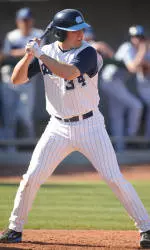
 Flack has been a stalwart at third base over the last two seasons. |
|
Improbably, Flack's funk lifted just in time to provide the most important home run of the Carolina season. It was his two-run homer in the seventh inning of the deciding game of the South Carolina super-regional that propelled the Tar Heels back to Omaha. Predictably, he was not impressed. "We were going to win the game anyway," he says. "It might have turned the momentum but with our pitchers and hitters, the result was going to be the same no matter what."
The major league draft in June of 2007 passed without Flack's name being called at all. He watched Horton, Fronk, and Carignan sign pro contracts and passed up summer ball. It was almost unbelievable. That quartet was supposed to enter Chapel Hill and leave together. Their work was done. They'd lifted the program from the fringe of the national scene to back-to-back College World Series appearances. Carolina still competed with programs like Clemson for the best in-state prospects, but now everyone recognized that UNC--with a starting lineup almost entirely made of Tar Heel natives--was a suitable choice for the best combination of baseball, academics, college life and pro preparation.
After a deceptively slow start to his senior campaign caused by a series of line drives that were hit directly at fielders, Flack pushed his batting average over .300 for the first time since 2006 in late March. His swing was shorter, more compact, with more bat speed. It looked like the swing of a player who could leave Carolina as the school leader in almost every offensive category. It looked like the swing of a player who might even--who knows?--hit another monumental home run in June. Or, as Flack would be quick to tell you, maybe even make a game-saving play at third base.
But no matter what his dramatic results in the batter's box or in the field, he's proudest of being a part of an even more remarkable change in the program itself.
"Sometimes the guys who have been around for a while will talk about it," he says. "We look at the change from our freshman to senior years and think, `We helped change that.' There's an aspect of brotherhood with Carolina baseball now. We've got our own fraternity. There are guys in this locker room battling for the same spot, but as soon as they get off the field they're best friends. One of them is playing and the other is on the bench and the guy on the bench is hollering for the guy who took his spot. It takes guys like that to help turn around a program."
Yes, one big hit in Alabama energized the Carolina program. But it is this attitude that revived the program.
The story of Chad Flack Who Hit the Home Run Against Alabama, it seems, is not at all about the home run.
"I hope not," he says. "I hope it's about winning. It's hard for me to imagine any place meaning more to someone than Carolina means to me. So if I can be a small part of a story about Carolina going to Omaha, I'm happy."
Adam Lucas is the publisher of Tar Heel Monthly. He is also the author or co-author of four books on Carolina basketball.