University of North Carolina Athletics
Lucas: A Career Rebooted
September 27, 2008 | Football, Featured Writers, Adam Lucas
Sept. 27, 2008
By Adam Lucas
MIAMI GARDENS, Fla.--All the noise was just too much.
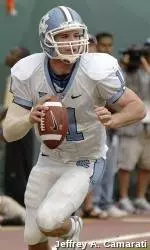
Cameron Sexton looked over to the Carolina sideline late in Saturday's first half and saw a frenzy. He saw coaches gesturing and players yelling. All of them were trying to help him. All of them wanted to give him advice. All of them were moving fast, talking fast, and he wanted them to slow down. He wanted them to trust him.
"Someone has got to tell them to shut up," Sexton told Greg Little. "They act like I haven't been here before."
Little, who has never been accused of lacking confidence, just grinned at Sexton. This was the third-string quarterback?
"For him to say something like that was unbelievable," Little said, shaking his head. "To have that kind of confidence..."
His words trailed off. What he didn't say told you as much as you needed to know about where Sexton has been.
He has been a highly touted prospect and a forgotten man. He has been the starter, he has been the backup, and he has been the backup's backup. As college sports fans, we're accustomed to seeing careers begin and finish. It's only rarely that we get to see a player reboot a career.
"There were many times I'd go home at night and call my parents and tell them I didn't know if I wanted to play football anymore," Sexton said. "I felt like I just didn't know what to do on the field anymore. But they told me to keep plugging. And the confidence started to come back."
It started to come back with the arrival of Butch Davis and John Shoop. "Those guys came in here and taught me how to play football again," Sexton said.
All afternoon, while the game moved at high speed around him, Sexton saw and felt things moving in slow motion. It was like a camera trick from The Matrix, where everyone else is flying around the frame and one man stands, motionless, in the middle of a well-formed pocket.
"He was so poised," said Shoop. "As we talked throughout the game, it became obvious that he and I were seeing the same exact stuff."
Even when he threw a 74-yard touchdown pass to Hakeem Nicks that brought the Tar Heels to within 24-21 in the fourth quarter, Sexton simply trotted down the field--pausing for a quick hug with Calvin Darity--to offer Nicks a high-five. No arm pumping. No dramatic leaps or pirouettes.
He knew there would still have to be another drive, a bigger drive. And when the Tar Heels took over again with 2:49 remaining, he quickly--and calmly, of course--cycled through his responsibilities for the final drive.
"Be efficient," Sexton thought to himself. "Let it come naturally."
It is not natural, of course. It is not natural to stand on a field in front of 35,830 screaming fans and not be nervous. On the sideline, T.J. Yates was standing at the far end of the Tar Heel players. He had ditched his crutches and was standing all alone. He had a white towel covering his face, and he would occasionally peer over the top of the towel to watch the plays unfold.
That, folks, is normal.
Sexton began picking apart the Miami secondary. Fourteen yards here. Eleven yards there.
Earlier in the week, Brandon Tate had approached his new quarterback and said, "Just put the ball in the air. We'll do the rest."
That's what happened. Sexton made a conscious effort to not be the big playmaker. He made an effort to be the smart playmaker. When Shoop's call came in on 2nd and 10 from the Miami 14, Brooks Foster was not the primary option. The first look was into the flat, for a running back. But the Hurricanes had that choice blanketed.
"I knew that play was designed so that Brooks would be in the end zone," Sexton said. "But I didn't know if he'd be open. We always say, `Plays gain yards and players score touchdowns.' I wanted to let him make a play on that one if he could."
When it was over, it was a blur. Over here was Mark Paschal being overcome with emotion and shedding tears on the field. Over there was freshman Zach Brown hoisting Yates onto his back and carrying him to the corner of the field so the injured QB could sing the fight song with his teammates and fans. Back there, back in the tunnel, were Sexton and Shoop enjoying one of the best player-coach hugs you'll ever see.
Through all of that, Sexton never seemed particularly emotional. It was only when he began to ponder what he might say when he finally was able to talk to his family--the support group that had been with him through those days when he wondered how much love for the game still remained--that he admitted to being overwhelmed. It was the first time all day he'd looked unsure.
"You know what?" he said. "I have no idea what to say to them. I've never experienced anything like this. How do you explain this?"
Don't ask us, Cameron. On Saturday, you were the one with all the answers.
Adam Lucas is the publisher of Tar Heel Monthly. He is also the author or co-author of four books on Carolina basketball.