University of North Carolina Athletics
Book Excerpt: Hard Work
November 12, 2009 | Men's Basketball
Nov. 12, 2009
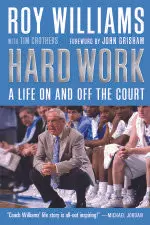
The following is an excerpt from Hard Work, the new autobiography written by UNC head coach Roy Williams along with Tim Crothers.
To purchase the book, click here.
Chapter 2: Angels and Demons
I probably shouldn't share this because it's not really something to be proud of, but one part of my family tree goes back to the McCoys who feuded with the Hatfields all those years. On the other side of the tree, my mother's side, they changed their name from Dalton to Deyton because they didn't want to be associated with the Dalton Gang, some nasty folks who were killed trying to rob a bank in a small town in Kansas. There are no heroes in my family history, just a bunch of outlaws and fighters.
My dad had 12 brothers and sisters, and my mom had nine, and everybody lived within a few miles of each other in the mountains of Western North Carolina near Asheville, where I was born and raised in the early 1950s. It was a very hardworking family on both sides.
My mother quit school in the 10th grade and my father quit school in the sixth grade, both of them to go to work. My mother started working in the cotton mill and my father, as a 13-year-old, started picking cotton before it went to the mill. I was brought up in a very uneducated family. My grandfather on my mother's side owned a pool hall in Caroleen, North Carolina. Friday night would be the only night he'd drink, but he would drink a lot. He'd drink so much that when somebody brought him home, he couldn't undress himself. He'd come home with the money he'd earned for the whole week and he'd tell my grandmother, "I'll give you $5 if you'll take my shoes and socks off. I'll give you $10 if you take my coat and shirt off." That became Granddaddy's way of giving Granny the grocery money.
My grandmother on my father's side we all called Big Mom because she looked after the whole family. Her husband, Pop, ran his own little sawmill -- a shed and a saw is all it really was -- and when I was four or five years old, all the cousins and I would bundle kindling for him. Pop would cut logs to make furniture. The leftovers were kindling, so on Friday afternoons Pop and I would go into the African-American section of town and sell kindling to people that still heated and cooked with a woodstove.
My mother's name was Lallage. I thought she was an angel. She was intelligent. She was sweet. She was shy. She appreciated the most simple things in life. She lived by the Golden Rule: treat folks like you'd like to be treated. She enjoyed people and she was polite, but she had a fence around her and she wouldn't let anybody in until you passed her test. Very few people got inside that fence.
Family was all that mattered to my mother. Family was her first priority and second, third, fourth, and fifth. Nothing ever got in the way of that. She always put the rest of the family ahead of herself. All she cared about was providing, having a roof over our head, clothes for us to wear, and food for us to eat. Everywhere we'd go, she packed up my older sister, Frances, and me; it was like the mother duck and her little ducklings.
My mom was stronger than my dad.
My dad was so funny. His name was Mack Clayton Williams, but everybody called him Babe. His mama gave him that nickname because he was her favorite. She treated him like her baby, even though he was somewhere in the middle of all of her kids. Babe would pick on everybody in a jovial way, and they could pick on him. He had this laugh that made his whole body shake. For all of my cousins, he was their favorite uncle. He liked to play tricks, and if a rubber snake showed up somewhere, you knew who was behind it. Everybody loved Babe.
My dad could tell a story a hundred times and he'd laugh just as hard at the end of the hundredth telling as he did at the first. I remember one time a bunch of the Williams family went to a Baptist revival with my uncle Glenn, who was a deacon in his church. When we got back home, my daddy started teasing Glenn by saying, "Glenn is so cheap that when the collection plate came around, he put a five dollar bill in there and then he reached in and took back four ones. Isn't he supposed to be setting a good example for the rest of us?"
He was giggling about it and Glenn swore that he didn't do it, but Daddy was never one to let the true facts get in the way of a good story. He was always kidding people. In fact, that was his life. He wanted to have fun, and sometimes having fun got in the way of some of his responsibilities as a husband and a father.
My dad was an alcoholic. He smoked. He cursed like a sailor. Every vice you could have, he had. He didn't play any sports; he just worked and worked and worked. I remember somebody once asked him about running. "The only time I'm running," he said, "is if I'm real afraid of the guy that's chasing me."
My dad was a good man, but alcohol changed him. When I was a kid, I enjoyed being around him if he was not drinking and I hated being around him if he was. Drinking put him on edge. It could make him mean. It made me not even want to talk to him.
My first childhood memories are of having a lot of fun with my cousins playing cowboys and Indians. My favorite picture is of me holding a six-gun poised to shoot, because I remember how happy that made me feel to be a cowboy living in a time when you were either a good guy or a bad guy.
But at around age seven, it wasn't fun anymore. My dad started going to the beat of a different drum. A lot of nights he came home drunk at 2 or 3 o'clock in the morning. One night he came home with two black eyes, because he'd been in a bar and gotten into a brawl. But that was just him.
Lots of people in my family were drinkers and fighters. Every gathering, every reunion, and every family picnic on the Williams side ended up with two of the boys going at it. I remember at five or six years old asking one of my cousins, "Who's going to end up fighting tonight?" There would always be a fistfight over something that somebody said that somebody else didn't like, just because there was so much drinking going on.
There was one little area in Asheville where my grandparents and three of their grown sons lived, all within 100 yards of each other, in little houses along a dirt road. Maybe that's where the Hatfields and McCoys figure in, because there were several times when the boys from over the hill came by and they wanted to play with us, but at the end somebody always drew a line in the sand. That's just what we did.
It was the Williams boys against everybody else. I'd bloody a guy's nose and he'd bloody mine, and then two days later I'd be playing and fighting with those same guys. I wasn't a great fighter, but I was never afraid of a scuffle.
One of my uncles, who we called "Hillbilly," once told me the story of a night at a beer joint called the Silver Slipper. A guy came out of the bar and said that my dad and my uncle Gordon were about to get in a fight with some other guys and the other brothers might want to go in there and help them because there were three of theirs and only two of ours. Uncle Hillbilly said, "Naw, they ought to be able to handle that. Let's just see if they're tough enough."
So Hillbilly and the others stood there and watched through the window while my dad and Gordon fought the other three guys. The Williams boys came out and they'd won, but they looked like they lost. That was the only kind of competition I knew. Were you tough enough? And when somebody drew a line in the sand, would you step across?
Between my mother and father there was a lot of physical abuse. He would come home drunk and push her around, and Frances and I would try to stop it. I'd try to separate them, but I was too small and my dad would just push me away.
My mother and father split for the first time just after I'd finished first grade. My mother took us away and the three of us lived all summer in a single room at the Shamrock Court Motel, which my aunt Doris owned. My mother would go off to work and Frances was off doing odd jobs for somebody, so I would go around with another of my aunts, Leona, who was a maid at the motel. She paid me 25 cents a day to take off the dirty pillowcases and put on clean ones. At lunch Aunt Doris would fix me a sandwich, and then I'd go and work some more in the afternoon. That was it. There was no ballplaying. Nothing that kids do. It was just survival.
When the school year started, we moved in with another aunt. We lived in her trailer because she had an empty bedroom. I slept on the couch and my mother and sister shared the back bedroom. We lived there for four or five months, and then Dad started coming by and my parents got back together again. That lasted a little while before they broke up again. We left again and lived with another aunt. All of these aunts that put us up were my dad's sisters. They were all mad at Babe because they knew that his drinking and carousing was ruining my family. It was difficult for me to understand why my father was doing this to us. My mom and dad got together and broke up, got together and broke up, and the last time we moved out I was 11 years old.
Frances was four years older than me. She was outgoing but not very goal oriented. She was fun but not the life of the party. She was caring but she didn't dote. Even as a teenager, she was really looking forward to growing up, to moving on with her life. She was anxious to get out of our house and start the kind of family we didn't have. We didn't spend that much time together, didn't play much together, but we had a typical brother-sister rivalry. She would always tell people that when we washed dishes together, she would wash and I would dry but I wouldn't dry the pots and pans because I said they were too heavy. She always thought I was trying to get away with something, but she was a good sister.
I know Frances was also upset by our family situation, but she didn't seem to be as bothered by it as I was. She was older, more mature, and just handled it better. During the tough times, she was keeping an eye on me more than I knew she was, but I just wasn't willing to talk about our mom and dad splitting up. I never really talked to anybody about it. I pretended it wasn't there.
During one of the times when my mother and dad got back together, we lived in a house on Warren Avenue. That was the first and only house we ever owned. My mother, Frances, and I left and came back, and left and came back, and then one day when we were staying with one of my aunts, my dad said, "Why don't you guys come back and stay at the house, and I'll leave and let you guys live there?"
We'd only been back living in that house for two weeks when these two guys pulled up in the driveway. They were wearing dark sportcoats, white shirts, and ties. I was on the porch, but I ran in the house to tell my mom as they came walking up the steps. I remember latching the screen door, and I wouldn't unlatch it to let them in. It turned out that during that seven-month time period that we'd been gone, my dad hadn't paid the mortgage. So they came and foreclosed on the house. They told us we had three days to get out. I went and packed up my stuff, and we moved back to the motel. To this day I still have a negative feeling about people in dark sportcoats, white shirts, and ties.
Every time my parents got back together, there was a lot of fighting. My dad never hit my mother with his fist, but he went as far as he could go without doing that. I tried to run away from home one time because I just wanted to get away. I didn't get very far; I don't know if I wanted to get very far. I just wanted to shock my dad into stopping.
I was always feeling like I needed to escape.
One of our neighbors at that house on Warren Avenue had a basketball goal in the backyard. I never had a basketball, but they had one, and when I wanted to get away from what was going on at home, I would just go over there and shoot. The goal was a pole with a plywood backboard, and there was no net, just a bent rim. I'd go over there for hours. If it was raining or snowing, I'd get filthy on the dirt court, but I didn't mind. It was something I could do by myself. All I needed was a basketball and a goal and some sweat and I could lose myself in the game. I was in heaven, like a kid left all night in a candy store. That court was my refuge, the one place where it felt like there were no problems in the world.
When I was 11, we moved to a place on Reed Street. We were 100 yards from Biltmore Elementary School, where there were some asphalt courts. Every day after school, I'd go home, change clothes, and head straight to the courts to play basketball until 6 o'clock.
When I was in the seventh grade, a few other boys and I started sneaking into the Biltmore gym to play. I always played with older guys. One of them had the idea of hiding someone in the bathroom, and then when the head of the physical education department would go home at 4 o'clock, our guy would come out of the bathroom and prop the gym door open and we'd play on the court inside.
One time we were in there playing and one of the guys started clowning around with a fire extinguisher, and it sprayed all over the girls' locker room. That just infuriated me, and that's when I started sneaking in by myself, because I didn't want to be responsible for anybody else. On one outside wall there were some uneven bricks I could climb to get to a second-floor window. I opened the window and dropped down to the balcony inside the gym. I never turned on the lights. There was just an exit sign lighting each end, and I would play in the half dark. I would just shoot and rebound and shoot again. It was peaceful, and at that point the peaceful part of it was more important than getting to be a better player.
I got caught several times. It became a little bit of a challenge for this one policeman to catch me in there and run me off. He came in the gym a couple of times and would find me mopping the floor. He probably thought I was trying to keep it cleaned up, but I was just trying to cover my tracks. I didn't want anybody to know I'd been in there.
Finally, one night he said, "It doesn't look like I'm going to be able to stop you. How do you get in here?"
I was scared to death. It was dark, and I took him outside and showed him how I climbed up the outside of the building. Then he said, "Okay, come on with me."
I had been in the junior deputy sheriff's program, and one day they were taking everybody to the jail and the courthouse just to show them what it was like, and I didn't go that day because they said they were going to fingerprint everybody and that frightened me. So when the policeman put me in the back of the police car, I thought he was taking me to jail. He drove over to Mr. Norton's house. Mr. Norton was the school principal. When we reached his house, the policeman got out of the car and said, "Stay here."
I was about to mess my pants, I was so dadgum scared. He knocked on the door, and when Mr. Norton opened it I could see them talking. After a little while, Mr. Norton went back in the house and then came out to the car. I sat there trying to figure out how I was going to tell my mom that she had to come bail me out of jail. Mr. Norton reached in the window and handed me a key. It was the key to the Biltmore gym.