University of North Carolina Athletics
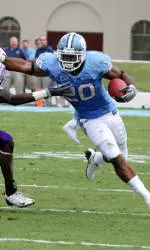
Georgia Tech Game Guide
September 24, 2009 | Football
Sept. 24, 2009
By Lauren Brownlow
Every Thursday, check TarHeelBlue.com for the latest edition of the Game Guide, which provides all the information you need to get ready for gameday.
The Basics
No. 22/19 North Carolina (3-0, 0-0) will travel to Atlanta for its ACC opener to face Georgia Tech (2-1, 1-1). The Tar Heels are coming off of a 31-17 win over East Carolina. Georgia Tech is coming off of a 33-17 loss at Miami last Thursday. Carolina is 18-23-3 against Georgia Tech going into the 45th meeting between the two schools and has won just two of the last 11 meetings, both in Chapel Hill. Carolina has not won in Bobby Dodd Stadium since 1997. Georgia Tech leads the series in Atlanta 15-7-1, including the last five in a row. Carolina has its first 3-0 start since 1997 when that team started 8-0. Carolina has not won its ACC opener since 2000.
Game Time: North Carolina at Georgia Tech, 12:00 PM, Raycom Carolina's game notes can be here.
Last Time: No. 19 Carolina beat No. 22 Georgia Tech, 28-7 on November 8, 2008 in Chapel Hill. Carolina got out to a 7-0 lead in the first quarter on a 67-yard drive, capped off by a touchdown pass from Cam Sexton to Zack Pianalto. The Carolina defense stopped Georgia Tech on fourth and short twice in that quarter. In the second quarter, Georgia Tech missed two field goals. It was back-to-back fumbles that gave Carolina a 21-7 lead on two Ryan Houston touchdown runs with 10:49 to go. Jonathan Dwyer ran for an 85-yard touchdown with six minutes left to cut it to 21-14, but an interception by Trimane Goddard led to a Sexton-Hakeem Nicks 31-yard touchdown hook-up with 4:11 left to give Carolina a 28-7 lead.
Sexton completed 7-of-16 passes for 100 yards, two touchdowns and no interceptions. Hakeem Nicks led Carolina with three catches for 72 yards and a touchdown. Brooks Foster added two catches for 30 yards; Shaun Draughn had two catches for 18 yards. Draughn also led the team in rushing with 90 yards on 17 carries. Ryan Houston added 74 yards on 13 carries and two touchdowns. Mark Paschal led the team in tackles with ten. Robert Quinn had six tackles and two forced fumbles. Georgia Tech's Josh Nesbitt completed 10-of-22 passes for 97 yards and one interception. He added 62 yards rushing on 15 carries. Demaryius Thomas led the team in receiving with four catches for 35 yards. Jonathan Dwyer rushed for 157 yards on 22 carries.
Gameday Weather: Check the local weather forecast before heading to the game.
Radio Coverage: Tar Heel Sports Network coverage begins at 11:00 AM. The radio broadcast is also available on Sirius Channel 211/XM Channel 191. at 12:00 PM. Since it's an away game, the Georgia Tech broadcasters will be heard instead of the Tar Heel Sports Network crew.
TV Coverage: The game will be shown regionally on Raycom.
Game week TV/radio coverage: "Butch Davis Live", Coach Davis' weekly radio show, will be broadcast live from the Top of the Hill restaurant on Franklin Street every Wednesday at 7:00. Inside Carolina Football with Butch Davis airs Saturday morning at 9 a.m. on FOX Sports South. Inside Carolina Football with Butch Davis will air on Sunday at 11:30 a.m. on WTVD ABC 11 in the Triangle and will review Saturday's game. The show will also be available On Demand on Time Warner Cable channel 1234 for free. The Tar Heel Football Review show featuring highlights of the previous week's games will air Tuesday's at 7 p.m. and Thursday's at 8 p.m. in the Triangle and Fayetteville on the local Time Warner Cable station.
Storylines
Keeping the ball: Some members of Carolina's offense took it upon themselves to apologize to the defense for putting them in such bad positions two weeks ago at Connecticut. The defense didn't mind and did what it needed to do, waiting for the offense to come around, which it did. But part of what helped out both the offense and defense is that Carolina still managed to hold the ball for 33:40 (compared to 26:20 for Connecticut) and run 70 plays compared to just 61 for Connecticut. And despite being on the field for nearly 11 minutes of the second quarter, Carolina's defense gave up just three points. The Carolina offense repaid them by holding the ball for 19 minutes and 23 seconds in the second half, including over 11 minutes in the fourth quarter.
Even though this Georgia Tech offense is decidedly more dangerous than Connecticut's, it is still an offense that can best be controlled by keeping it off the field. Carolina has held the ball on average for eight minutes or more of each quarter in its last two games, except for the second quarter (4:50). It is averaging 9:24 in the first and 9:32 in the fourth in the last two games, both relatively tight. Against Miami, Georgia Tech held the ball for 8:54 in the first quarter and would have it just 17:31 for the remaining 45 minutes of the game. The Yellow Jackets had 35 of their 54 plays in the first half. That was largely because Miami's offense maintained possession for over 19 minutes of the 30-minute second half. Three of Miami's five second-half drives took 4:30 or more. "We have to realize that we need to be able to hold onto the ball, too, time of possession," Kyle Jolly said. "Their offense holds onto the ball quite well. So we're going to have to try to help our defense out and get them rest by holding onto the ball."
Carolina is just seventh in the league in third-down conversion, averaging 35 percent. Georgia Tech, however, is last in third-down defense, allowing opponents to convert 44.7 percent. Despite Carolina's problems on third down, the Tar Heels are fourth in the league in first downs, averaging 20 per game. Carolina is one of only four teams to average 20 or more. Georgia Tech is eighth in opponent first downs allowed with 18 per game. Carolina converted 4-of-11 third downs against East Carolina but punted just four times; Carolina also committed just one turnover.
It's also important to get out to an early start, particularly on the road. Carolina did not score a point until the fourth quarter in its only other road game this season. Georgia Tech has been outscoring opponents 41-7 in the first quarter (of course, 24 of those points came against Clemson at home). Though the Yellow Jackets managed to hold on to that win even as Clemson scored 27 straight, it was perhaps a few too many points for the Tigers to make up. Carolina absolutely needs to get on the board as soon as it can. "We definitely need to start fast and go out there and just try to get some points on the board. That changes the way their offense can play," Jolly said. "Their offense is built on being able to control the clock and being able to just methodically work down the field. But when they're behind, they're having to throw it a little bit more and that's not what that offense is designed to do."
That being said, this is still a defense that has now been outscored 60-22 in the last six quarters. This defense is young, but it still has some talent. Johnson felt installing a new scheme had made things too complicated and it did seem that way as the defense is giving up 25.7 points per game. The defense will switch from a 4-2-5 scheme (four linemen, two linebackers and five defensive backs) to a 4-3-4. Georgia Tech has allowed 15 more rushing yards and nearly 50 more passing yards than last season on average already (135 on the ground and 241 in the air). But with a veteran at defensive end and quite a few experienced members of the secondary, combined with nine days off to fix the problems, this will likely not be the same defense. "They're a high-level team. They're not ranked right now, but that doesn't mean that they're not an extremely talented defense," T.J. Yates said. "We know our defense is going to do their part - we've got to do stuff offensively that's going to put some points up on their board so we can try to play with a lead."
Getting the ball back: It sounds simple, but at times it really is not. Last year, Carolina was fantastic at getting "take-aways". But at times, the defense couldn't get a take-away when it really needed it and ended up giving up a score because it couldn't stop the opponent consistently. But this Georgia Tech offense is the kind that can best be shut down through not letting it keep the ball. Defenses can get worn down through the cut-blocking and monotony of defending it. That moment when the defenders are worn down mentally and physically is the moment that offense becomes the most lethal. "That is the biggest misnomer out there that we are going to win this game because we really want to," Georgia Tech head coach Paul Johnson said. "They can change that with one lick to the head. Then maybe it's, I did not want to win that as much as I thought I did."
Georgia Tech ran just 54 plays and began only nine drives against Miami. Miami began just ten drives but held a nearly seven-minute advantage in time of possession and ran ten more plays. The Hurricanes also held the Yellow Jackets to just 4.2 yards per play. "Their offense was able to generate points. They put points on the board, which sometimes can certainly help kind of take Georgia Tech a little bit out of their element," Davis said. "When they fell behind a little bit early, it puts a little bit of pressure (on them), but they don't panic. They can ring up 400-500 yards of rushing offense on anybody. As we saw last year with Jonathan Dwyer, he could hit a home run; a 70-yard run could be just as effective as a 70-yard pass, all in one play."
Carolina "gets the ball back" from opponents (without them scoring) through missed field goals, turnovers on downs, turnovers and forced punts. Knowing that, the Tar Heels got the ball last season on 64% of opponents' drives, forcing 61 punts, seven missed field goals, 27 turnovers and nine turnovers on downs. This season, Carolina has gotten the ball back on a ridiculous 32 of 40 drives (80%), forcing seven turnovers, one missed field goal, 22 punts and two turnovers on downs. That has been the difference this year. Carolina's opponents scored 30 touchdowns on 162 drives last year (18.5%) and this season, there have been three touchdowns scored on 40 drives (7.5 percent).
Carolina's opponents averaged 73.6 plays per game last season. This year, opponents are averaging 60 plays. A big reason is Carolina's ability to stop teams on third down. Carolina is second in the league and sixth in the nation in third-down defense, allowing opponents to convert just 22.2% (10-of-45). Georgia Tech is fifth in the league in third-down conversions at 42.5 percent. Carolina is also tied for second in average first downs allowed per game at 11.3. Last season, Carolina allowed Georgia Tech to convert 6-of-14 third downs including 4-of-7 in the second quarter. Georgia Tech had 20 first downs (13 rushing) and ran for 326 yards on 54 attempts (6.0 yards per carry). Georgia Tech racked up 423 yards of total offense, averaging 5.5 yards per play. The Yellow Jackets also had the ball nearly four more minutes than Carolina. To put that in perspective, Carolina's last two opponents have totaled 443 yards in 122 plays (3.6 yards per play).
It was a bit of a concern against East Carolina though; going into that game, Carolina had held its first two opponents to 4-of-29 on third down. East Carolina converted 6-of-16. Carolina held the Citadel to a ridiculous 23 yards on 16 third-down plays and just two third-down conversions. Those were on 3rd and 3 and 3rd and 1, respectively. In fact, the longest third-down conversion Carolina has allowed this season is 3rd and 8. In the first two games, Carolina's opponents averaged 2.4 yards per play on third down; ECU averaged 4.4. On the ten third downs converted by Carolina opponents, East Carolina averaged 2.7 to go on the six they converted and put up 9.3 yards in those six plays. Carolina's previous two opponents gained 21 yards in four plays with 3.8 to go. East Carolina gained over three-quarters of its rushing yards on third down (42 of 55). That will certainly not fly against Georgia Tech.
Against Miami, Georgia Tech converted 6-of-14 third downs and 4-of-5 third downs of five yards or fewer. Georgia Tech faced third and more than ten yards five times and converted none of them. It did convert one 3rd-and-10 on a 56-yard pass. But on third down and more than ten yards, Georgia Tech completed no passes in four attempts and rushed once for two yards. It puts Georgia Tech out of what it wants to do if Carolina can not only get ahead early, but also keep them facing third down and long. "They like to run. They don't like to be in third downs a lot, especially third and long," Da'Norris Searcy said. "So if we keep them in third and long and force them to pass, it works to our advantage."
The best part of Carolina's defensive performance is that it did not allow Georgia Tech in the red zone. It also stopped Georgia Tech on fourth down twice, momentum-shifting stops in the first quarter that set the early tone. It recovered two fumbles in the fourth quarter that led to two game-sealing scores. Miami managed to slow down Georgia Tech without forcing a single turnover. But if Carolina can get a few turnovers, that would be even better than just stopping the Yellow Jackets. "We need to get the ball back. The offense needs to get the ball," Quan Sturdivant said. "Their offense, they're just going to try to grind the ball and eat up clock. So we need to get the ball back as many times as possible for our offense."
One of the biggest factors in this game will be Carolina's maturity as a defense. If this group can keep its head after a very emotional win last weekend, and if it can remember that it didn't stop Georgia Tech the way it could have last season, then it will at least be prepared and mentally ready. But if this team thinks that it has this offense figured out, Carolina could be in big trouble. Georgia Tech has had nine days to tweak its offense and fix things that weren't working. "The one thing that you can't do against a team like this - and this goes back to the days of the Oklahoma wishbone and a lot of the other really good option offenses - is that you can't void your own personal responsibilities," Davis said. "They've added some things, some misdirection and some things to get the ball on the perimeter that last year weren't really there for them just because of the added talent that they've got on their roster. That makes it that much more difficult. So you have to play disciplined and you have to tackle well."
The kicking game: It would be nice if Casey Barth made all of his field goals and made every kickoff land in the end zone, but realistically that is not going to happen. Barth, combined with Carolina's kickoff coverage unit, has combined to improve more and more each week. But both the kickoff and punt units are becoming a problem. Carolina did not force East Carolina to start a single drive inside its own 20-yard line; five of the 12 drives began at the ECU 40 or better. Carolina simply can't continue to give up the kind of field position, particularly when facing a dangerous return unit like Georgia Tech's. Georgia Tech leads the league in punt return average with 43 yards per return. It is fourth in kickoff returns with 23.4 yards per return. Jerrard Tarrant has returned punts for touchdowns in two of three games this season. The only reason he didn't return a punt for a score against Miami is because he did not have a single return.
Last season, Georgia Tech started all drives inside its own territory; the best field position it had was at the 40-yard line after Carolina turned it over on downs. Its only touchdown drive began at the Georgia Tech 15-yard line and that was just on a Jonathan Dwyer burst for a huge play. Georgia Tech ended seven of its 13 drives in North Carolina territory. Of those seven drives, one resulted in a touchdown, two in missed field goals, two in turnovers on downs, one on a punt and one at the end of the game. Carolina, on the other hand, benefited from excellent field position. Two fumbles forced by the defense gave Carolina the ball in Georgia Tech territory twice; Carolina turned both into touchdowns. The third drive began in Georgia Tech territory was on a long Johnny White kickoff return and Carolina drove 39 yards for a score.
The punters were a huge part of the game. Terrence Brown punted six times for a 45.7-yard average. He pinned Georgia Tech inside its own 20-yard line three times and had one touchback. Georgia Tech kicker/punter Scott Blair missed two field goals and punted for an average of just 34.2 yards on four punts, failing to pin Carolina inside its 20 at all and recording one touchdown. With a dangerous punt returner in Tarrant and field position being incredibly valuable, Carolina will need to find a way, either through the gunners getting down the field a step faster or Grant Shallock adding an extra 5-6 yards to his 31-yard average last week, to limit the damage it did to its own field position last week.
At The Game
Listening to the Tar Heel Sports Network at the game: The in-stadium frequency at Bobby Dodd Stadium is not yet known.
Tickets: Tickets are available for purchase here.
How to get to the game: For parking information and directions, click here.
What to do in Atlanta: Check Georgia Tech's visitor's guide for comprehensive information on Atlanta, including hotels, restaurants and other attractions. If you want to combine good food with a famous local attraction, be sure to visit The Varsity.
Watching At Home
Turn down the sound: If you're watching at home while listening to the radio or over the computer via Carolina All-Access, there will inevitably be some delay. For the reason - and a possible solution - click here.
A full list of THSN affiliates can be found here.
Raycom coverage: The game will be shown on Raycom. Steve Martin will handle the play-by-play, "Doc" Walker will be the color analyst and Mike Hogewood will be the sideline reporter. For a list of affiliates, click here.
Names To Know
Quan Sturdivant: Last season against Georgia Tech, Sturdivant had eight tackles (seven solo) and one tackle for loss. He is now holding down the MIKE linebacker spot, a position once occupied by Mark Paschal. In the Georgia Tech game last season, Paschal had a huge game, recording ten tackles (nine solo), a recovered fumble and a quarterback hurry. Paschal was by far the slowest of his two fellow starters, Sturdivant and Bruce Carter. That shows that while this offense is difficult to stop, it is not impossible if you play smart. Carolina's linebackers, particularly Sturdivant, will be very important. He is the quarterback of the Carolina defense and is responsible for a lot of what goes on in terms of lining up teammates, making calls, etc.
Sturdivant has already picked up where he left off last season, leading the team in tackles with 22 (tied for the lead in solo tackles with 15). He also leads the team in tackles for loss, a category Paschal also led in a year ago, with five and he has two pass breakups. Against East Carolina, Sturdivant had seven tackles (five solo) including one for loss. He added a pass breakup and a quarterback hurry. He has shown he can make momentum-changing plays as well, blowing up a screen pass for a five-yard loss on 3rd and 9 last weekend when the game was still tied at seven. Particularly during running plays, Sturdivant seems to be there before a back can even turn the corner. His ability to read and react the right way will be crucial to Carolina slowing Georgia Tech.
Shaun Draughn: Even though his fellow back Ryan Houston keeps getting the touchdowns - four, to be exact - Draughn is silently and steadily continuing to churn out yardage and improve many aspects of his game. He was never an elite pass-catcher but has now become a reliable target for T.J. Yates as the young receivers improve, catching eight of the 12 passes thrown his way this season for 44 yards. Three of his catches were for first downs. He leads Carolina in all-purpose yards with season with 89 per game and is averaging 74.3 yards on the ground per game and 4.2 yards per carry.
He showed flashes of that ability to be a receiver last season; in the Georgia Tech game, he was tied for the second-leading receiver with two catches for 18 yards. But what was most important in that game were his 17 rushes for 90 yards, 5.3 per carry. He had a 36-yard run, giving him 3.4 yards per carry on his other 16 attempts. But it was Draughn's ability to keep the ball moving forward, keep fighting for extra yardage, that kept Carolina's drives moving. His final three carries of the game, all on the drive for Carolina's second touchdown, totaled 23 yards. Draughn is always able to stay fresh and Carolina will definitely need that against this defense.
As great as Miami quarterback Jacory Harris was against the Hurricanes, it was the rushing attack that helped keep drives going. Miami rushed for 184 yards on 39 carries while Harris attempted 25 passes. Miami's two main running backs, Javarris James and Graig Cooper, combined for 31 carries, 165 yards and one touchdown (5.3 yards per carry). The duo also combined to catch five passes for 44 yards. Cooper had 17 carries for 93 yards, not unlike Draughn's effort last year against the Yellow Jackets. "If a team can do that and throw, you are in a world of trouble because you take nothing away. So we've got to try to take something away this week," Paul Johnson said. "Good teams, you're not going to totally shut them down."
Demaryius Thomas: The fact that the 6-3 junior is the leading receiver in the ACC despite playing in one of the most run-heavy offenses in the nation is impressive. Thomas has been targeted by Nesbitt on 20 of his 40 pass attempts and has caught 12 of those (the other catch was on a fake field goal) for 293 of Nesbitt's 357 passing yards. He has also caught both of Nesbitt's touchdown passes. Thomas has 327 yards in three games, averaging 109 per contest and 25.2 yards per catch. He has caught at least one pass in 19 straight games.
He had four catches for 101 yards, including a 56-yarder that set up a touchdown to go up 24-7 against Jacksonville State. Against Clemson, he had three catches for 93 yards and a touchdown. His 34-yard touchdown catch came on the now-infamous fake field goal by Scott Blair and gave Georgia Tech a 21-0 lead. Then he had a 39-yard catch that kept a drive alive that would result in Georgia Tech's game-winning field goal. He had six catches for 133 yards and a touchdown at Miami. He had a 17-yard catch that gave GT a first down on a drive in which they would miss a FG that would have cut it to 14-6. He had a 39-yard catch in the third quarter that set up Georgia Tech's first touchdown to cut it to 24-10. He caught a 56-yard touchdown that cut the lead to 33-17 midway through the fourth quarter.
Nesbitt targeted Thomas ten times against Miami out of his 15 attempts (and that Thomas caught all six) shows that while there are other threats to worry about on Georgia Tech, Thomas might be the biggest. Everyone knows that Nesbitt is going to Thomas, yet he manages to keep catching them. If Carolina falls asleep while defending the run, Thomas will torch them. "We know we've got to stop the run, but still be alert for the pass," Searcy said. "He's a good receiver. I've seen him catch plenty of balls over Miami when he had to. So they know they've got a good receiver in him."
Anthony Allen: Jonathan Dwyer has been hampered with a shoulder injury and though he has been practicing, his status is still questionable for the game. But Louisville transfer Anthony Allen has been one of the two starting A-Backs and has already made a name for himself. He was Georgia Tech's leading rusher against Miami, netting 42 yards on six carries and a touchdown. In the win over Clemson, Allen had 127 yards and a touchdown on just five carries (25.4 yards per carry) and added one catch for 24 yards. He is Georgia Tech's second-leading receiver with four catches for 100 yards and two touchdowns. Allen's 190 yards are second on the team behind Josh Nesbitt's 213 yards rushing, but Allen has amassed his 190 yards on a mere 14 carries (13.6 yards per carry) while Nesbitt has carried it 46 times (4.6 yards per carry). Dwyer has 30 carries for 168 yards (5.6 yards per carry). Without a 74-yard touchdown to open the season, it would be 29 carries for 94 yards (3.2 per carry).
He essentially saved Georgia Tech's win over Clemson. He had an 82-yard touchdown run in the first quarter that gave Georgia Tech a 7-0 lead and started the offensive explosion. His 32-yard rush set up a field goal to give the Yellow Jackets a 24-0 lead at the beginning of the second quarter. After Clemson had taken a 27-24 lead with 11:26 to go, Allen caught a 24-yard pass on third down that kept a drive alive that would eventually result in a game-tying field goal with 5:32 left. Against Miami, he scored a touchdown to cut the lead to 24-10 midway through the third quarter. He has shown a propensity for big plays in this young season and if Carolina is not careful, he could break the game wide open.
Lauren Brownlow is the executive editor of Tar Heel Monthly.

Players Mentioned