University of North Carolina Athletics
Lucas: In Rhythm
November 13, 2011 | Men's Basketball, Featured Writers, Adam Lucas
Nov. 13, 2011
By Adam Lucas
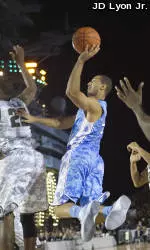
ASHEVILLE--When Tyler Zeller missed a dunk and Justin Watts missed a layup, Kendall Marshall had seen enough. UNC-Asheville led 12-9 in front of a raucous Kimmell Arena-opening crowd of 3,280, and Marshall could feel that things weren't right.
In some ways, it felt very much like the trip to College of Charleston in January of 2010. On the road, against a team jacked to have a visit from the Tar Heels, in a new arena with noise vibrating off the walls. Carolina was showing just the slightest hint of vulnerability, which is often the only opening an underdog might need.
At the next dead ball, Marshall gathered his teammates around him. He put his palms down and said only two words: "Settle down."
"We were off on some of the little things, and we were doing some uncharacteristic things," Marshall said after Carolina moved to 2-0 with a 91-75 win. "Z missed a dunk and we had some turnovers. I just wanted to let the guys know that we were OK, that we just needed to settle down and get into a rhythm."
The way Carolina gets into a rhythm is simple--they get the ball to Marshall. He found Reggie Bullock for a backdoor layup. He spotted P.J. Hairston open crosscourt for a three-pointer. He found James Michael McAdoo in the post for a basket and a foul. And by the time the flurry of passing was over, Carolina had taken a lead they would not relinquish, and Marshall was on the way to dominating a half...while scoring only two points.
He had 10 assists and zero turnovers in the first 20 minutes. He finished with 15 assists, the most ever by a Tar Heel in a true road game, and he would have had at least three more "the way we keep them," according to Dean Smith, when he passed the ball into the paint to a Tar Heel post man who was fouled and picked up free throws.
The quintessential sequence came late in the half, when Marshall had the awareness to realize the Tar Heels were likely to take possession with less than a minute on the clock. He sidled over to the Carolina sideline and asked Roy Williams if he wanted a two-for-one, meaning the Tar Heels would shoot fairly quickly on the next possession, forcing the Bulldogs to relinquish the ball once more before the halftime buzzer sounded. Williams being Williams, of course, he did want a two-for-one. Williams wanting to speed the tempo is, as national anthem performer Bruce Hornsby would say it, just the way it is.
So Marshall immediately took the ball all the way to the rim, finishing off the glass with his right hand for his only basket of the half. After a Bulldog miss, Carolina had the ball with the shot clock off. Marshall stood out top, banging the ball off the hardwood as the game clock slipped under 20...under 15...under 10...uh, Kendall, are we going to do this anytime soon?
His teammates knew what was happening.
"I knew exactly what he wanted," Tyler Zeller said. "You get to the point that you just make eye contact and you can get into exactly the play he wants. Justin Watts picked it up, too. He screened across and I slid behind their zone. Kendall was just trying to find one passing lane."
Sometimes, you wonder if he even needs the one. With six seconds left on the clock, with precision execution that would have impressed even Carolina's new friends on the USS Carl Vinson, Marshall initiated the play. Dribble, penetration, pass to Zeller, basket, halftime buzzer, all in less than the length of time it took you to read this sentence.
On that simple two-for-one, Carolina stretched a five-point lead to nine points, taking control of a game that had been unsettled for most of the first half.
Watching Marshall and Williams interact is to see the best of the Carolina point guard-coach relationship. You know how your parents (are we at the point yet it would be your grandparents?) told you Phil Ford and Dean Smith knew what each other wanted without speaking? We're getting to that point with Marshall. At one point in the first half, Williams began to signal in a play from the sideline before an in-bounds pass. Marshall, standing near him waiting to receive the pass, had already called a different set. The point guard told his coach what he had called, and Williams told him to go with it and found a seat on the bench. A few seconds later, running the play he had called, Marshall picked up yet another assist, this time to John Henson on what is become a new Henson trademark--a baseline jumper.
The point guard is not infallible. He got too deep on a 3-on-2 fast break and missed a potential pass to Dexter Strickland, causing Williams to jokingly note afterward, "He would've had 16 assists if he hadn't screwed up on the 3-on-2."
But everything runs through him. In the second half, it was Marshall who went over to the bench to clarify with the head coach how the Tar Heels should defend ball screens. It had been discussed in the previous timeout, but no concrete decision was ever reached, and Marshall didn't want to give away any defensive possessions because of confusion. Watch a Carolina huddle. It is Marshall who speaks first, loudest and last.
By the time the game was decided and the last of the 15 assists had been distributed, Marshall had moved to the Tar Heel bench, where he found a seat next to Leslie McDonald. The students in the nearest end zone began chanting, "O-ver-rate-ed."
Looking at the scoreboard, Marshall and McDonald laughed. And then, subtly, Marshall began clapping with the chant, always in rhythm.
Adam Lucas is the publisher of Tar Heel Monthly. He is also the author or co-author of six books on Carolina basketball, including the official chronicle of the first 100 years of Tar Heel hoops, A Century of Excellence, which is available now. Get real-time UNC sports updates from the THM staff on Twitter and Facebook.