University of North Carolina Athletics
Lucas: Playing Hooky
March 11, 2011 | Men's Basketball, Featured Writers, Adam Lucas
March 11, 2011
By Adam Lucas
To Whom It May Concern:
Please excuse Asher from school on Friday. He had strep a cold...
Look, I'm going to be honest with you. Asher was at the ACC Tournament on Friday. Yes, I realize that's not an excused absence, even though watching basketball on ACC Friday is more quintessentially North Carolina than feasting on barbecue or praying for one inch of snow to force a school cancellation. I know watching Carolina play Miami is not necessarily part of his essential education. He probably didn't learn anything in Greensboro that will help him on his SAT when he sits down to take it in twelve years (although he may very well have picked up some new vocabulary words when the Tar Heels were down 19 points with less than 10 minutes to play).
Some families go to Yellowstone. Ours goes to Greensboro. That's the way it has always been, ever since I was in third grade. When my teacher found out I was going to the ACC Tournament, she said if I'd make a sign with her name on it and got the sign on TV, she'd excuse the absence. I didn't get any airtime, so in subsequent years my parents would write me a note on Monday after the ACC Tournament explaining that I'd been "sick" the previous Friday.
So, you see, there is hope for Asher, who is five years old. I missed all those Fridays and I turned out perfectly norm...OK, maybe that is not the best example.
But while you're deciding whether his absence on Friday should be excused (and I realize he did not exactly camouflage it very well, considering that he showed up for school on Friday for two hours while wearing his Tyler Hansbrough jersey and announcing to anyone within earshot that he was "going to the ACC championship"), please consider the following subjects that we covered in two short hours Friday afternoon in Greensboro:
History: I've told him all the stories about the great Carolina comebacks, shown him the pictures of Duke '05, Florida State '93, and all the others. But he needed his own frame of reference, needed a first-hand example so he'd understand why opponents are always nervous holding a late lead against the Tar Heels.
Friday, in UNC's largest comeback in ACC Tournament history and the largest second-half comeback since 1993, he got it.
You have to learn how to sense those momentum-turning plays that ignite a comeback. Against Miami, it was a five-second call forced by Kendall Marshall against Malcolm Grant. How unlikely did a comeback seem at that moment? Absolutely no one in the Coliseum crowd of 23,381 reacted to it. The official blew his whistle, held up five fingers, and the teams went to the other end of the court without a cheer, without a clap, and without a whistle.
"I don't think (Grant) realized how close I was to him," Marshall said. "I could see the ref out of the corner of my eye. So I tried not to make any gestures or call out that I wanted a five-count. I just tried to stay in his space because he had no idea. And that was the start of the run for us."
It was. It led directly to a Leslie McDonald three-pointer, and then a Marshall three-pointer. That's when Roy Williams called his second timeout of the half, a classic Dean Smith-esque stoppage of play. Carolina wasn't particularly close, as they'd closed to 55-45 with under seven minutes to play. But just the simple act of calling the timeout made it feel closer. This was Williams's 800th game as a college coach. And if we've learned anything from watching him in the previous 799, it's that he treats timeouts like they're the last Coca-Cola in the fridge. Surely, if a coach as stingy with his timeouts as Williams was burning one now, the game must be within reach.
The head coach will get plenty of attention for his vein-popping substitution of five walk-ons midway through the first half ("He was screaming so loud and talking so fast, I thought he might be talking another language," said Dexter Strickland). What won't get as much attention is the unruffled way he orchestrated the final minutes of the second half, switching the Tar Heels to a trapping defense to try and create tempo.
Some of this will sound very familiar to those of you with a degree in Tar Heel comebacks, because it sounds like another man who used to occupy the head coach's chair.
At the 12-minute timeout, Williams's confidence-building message was this: "There's so much time left."
At the 8-minute timeout, Williams's calm message was this: "There's a lot of time left."
And by the time there was just over four minutes remaining, Williams had shifted into game-winning mode: "We've practiced these situations all year."
When McDonald drew a charge with 4:04 remaining, Marshall's seemingly inconsequential five-second call had sparked a 16-1 run. I don't know if Asher will remember every detail of one of Carolina's biggest comebacks in a history that's full of them. But I hope he'll learn how to spot those tiny little plays that eventually turn into big ones.
Social studies: With about six minutes left in the first half, after yet another Tar Heel turnover, Roy Williams's high school coach (and one of his closest friends), Buddy Baldwin, hopped out of his seat in the Greensboro Coliseum stands. "I'm going to walk," he said.
This isn't exactly indisputable science, but I believe this works. Asher needs to learn this early in life. If Carolina isn't playing well, change seats. Go to a different room. Go to walk. This can make an extraordinary difference in a season. As several Carolina coaches have said, you don't have to be superstitious. You just have to be careful.
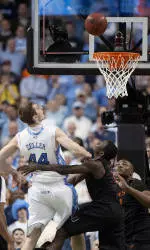
Math: Most of us see 5.6 seconds as a blink. Marshall sees it differently. He sees it as time to use a screen, time to get into the lane, and time to draw a couple of defenders before calmly dishing to Tyler Zeller for the game-winner.
"I looked up at the clock right when I came off the hedge," Marshall said. "I saw two seconds or so."
We interrupt this quote for just a brief second to highlight the uncanny poise of a freshman. Marshall saw two seconds. And not only did he see two seconds, but he had time to calculate exactly how much time he needed to do what he still had left to do. Most players can't do that. Heck, I can't decide what kind of milkshake I want in the Cook-Out line in two seconds. Marshall can win a game in two seconds. OK, Kendall, back to you.
"I saw two seconds, so I knew `Z' would have time to get it off."
Extracurricular activities: Steve and Lori Zeller, Tyler's parents, were standing between the Coliseum and the team bus after the game, waiting on their son. They'd driven from Indiana just for the game, and as soon as they hugged him, would turn around and drive back to Indiana to watch their youngest son in a high school playoff game. Was the drive worth it?
In the moments before tip, they saw Tyler--in full uniform--accept the 2011 Skip Prosser Award, given to the conference's most outstanding scholar-athlete in men's basketball. This will be a footnote in most stories. It deserves more than that, because as Williams noted, it's symbolic of a tremendous amount of work done by a student who also happens to be very talented with a basketball. Two hours later, his parents saw Tyler make a walk-off layup. Maybe they're not driving home after all. They're probably floating.
That's the kind of day it was in Greensboro. I hope the day was equally educational in kindergarten.
But I doubt it.
Adam Lucas is the publisher of Tar Heel Monthly. He is also the author or co-author of six books on Carolina basketball, including the official chronicle of the first 100 years of Tar Heel hoops, A Century of Excellence, which is available now. Get real-time UNC sports updates from the THM staff on Twitter.