University of North Carolina Athletics
Lucas: Calling His Shot
February 22, 2012 | Men's Basketball, Featured Writers, Adam Lucas
Feb. 22, 2012
By Adam Lucas
Monday night, Kendall Marshall watched Connecticut beat Villanova in overtime. His Tar Heels had already practiced for the next evening's showdown at NC State, and the Carolina point guard stayed 30 minutes after the practice to take a few extra shots.
During the extra session, he worked his way around the three-point arc, tossing in four...five...six in a row. In an empty gym, working just with muscle memory, college shooters can put on an impressive display of marksmanship. Even by those standards, though, this was a remarkable performance.
Later, Marshall joined managers Teon Watson and Maggie Wooten as they watched UConn get a road win in Philadelphia. It was less than 24 hours until Carolina took the floor against State.
"I think," Marshall told the managers, "I'm going to drop a career high tomorrow."
There was no particular reason to believe him. His career high was 18 points, set against Clemson as a freshman, and he'd scored in double figures just three times this season. In his previous three games combined, he'd tallied 14 points.
Tuesday morning, Marshall walked past the Smith Center on his way to his 9:30 a.m. Information class. Video coordinator Eric Hoots called him into the basketball office.
"You see this?" Hoots asked Marshall.
The "this" in question was the matchup feature of that morning's News and Observer sports section, listing which team had the edge at each position on the court. The point guard segment of that story read as follows:
"Depends on which version of Lorenzo Brown shows up. If it's the passive one from the first meeting in Chapel Hill, then it's Marshall all day, every day. If it's the Brown who had 19 points, six rebounds and five assists at Duke, and was aggressive with the ball, then it's the multi-faceted Brown over the one-dimensional Marshall. Edge: Brown."
Marshall read it once. Then read it again. "The multi-faceted Brown over the one-dimensional Marshall," it said. He raised his eyebrows and harrumphed. All he said was, "Who wrote that?"
Then he was off to class, where he arrived a few minutes early. Only two other students were in the classroom--because unbeknownst to Marshall, class had been canceled.
"I could have gotten another hour and a half of sleep," Marshall lamented.
Imagine what he could have done with another 90 minutes of rest. Instead, all he was able to do in Raleigh on Tuesday night was post 22 points, 13 assists and zero turnovers. This was not just a good performance by Marshall's standards. We've grown desensitized to his games, and it's to the point that 13 assists seems, well, commonplace. For him, it is.
This game doesn't go on that scale. This goes on a different measure, the one with Ty Lawson's 23 points and six assists against LSU in 2009 or King Rice's 22 points and 13 assists against Kentucky in 1989 or Phil Ford's 24 points and 14 assists against State in 1977. There's, "Hey, that was a good game." That's not what this was. This was set-the-bar good.
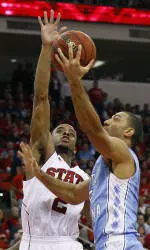
Marshall nailed his first three-pointer 2:20 into the game, giving the Tar Heels a quick 10-2 lead and forcing a State timeout. It was plainly obvious the Wolfpack didn't believe he could maintain his hot shooting. With 3:30 left in the first half, Marshall received the ball on the right wing after an inside-out pass from Tyler Zeller. He gave a ball fake to his left, which sent Scott Wood scurrying to cover a man that wasn't there.
Wood's decision proved to be an even worse idea than the unitard, a uniform malfunction worn by the 1989 State team, which lost in the ACC Tournament quarterfinals and the NCAA Tournament round of 16 and was honored in a pregame ceremony. Marshall kept the ball, stood entirely unmolested a step behind the three-point line, and casually tossed through his third three-pointer of the half. He had never before made more than two three-pointers in any game as a Tar Heel.
Asked why State would back off him on a hot shooting night, Marshall grinned, playing up his reputation as a reluctant shooter. "I think they were calling BS on a couple of those early shots," he said.
He made it look easy, the shooting and the passing and the control of the action. Game management has always been his gift. His teammates and coaches feel better when the ball is in his hands, when he can initiate the action. Consider that he had 13 assists and zero turnovers--13 assists and zero turnovers!--but most stories on Wednesday will undoubtedly focus on his shooting. Thirteen assists for Marshall is like 10 rebounds for John Henson, barely enough to make us stifle a yawn.
He is a better shooter than some observers think. He spent long hours in the gym with his father, Dennis, over the Christmas break--not necessarily changing his mechanics, but simply building his confidence. There have been times this season that he has sliced into the paint, approached the goal with what looks like a clear path to the rim, and still chosen to pass. It's OK to admit it: you have screamed, "Shoot!" at your television at least once this season.
But, hey, if you could pass like Kendall Marshall, would you shoot? Does Adele rap? Did Picasso dance? Does Roy Williams play zone defense? You find what you're best at, and you do it.
Sometimes, though, there are those days, the ones when class is canceled and the sun is shining and spring seems imminent...and the shots are falling. By the time Marshall capped his evening with a pair of free throws with a minute left, giving him 22 points and sealing Carolina's 86-74 win, he glanced into the rapidly emptying student section with a look of bemusement. It was almost a nod to Michael Jordan's shrug-and-smile from the 1992 NBA Finals against the Portland Trail Blazers. "So, can you believe this?" Marshall's expression seemed to be saying.
Beaten, Brown approached his fellow point guard. "You played a hell of a game," he told Marshall.
Afterwards, Marshall answered every question and did every interview. Finally, as he began to take off his uniform, he was asked if this was the best game of basketball he had ever played.
"It's pretty high up there," he said. "I'm very happy with our effort as a team. Individually, I feel like I helped the team out."
Sure. Also, Beyonce helped out Destiny's Child, Sylvester Stallone helped out the Rocky movies and Harry Potter helped out the book industry.
At that moment, Marshall was reminded of his comment from 24 hours earlier. He'd called his shot. This was his moment to swagger. Give us an, "I shocked the world!" or a, "Told you so," or coin a cute little phrase like, "Kensanity."
He did none of these things. Mostly, he just looked confused.
"I did what?" he said.
The conversation was relayed to him again. "Oh yeah," he said, and that familiar smile spread across his face. "I did say that. But I didn't mean it!"
Adam Lucas is the publisher of Tar Heel Monthly. He is also the author or co-author of six books on Carolina basketball, including the official chronicle of the first 100 years of Tar Heel hoops, A Century of Excellence, which is available now. Get real-time UNC sports updates from the THM staff on Twitter and Facebook.