University of North Carolina Athletics

Jacobs: Marshall's Career Game
February 23, 2012 | Men's Basketball, Featured Writers
Feb. 23, 2012
by Barry Jacobs, TarHeelBlue.com
There's no way a writer's question could have any influence whatsoever on a University of North Carolina basketball player. The pen may be mightier than the sword, but a random query can't possibly have an impact on the thought process or performance of a high-caliber athlete on a top-10 team.
But what if it could?
Not likely. By the time a premier player gets to college, he's gone through the rigors of recruiting and summer all-star travel. He's accustomed to the sometimes odd give-and-take between writer and interview subject. Sharp kids learn what to say and what not to, and how to say it. Even the most off-beat query is apt to get a polished, diplomatic answer.
Give a student-athlete a year or two in a big-time setting, and he or she can handle press probes with an aplomb many politicians would envy.
Now it is true that interactions in some player lounges and locker rooms are more comfortable, facile, and, within obvious limits, open and revealing than others. UNC players are generally among the most articulate and engaging of ACC interviewees, even as they're swarmed in post-game situations by groups that can grow to two dozen media types.
Besides, interviewers aren't there to make arguments -- usually - or to convince anyone of anything. That's what coaches do. There is inside the basketball program and outside, and media members are decidedly out.
And yet what are we to make of the odd, very odd, circumstance of Kendall Marshall and the question about Jeremy Lin?
Lin of course is the New York Knick who's taken the NBA and the international sports world by storm, the equivalent of the ugly duckling who's emerged as a swan.
Unrecruited coming out of high school, relegated to pursuing a measly Harvard education in order to play college ball, Lin went undrafted upon graduating college. He was cut by two NBA teams before settling in New York, the self-styled media capital of the world, and was regarded as a roster afterthought by the struggling Knicks.
But the 6-3 Lin has a knack. Several knacks, actually, as he demonstrated once given a chance to show what he can do.
Contending with injuries, New York coach Mike D'Antoni gave the 23-year-old a shot at the playmaker position, and struck gold.
Lin immediately proved poised and creative, aggressive and productive. His apparently middling athleticism compared to his superbly gifted teammates and competitors belied an ability to read the court and make good decisions, not only to his benefit but to the advantage of his squad.
Suddenly, game after game Lin recorded impressive totals in assists and points and the Knicks were winning. They were 9-2 through Feb. 22 with Lin in the lineup.
Then of course there was the media frenzy, the "Linsanity" that landed the former unknown on the covers of Time magazine and Sports Illustrated (twice), that led the New York Times to run several Lin-related articles almost daily, that caused a rush on Lin jerseys and memorabilia and stoked attendance wherever the Knicks went.
So, given the attention, one writer was struck by a certain similarity between Lin's skill set and athletic profile, and that of UNC's Marshall, among the most talented complementary players ever to grace a program that's seen more than its share of greatness.
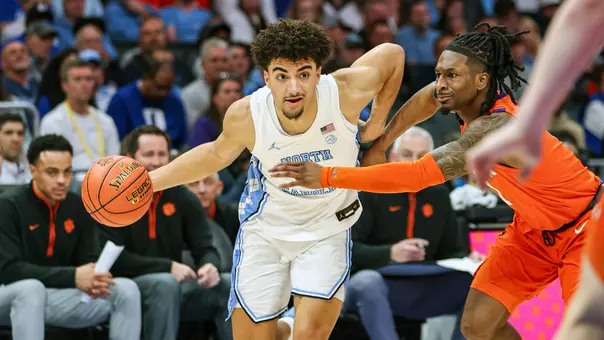
The Tar Heels had just beaten Clemson in Chapel Hill for the 56th time in 56 tries, the very definition of more of the same. Marshall played 35 minutes and recorded 13 of the Heels' 19 assists. He'd taken only four shots himself, making two, and committed three turnovers.
To that point, it was the seventh time the sophomore had at least 13 assists in a game this season. The Clemson contest marked the 11th time Marshall hit double figures in assists in 2012; next closest in the ACC was N.C. State's Lorenzo Brown with two such outings.
All of which led a writer to ask Marshall if he saw any similarities between his game and Lin's.
"That's surprising to me," Marshall said of the comparison, "because I see he's averaging about 26 or 27 (points) a game." At the time Marshall averaged 6.8.
"And double-figure assists," the writer replied, substantiating the parallel he saw.
"He's a great player," Marshall offered, humoring his questioner. "He's very fun to watch, some of the performances he's putting on and ultimately helping his team win."
Clearly, Marshall was unmoved. Or was he?
Three days later the Tar Heels ventured to Raleigh and took up the Wolfpack's unspoken invitation to decide matters from long range. Marshall in particular was offered ample open looks from beyond the arc, where he'd had minimal impact in 2012. Entering the N.C. State game Marshall had tried about a pair of three-pointers per game and converted 27.5 percent. ut that night, the 6-4 point guard and the Tar Heels prospered from the perimeter in an 86-74 win. The team made 10 of 19 attempts from 3-point range, its best showing in more than three weeks. Marshall launched five bonusphere shots, making four. In all he had 22 points.
The scoring total was his career high, as were Marshall's seven field goals and the number of 3-pointers he converted.
And once again there were 13 assists, this time unblemished by a counterbalancing turnover.
Afterward UNC coach Roy Williams called Marshall's performance "phenomenal." Teammate Harrison Barnes commented, "I thought I was watching Jeremy Lin out there."
Wait. Jeremy Lin? Where did we hear that before?