University of North Carolina Athletics
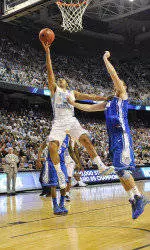
Lucas: The Marshall Effect
March 21, 2012 | Men's Basketball, Featured Writers, Adam Lucas
March 21, 2012
By Adam Lucas
How do you measure essentialness? That's the question as Carolina prepares to depart for St. Louis tonight, where they will hold an open practice at the Edward Jones Dome tomorrow afternoon.
As Roy Williams has repeatedly said over the last three days, he has no idea if Kendall Marshall will be physically able to play on Friday night against Ohio. What he does know is that Marshall is integral to the Tar Heel offense. As the head coach himself said during the ACC Tournament, "Nobody is indispensable, but if we do I'd say it's Kendall."
The numbers support him. ESPN Stats and Info found that through assists and field goals, Marshall is responsible for 80 of Carolina's 164 points so far in the NCAA Tournament--more than any other player in the field. That number is even higher when you account for the free throws created by a Marshall pass, which don't show up as an assist.
But Marshall's impact goes even deeper than points and assists. It's pretty simple: the Tar Heel offense works more efficiently when the ball is funneled through him. So far in the tournament, Carolina is shooting 42.6% from the field when the shooter receives the ball from Marshall, as compared to 37.8% when the ball doesn't go through the point guard.
The with-Marshall numbers would be even higher if his personal field goals were included. Notably, during NCAA play the sophomore has attempted all of his field goals with his left hand except for one--the driving layup attempt on which he suffered the fractured wrist against Creighton.
Jeremy Jones, a member of the Smith Center stat crew, has kept detailed figures on all of Carolina's assists this season. His numbers suggest three players would be most impacted if Marshall was unable to play: Reggie Bullock (49 percent of his field goals have come from a Marshall assist), John Henson (43 percent) and Tyler Zeller (42 percent).
Of course, even if Marshall was unable to play--and again, there is absolutely no indication as of yet whether he will or won't play, and it's unlikely that anyone will know before Friday evening--the Tar Heels still have three first-team All-ACC players in the starting lineup. But the simple fact is that Marshall impacts every other player on the court. In Carolina's two NCAA Tournament games this year, the Tar Heels are shooting 23.8% (5-21) from the field, and have generated just three points from the free throw line, when Marshall is out of the game.
Carolina would miss Marshall's scoring, but they'd also miss the way he sets up everything else. When he was out of the game in Carolina's two NCAA Tournament games, the offense became much more one-on-one based, especially for Harrison Barnes. When Marshall goes out, Barnes--who during Marshall's freshman season was one of the very first Tar Heels who expressed that he usually received the ball in better scoring position from Marshall--is more likely to try and create his own shot with a drive to the basket. Stilman White, a likely candidate to earn some of Marshall's minutes, has just two assists to Barnes this season. Of Barnes's 12 field goals in the NCAA Tournament, more than half (7) have come on assists from Marshall.
A more likely gauge of what the offense might look like with an injured Marshall trying to play through the pain would be the eight minutes of the Creighton game after he suffered the fall under the basket. During that stretch, the offense changed: of Carolina's 12 field goal attempts, just four came off a pass from Marshall, an extraordinarily low percentage. Consider that before the injury, 30 of the Tar Heels' 49 field goal attempts with Marshall in the game had come off his passes, and eight of the remaining 19 shots had been Marshall field goal attempts. In other words, with a healthy Marshall in the game, the Tar Heels attempted just 11 shots that didn't come directly from their point guard.
That's part of why Williams calls his point guard the closest person on the roster to indispensable--and why Marshall's status will continue to be the top Tar Heel basketball story between now and Friday night.
Adam Lucas is the publisher of Tar Heel Monthly. He is also the author or co-author of six books on Carolina basketball, including the official chronicle of the first 100 years of Tar Heel hoops, A Century of Excellence, which is available now. Get real-time UNC sports updates from the THM staff on Twitter and Facebook.