University of North Carolina Athletics
Lucas: McAdoo's Mission
January 31, 2014 | Men's Basketball, Featured Writers, Adam Lucas
Here's how far James Michael McAdoo has come: he's now comfortable calling one of Roy Williams' timeouts.
The Carolina head coach, as you might have noticed, prizes his timeouts. No one calls them without his permission. "I want to have my timeouts at the end because they're more important then," he has said before.
And yet, there was McAdoo flinging himself on the floor in the first half of Carolina's win over Clemson on Sunday night, throwing his arms around the ball, and signaling for a timeout.
Now, it's true that the Tar Heels would've lost that timeout at halftime if they hadn't called it; it doesn't carry over to the second half. But how many times have you seen them use it this year? Once, perhaps twice? And how many times since Williams has been back at Carolina have you seen a player call a timeout purely on his own?
But McAdoo did it, and even in hindsight, he was confident about it.
"Coach is very stingy with his timeouts," he said. "But he was excited because I dove on the ground."
That's veteran wisdom. And in case you haven't noticed, McAdoo has been coupling that wisdom with some veteran play lately, too. He's in the top 10 in the Atlantic Coast Conference in both scoring and rebounding in ACC-only games, and he's second in the league in field goal percentage (55.8 percent) and fourth in offensive rebounding (3.4 per game) in league games.
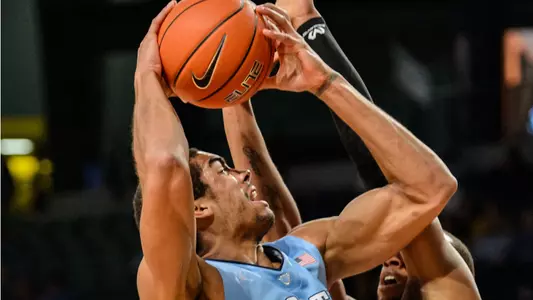
Clemson unwisely tried to play the Tar Heels man-to-man and it went poorly, especially when they tried to match up with McAdoo. Not content to shoot the fadeaway jumper that has sometimes been his trademark move over the past two seasons, the junior instead went ferociously to the rim, which led to 22 points and 10 free throw attempts--the third time in the last four games he has attempted nine or more free throws (The next step, of course, will be converting 65 percent of them. The only flaw in McAdoo's ACC play is his 42.0% mark from the charity stripe, although he knocked down an important pair in the final two minutes at Georgia Tech).
"I told him on the bench that I don't believe anyone can guard him when he attacks the basket that way," said Leslie McDonald. "He's either going to get fouled or make the shot, and teams have to guard him because he is capable of knocking down that midrange shot."
What's most impressive about McAdoo is that he has maintained the exact same demeanor following his recent hot streak as he did a few weeks ago when he was struggling. His tone has been the exact same. His responses in interviews have been identically courteous. He's not doing any standup routines this week, just like he wasn't sullen after shooting 5-of-15 from the free throw line and getting just two rebounds against Texas.
That even keel is a necessary quality for a player who has seen his reputation fluctuate more wildly during his college career than perhaps any player in the Williams era. Based off spot minutes as a freshman, those who make their livings as "draft experts" elevated McAdoo to exalted status. Then, as a sophomore, those same draft experts buzzed that he might be overrated, because he wasn't living up to the standards set by...those same draft experts.
The fact, however, is this: he has 1,046 career points as a Tar Heel in fewer than three seasons, making him just the 69th player in school history to crack 1,000. In the next few weeks, he will almost certainly pass John Henson, and has a chance at cruising past Sean May and James Worthy, who also posted their scoring stats in three years.
And yet he is carving out a junior season that goes beyond the mere numbers. It was McAdoo's headlong dive on a loose ball that sparked Carolina's solid effort against the Tigers. Later, with six minutes left in a game his team led at the time by 28 points, with a box score that at that time already featured 20 points and seven rebounds, there was McAdoo taking a charge.
The very best players find ways to contribute that highlight not just what their particular strengths are, but what their specific team's needs might be. This year's Tar Heels, as they have proven throughout January, need those types of maximum-effort plays.
"Those are just winning plays," McAdoo says. "It's stuff you have to do if you want to win a ballgame."
Adam Lucas is the editor of CAROLINA.