University of North Carolina Athletics
Lucas: The Little Brother
December 8, 2014 | Men's Basketball, Featured Writers, Adam Lucas
By Adam Lucas
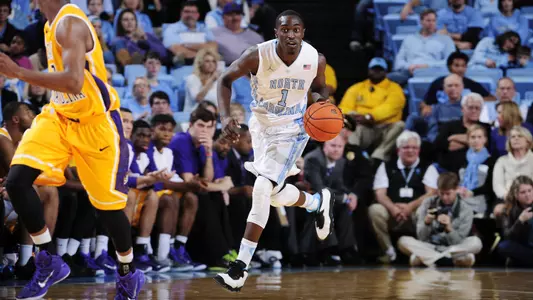
J.P. Tokoto was standing on the sidelines at a recent Carolina practice, grabbing a breather before diving back into the fray, because Tokoto is almost always on the court. He played a team-high 26 minutes in Sunday's 108-64 win over East Carolina and through eight games, is averaging 27.4 minutes per game, second only to Marcus Paige.
As Tokoto watched at practice, freshman Theo Pinson made a high-risk, high-reward play, the kind that will either be spectacular or terrible, with nothing inbetween.
Assistant coach Steve Robinson leaned over to Tokoto. “That's your little brother,” Robinson said with a nod towards Pinson.
Tokoto just grinned. He sees all of Pinson's potential, and he also sees his struggles, and he sees someone very familiar: himself.
“It's reminiscent of the same plays I made as a freshman,” Tokoto says. That's the season when Tokoto finished with just 26 assists against 31 turnovers. Those numbers are correct. The player who currently leads the Tar Heels in assists by a wide margin with 38 assists (against just 15 turnovers) had only 26 assists his entire freshman season.
There are moments when Pinson looks so much like a freshman Tokoto that it's eerie. He wasted an offensive rebounding opportunity when the Tar Heels secured an errant Marcus Paige free throw in the first half by hoisting a what-was-he-thinking fallaway midrange jumper. At the next stoppage, there was Roy Williams, through gritted teeth, barking, “Theo! Take good shots!”
But just a couple minutes later, Pinson had the ball in transition, with three Pirate defenders already back. You could see the choices cycling through his head: I could jump over them (he probably could). I could try to go around them (maybe). What he chose, however, was the wiser, more mature play: he waited for Nate Britt to catch up with the play and then fed Britt for the easy basket.
“I could've tried to create something in the air on that play,” Pinson said. “But I wanted to come in under control and make the easy play. I was trying to take my time. A lot of people try to bulldoze themselves in there, and I've learned to be patient when I'm in transition by myself, and take what the defense gives me.”
Often, the difference between a freshman and an upperclassman is that a freshman knows exactly what Pinson is talking about. But an upperclassman knows it and is actually able to execute it consistently. It's fun to watch both Tokoto and Pinson play basketball. They're almost always involved in the play, and they're almost always at full tilt. The difference: Tokoto (19 points, eight assists, three rebounds, just one turnover against ECU) has learned how to manage some of his more rash impulses, whereas Pinson still sometimes plays like he's in a video game.
That's why, later in the first half, Pinson was on a fast break with Tokoto and was suddenly possessed by the urge to throw a misguided lob that banged off the rim.
Within moments of Pinson returning to the bench, Roy Williams grabbed a clipboard and began furiously diagramming how the defense had been aligned and other options Pinson could have taken. “Theo,” the head coach told him, “I like dunks. But I'd rather just have two points.”
“Basically, he wants me to make the easy play,” Pinson said. “Make the play that gets us two points.”
That should sound very familiar, because it's the exact same mantra Williams repeated to Tokoto for the better part of two seasons. Make the easy play. Make the easy pass. It doesn't always have to be spectacular. There have been times over the past two seasons when Williams has banged on scorer's tables, slapped his hands in frustration, begged, cajoled and pleaded with Tokoto to make the easy play.
And now Tokoto has transformed into the kind of player who controls games with his passing. He had eight assists and just one turnover against East Carolina, and he's turned into someone you have to watch in the open court: he might jump over a defender, or he might fire an assist to a teammate you haven't even spotted yet.
The interesting question now becomes exactly how much of Tokoto's path that Pinson will follow. Williams said recently that Tokoto has had more individual extra shooting sessions at his request than any other player on the team, and he's made himself into a much more reliable shooter by virtue of the extra work.
Pinson, too, is working on his shooting mechanics. He's working on his follow through, and Robinson has consistently told him to be “shot ready,” to catch the ball prepared to fire rather than catching and then assessing the situation. Pinson knocked down a three-pointer against ECU, the second of his college career.
Tokoto sees some encouraging similarities.
“As far as finishing at the rim or getting to the rim, he has a lot of the same characteristics as me,” Tokoto says. “He's going to grow. He makes a lot more heady plays than I did as a freshman…He can shoot better than I could during my freshman year.”
Tokoto put in the work to address those deficiencies and has become perhaps the most complete player on the roster (he leads the team in steals and assists, is third in rebounding and fifth in scoring). Pinson has that kind of stat-stuffing potential, if only he'll follow the big brother's example.
“Sometimes I see the same stuff J.P. sees at the same time,” Pinson says. “I'm like, 'I want to do that, too.' But I'm a freshman, so I can't take quite as many chances as he can.”