University of North Carolina Athletics
Lucas: Beyond The Box Score
March 9, 2014 | Men's Basketball, Featured Writers, Adam Lucas
Jabari Parker was the best player on the court Saturday night in Duke's 93-81 win over Carolina in the regular season finale. The freshman is a pro, and he spent most of the evening proving it. Parker's fingerprints are all over the box score, as he finished with a game-high 30 points to go with his game-high 11 rebounds.
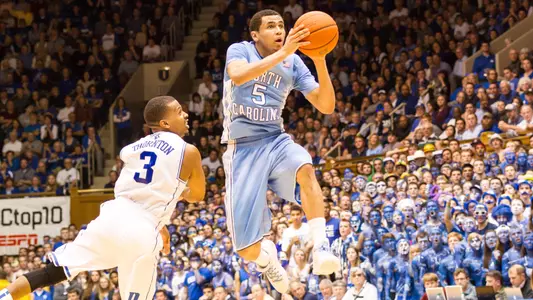
Marcus Paige was in the box score, too. He had a team-high 24 points. He played a game-high 37 minutes. This is a pretty normal Marcus Paige night. Forget about that for just a moment, although we'll come back to it. Let's talk about the things Paige did that were not in the box score and might not have even been very noticeable on television.
First, four minutes into the game, he played terrific late shot clock defense on Quinn Cook, who tried to create his own three-pointer with the shot clock under 10 seconds. First, Paige didn't allow the drive. Then he didn't give way when Cook tried a step back, and reached up with his left hand to block the three-pointer.
As the ball trickled out of bounds after the block, though, is when it really got good. Paige chased it down, leaped to secure the ball, and then turned back to face the court. You've seen plenty of college basketball, so you know what comes next: Paige is going to fire the ball back into the court to try and avoid coming down with it out of bounds.
Except...he didn't. Because when Paige surveyed the court, all he could see was Cook with an open path to the basket and two other Blue Devils in decent position nearby, so he made a novel choice: he simply came down with the ball, allowing Duke to inbound the ball--but not giving up an easy layup.
Think about it: how many times have you heard an announcer say, "Never throw the ball back in under your opponent's basket"? Now: how many times have you actually seen a player actively choose not to do it? That's what Paige did. How many times have you seen a player mindlessly fling the ball back in bounds just to try and complete a hustle play? At least a dozen on any given Saturday, probably.
Paige didn't do that. You know what his reward was in the official box score? He was charged with a turnover. It might be the best turnover in the history of college basketball.
Now fast-forward to the second half. James Michael McAdoo is Carolina's leading scorer with 13 points, but he also has three fouls. Less than 60 seconds into the second half, with Carolina down just five, McAdoo is whistled for a foul. Or, at least, the whistle blows. Which player is the first to shoot his hand into the air, to try and claim responsibility for the foul? Paige, who taps his chest and raises his hand, because he knows it would be McAdoo's fourth, and he knows what that would do to the team.
Roy Williams often talks about seeing the big picture. Paige sees his picture, his teammates' picture, and often the entire picture for the other team, too.
Then, with 1:33 left and the Tar Heels down 11, Paige went flying out of bounds again. This time it was under his own basket, and it wasn't a simple jump over the end line to grab an easy loose ball. This was with Carolina applying a full court press. McAdoo got a deflection, and that sent Paige flying out of bounds to secure it. He finally grabbed it past the first row of photographers and just before tumbling into the first row of seats.
Now he was under his own basket, of course, so the Paige mind told him instantaneously that it was acceptable to throw the ball back in. He did and it went to J.P. Tokoto, but he couldn't convert.
Forget the missed layup. It is fashionable to talk about Paige's size, about how he's no more than 165 pounds. You give me a team full of guys willing to throw their 165 pounds around like that, and I will, to borrow a Williams phrase, beat your rear end even if you have 210-pounders who look like middle linebackers. Paige is going to end his Carolina career as one of the toughest players of the Williams era. And then he'll help you with your calculus homework.
Or, if you'd rather, he can walk you through all the key plays. For almost 20 years, I've listened to players and coaches try to talk about what just happened in a basketball game a few minutes earlier. Very few can do it accurately. They misremember the defense, or they are confused about personnel. That's not just players--Williams is the rare coach who can usually recite for you, in detail, what all five players were doing on any given play.
Paige has the same gift. After the game, he was asked about Brice Johnson's offensive goaltend on a would-be three-pointer that could've cut the deficit to five points late in the game. His response:
"That wasn't the only (missed opportunity). We could've cut it to five with another three-pointer. We got one steal and didn't finish at the rim. We got another steal and didn't finish at the rim. We rushed those plays."
He's right, as the Tar Heels missed two layups in the final two minutes, and Paige himself missed a three-pointer that could've cut it to five.
Maybe it's not unusual to find this kind of understanding in a basketball player. The unusual part is to have it paired with such a ruthless ability to score. There came a point in the second half when Paige pretty clearly just decided it was his time to make baskets, and then he went out and did it. He beautifully split a trap, got an offensive rebound of his own miss and blindly fed a teammate for a would-be layup (it missed). He answered what looked like a backbreaking three-pointer from Rasheed Sulaimon that put Duke up 19 points with a three-pointer of his own nine seconds later.
He is on track to play more minutes than anyone in the Williams era, and yet he has been there in the second half, when other players are bent over grabbing at their shorts, every time Carolina has needed him. Do they need more from him in the first half? Yes, probably.
But if he spent the energy then, it's reasonable to wonder if he'd still have it in the second half. He's so committed to the team--"we want to have all our guys touch the ball and get the shots we work on every day," he said by way of explanation for why he wasn't as aggressive in the first half--that sometimes he's reticent to take over.
How, exactly, do you address this with a player? "Say, Marcus, we need you to be a little more of a ballhog. Try to work on that."
He's so team-oriented that it's not part of his nature. Carolina will need it to be during the postseason, which begins in five days. And here's a guess: he'll figure it out, and he'll leave the proof on the stat sheet. It's just that some of his most memorable plays might come away from the box score.
Adam Lucas is the editor of CAROLINA.