University of North Carolina Athletics
Pace: The View From The Bench
February 11, 2015 | Men's Basketball
by Lee Pace, GoHeels.com
Two former Tar Heel basketball managers several years ago queried their fellow managers from the coaching regimes of Dean Smith and Bill Guthridge for anecdotes and stories about their experiences as the cogs beneath the surface that have made the Carolina program run like a Swiss watch for half a century.
They never drew an X-nor-O nor launched a three-point jump shot. But these men and women handled stats, officiating and arena security during practice; uniform and equipment transportation to road games; will-call tickets for road games; and dozens more details to allow Smith, Guthridge and the team to focus on winning championships. Of course, they learned just as the players did the core values espoused by Smith and his long-time lieutenant: discipline, punctuality, good manners and grooming, humility, attention to detail and the perspective that all this fuss was about a game.
The result was a manuscript titled, “The View from the Bench,” and the passing of Dean Smith on Feb. 7 is a proper occasion to lift a few passages from the document prepared by Dan Veazey (1976 Carolina graduate) and David Hart (1984).
Elliott Murnick (1964) was there from the beginning. He was a freshman for Smith's first year as head coach in 1961-62 and remembers Smith's first game—Dec. 2 1961, the opponent was Virginia and the venue was Woollen Gym. Murnick was impressed by Smith's attention to all the details—pre-game meal, dress code, team schedule, early shoot-around, as well as the needs of the visitors from Virginia.
“It was surprising how many details and plans that Coach Smith was faced with and how he handled all of them in a professional manner,” Murnick says.
Before tip-off, one of the officials asked Smith for the game ball. The look on Smith's face told Murnick that was the one detail he'd overlooked. Murnick quickly located a satisfactory ball, and he and Smith had a good laugh about that for many years.
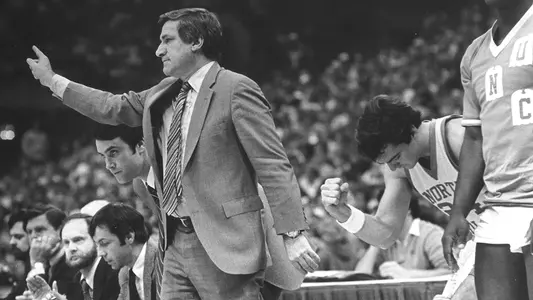
Ben Reid (1971) marveled at Smith's ability to subtly ride the officials. Reid was sitting at the end of the bench one game when Smith took exception to a call by Hank Nichols. Instead of yelling directly at Nichols, Smith walked the length of the bench, stopped in front of Reid and close to where Nichols was positioned on the baseline. Smith bent over and said to Reid, in his nasally voice loud enough for Nichols to hear, “Hank, that was the worst call I have ever seen in my entire coaching career!”
“The remarkable thing was not a single person in Carmichael or watching on television had any inkling that Coach Smith had actually given the official a really hard time for a bad call,” Reid says.
Veazey recalls a plane flight the Tar Heels took that included another team and its high-profile coach. Smith's policy was to have coaches, managers and underclassmen under a certain height to fly in coach, with seniors and taller players in first class for more leg room.
“On this flight, the other team's players, regardless of height, were cramped into seats in coach,” Veazey says. “Their well-known coach was flying in first class, while Coach Smith was studying in his seat toward the back of the plane.”
Chuck Duckett (1982) says it was understandable the Tar Heels were devastated at losing the 1981 national championship game to Indiana in Philadelphia. But what struck him was Smith being more concerned about President Ronald Reagan having been shot that afternoon. Smith told Duckett the pain the Tar Heels were experiencing was over “just a game.”
“Then the next year, after we did win, he was subdued as well and made his famous remark about being humble, that it was still a game and that a billion people in China did not even know we played the game,” Duckett says.
Hart remembers Smith loaning him a book about the Bible to help Hart understand the Bible's significance and relevance in modern times. He marvels that Smith brought a history professor named Jim McCoy along on a trip to play a preseason tournament in Greece to give the players some historical perspective on the Acropolis and other landmarks. He remembers the managers playing defense in practice with brooms in their hands before games against Virginia and its 7-4 center, Ralph Sampson.
And he remembers the aftermath of the 1982 national title, when the first 22 coaches, players and managers received watches. Hart was 23rd on the totem pole and didn't mind that he was first-man-out, given the once-in-a-lifetime glory of the experience. Upon arrival back in Chapel Hill, Smith asked him come by his office.
“Coach Smith then thanked me for all the work I had done and handed me a box saying, 'You were as much a part of this team as anyone else, and I want you to have this,'” Hart says.
He opened the box and saw that Smith was giving Hart his national championship watch.
“That single gesture so typifies the man, a coach who cares more about people than wins and team more than self,” Hart says.
Early in the managing tenure of Dean McCord (1985), he was seated directly behind Smith for a nationally televised game. Knowing the TV cameras were likely honed in on Smith during one stoppage of play, McCord waved at the camera and said, “Hi Mom.” Two days later, Smith asked McCord to stop by his office.
“Talk about excitement,” McCord says. “Maybe he wanted to thank me for my hard work. Maybe he thought I was such a great JV manager that he wanted to promote me to the varsity, right there, on the spot.”
No, Smith had a different agenda.
“Dean, I'm sure you love your mother, but we at Carolina don't do those types of antics on television,” Smith said. “We're a bit more professional than that.”
Jerry Hopkins (1991) was a JV manager in the late 1980s when late one evening he dropped by the basketball office to leave the statistics report from that night's practice on the desk of JV coach Randy Weil. He heard a noise in the break room and found Smith washing dishes and cleaning up after a cake celebration event earlier in the day. Smith asked for some help and Hopkins joined him in washing the dishes, cups and cutlery. Later he wondered about Smith's attention to this element of neatness when his own office was renowned for its clutter, stacks of papers and books and assorted mail to be attended to.
“I believe he was showing appreciation to his office staff who labor diligently during the season to keep the great basketball machine oiled,” Hopkins says. “I also submit this as an example of the humility Coach Smith possessed. He was not above taking the time to give thanks to those who toil to help him succeed.”
Adam Fleishman (1987) remembers the strict attention to detail. Nothing was too small to escape the attention of Smith and Guthridge.
“A measured action leads to a more focused action and ultimately better results,” Fleishman says, paraphrasing Smith's edict. “Among the minutia tracked, Coach actually had us report the number and misses of pregame layups.”
Julie Dalton Loos (1983) followed Carolina basketball growing up and wanted to be involved somehow upon entering Chapel Hill in the late 1970s. She wanted to be a cheerleader but didn't have the dance background to make the squad. She wrote Smith a letter after her freshman year inquiring about a job helping out in the basketball office or if the team would consider having a female manager. Smith replied about two weeks later and first apologized for taking so long to get back to her.
“I couldn't believe the top college basketball coach in the country was apologizing to an 18-year-old college student!” she says. “I think this demonstrates his humility and
his genuine respect for people, no matter their station in life.”
Jeff Mason (1978) likes the story of arriving at Cole Field House in College Park for a game against Maryland and coach Lefty Driesell in 1978. The squad started toward the locker room it had used in previous years until being redirected by a Maryland manager to another locker room.
“Coach Smith proceeded to explain to the team how Driesell was so superstitious he thought doing this would help Maryland win the game,” Mason says. “But, we knew it was about preparation and being focused.”
A few minutes later, Smith and Mason walked out onto the court as the players dressed. Mason asked Smith which basket he wanted to Carolina to play toward in the first half.
“The same one we started at last year when we won here,” Smith answered.
Writer Lee Pace (Carolina '79) has written for Goheels.com since its inception and survived the pressure of supposedly being the “A player” in a golf foursome that included Dean Smith.