University of North Carolina Athletics
Lucas: The Quiet Competitor
May 14, 2015 | Men's Basketball, Featured Writers, Adam Lucas
By Adam Lucas
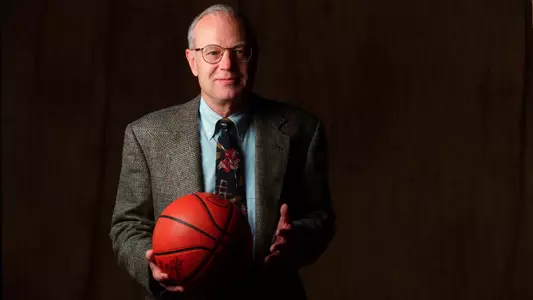
Bill Guthridge was consistently portrayed as a quiet gentleman. The picture most Tar Heel fans will have of him is sitting slightly behind Dean Smith, perhaps leaning over to make a point to the head coach. Only in Chapel Hill would a two-time Final Four coach, an Atlantic Coast Conference champion, and a consensus National Coach of the Year award winner be best known as an assistant.
That image of Guthridge is accurate…but not complete. In public, he was never going to be the center of attention. He wasn't going to entertain a room full of boosters with behind the scenes stories. He wasn't an electric radio show guest.
But he was also one of the most passionate members of the Carolina basketball family in the last 50 years, and was completely devoted to the Tar Heels, to Smith, and to the University of North Carolina. What you saw was the quiet assistant sitting on the bench. What burned just below that was a fierce competitor who might sometimes react more like a fan than you would expect.
When Smith was needlessly ejected from the 1991 Final Four, it was Guthridge who was furious in the tunnel after the game. When Lefty Driesell declined to shake Smith's hand in the mid-1980s, it was Guthridge who was incensed—and had to be prevented from chasing down Driesell—not Smith. When Roy Williams declined the opportunity to be Carolina's head coach in 2000, he had to mend more hurt feelings with Guthridge than with Smith.
The perception of Smith's program might have been that it ran without emotion. The emotion was there, it's just that it was often Guthridge providing it. The closest he came to leaving Chapel Hill was 1978, when he verbally accepted the head coaching job at Penn State. But the Tar Heels suffered a soul-crushing NCAA Tournament loss that also ended Phil Ford's career. Looking around at his devastated players in the locker room, Guthridge realized he simply couldn't leave.
“Penn State was a good situation,” he said in an interview in 2010. “But I already had a better job than that and I was happy here. So why leave?”
His dry sense of humor was legendary among his players. A Tar Heel passing him in the hallway might greet him with a quick head nod and a greeting of, “Coach.” Guthridge would invariably respond with a similar head nod and, “Player.”
It was Guthridge who was the creator of the well-known and slightly strange departure times for Carolina travel parties. The team bus never left at 2 p.m. It left at 1:57 p.m. His reasoning? People could misinterpret 2 p.m.—perhaps it really meant 1:45, or maybe 2:15. But 1:57 was 1:57.
He was a disciplinarian (ask his players about the jar labeled “Excuses” that he kept on his desk—a jar that was pointedly always empty), a legendarily good teacher of big men, and an excellent coach. It's often forgotten that he helped engineer the 2000 Final Four run by keeping his team in Charlotte overnight after a disappointing quarterfinal ACC Tournament loss, and pushing them hard in practice on Saturday. When his Tar Heels defeated Tulsa to earn a Final Four berth, the postgame locker room was one of the most emotional in the modern era, due at least partially to the devotion his players had for Guthridge and their joy in relieving--at least for a moment--the criticism he'd taken during the season.
Guthridge was completely committed to Carolina basketball, and he wanted to make sure everyone else in the program felt the same way. His calm demeanor--he could sometimes be found sitting in the stands an hour before road games eating popcorn or a hot dog--masked a passionate love for the Tar Heels. Even 22 years after turning down the Nittany Lions, Guthridge still couldn't quite bear to leave. When he retired as head coach in 2000, he knew he wouldn't be able to get through telling his staff about his departure. He handed out handwritten notes instead.
One of the best testaments to Guthridge's impact came on that retirement day, June 30. One of his most tempestuous relationships had been with guard Shammond Williams, who even walked off the court at Virginia on one occasion. But when Guthridge retired, Williams—then playing with the Seattle Sonics—made the effort to find a commercial flight to Chapel Hill, then flew out again as soon as the press conference was over. They'd had their disagreements, yes. But there was no questioning the depth of their relationship.
Just like Smith, Guthridge found a way to impact his players beyond teaching them offensive and defensive principles.
“I tell people that Coach Smith and Coach Guthridge are my light-skinned fathers,” said Antawn Jamison, who was the National Player of the Year for the 1998 team that Guthridge guided to the Final Four. “Together, they taught us basketball is secondary. They made sure we knew it wasn't the most important thing in the world, but that we had been given a talent, and it was our job to use it.”