University of North Carolina Athletics
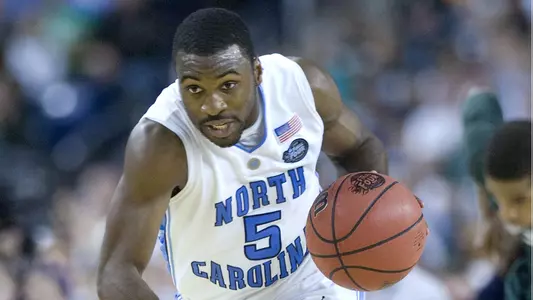
Know Your Final Fours: Part Two
April 1, 2016 | Men's Basketball
Carolina opens play in its 19th Final Four Saturday night in Houston. Take a look back at the 18 prior trips that have defined the program's history over the last eight decades. Part two takes you from a wild night in 1991 to a pair of dominant performances that ended with a title in 2009. For part one (1946-82), click here.
1991
Finish: Third Place (Lost to Kansas, 79-73)
Location: Hoosier Dome, Indianapolis, Ind.
Final Record: 29-6, 10-4 ACC
Carolina's seven-year Final Four drought that ends Saturday night has seemed like an eternity for fans, coaches and players alike. And while the nine-year stretch from 1982 to 1991 wasn't the longest dry spell in program history, surely it was the most painfully interminable. In addition to the shocking disappointment of the 1984 loss to Indiana in the regional semifinal, UNC had gone 0-4 in regional finals following the title in 1982. Most would tell you that the gulf between the Elite Eight and the Final Four is the biggest step short of winning it all, so excitement for the 1991 team would have been at a fever pitch.
Adam Lucas broke down the madness that was the national semifinals earlier this week. It would be the last hurrah for the senior trio of Pete Chilcutt, Rick Fox and King Rice, as well as the final time on the college game's biggest stage for Hubert Davis, who scored a game-high 25 against the Jayhawks. But the core of George Lynch, Eric Montross and Brian Reese (not to mention Henrik Rodl and Pat Sullivan) would be back two years later to finish what the 1991 team had started.
1993
Finish: Champion (Beat Kansas, 78-68, beat Michigan, 77-71)
Location: Louisiana Superdome, New Orleans, La.
Final Record: 34-4, 14-2 ACC
Just to get you in the right mindset to think about the 1993 Final Four, watch the first three minutes of this video for the greatest sports TV intro in recorded history:
If you watched that whole video (and who could blame you?), welcome back. Coach K doing pregame video analysis with James Brown and Pat O'Brien was pretty wild, huh?
Carolina had to navigate a loaded East Region just to get back to New Orleans, and the Tar Heels edged Arkansas by six and Cincinnati by seven in overtime for a shot at revenge against Roy Williams and Kansas. The Tar Heels led by four at the half and won 78-68 behind 25 from Donald Williams and 23 from Eric Montross.
At the time, the UNC-Michigan final was framed as old school vs. new school, and Steve Fisher's Fab Five was seen by some as brash and cocky. In hindsight, the Wolverines and their star of stars Chris Webber were simply ushering in an era of basketball that is much more familiar to the modern eye. And while Michigan started five sophomores against a veteran Carolina club, it was the Wolverines who were playing in their second straight NCAA final after outlasting Kentucky in overtime in the semis.
Webber, who finished with 23 points and 11 boards, was unstoppable at times, but the Tar Heels weathered an early storm and led by six at the half. Michigan surged ahead by four with less than five minutes to go, but again Carolina responded. Time and again it was Williams, who picked one heck of a time to play the best basketball of his life, keeping the Tar Heels in it. The Final Four MOP finished with 25 points for the second straight game and made 5 of 7 from deep, just as he had against Kansas.
UNC's famous ability to avoid giving opponents free points at the foul line under Coach Smith proved to be an unlikely key to salting the game away. Clinging to a 73-71 lead, Carolina had fouls to give and could afford to play aggressive, trapping defense even in the game's final minute. So when Webber dribbled to the corner in front of the Michigan bench, he was immediately surrounded by Derrick Phelps and George Lynch. Of course, you know what happened next, and it was Williams who drilled four straight free throws late to give Carolina a 77-71 win and Coach Smith his second NCAA title.
1995
Finish: Third Place (Lost to Arkansas, 75-68)
Location: Kingdome, Seattle, Wash.
Final Record: 28-6, 12-4 ACC
After the stomach punch that was losing in the second round to Boston College in 1994, Carolina stormed back to the Final Four a year later with a young roster that featured a pair of NBA-caliber sophomores in Jerry Stackhouse and Rasheed Wallace. The Tar Heels had to beat a Georgetown team that featured Allen Iverson in the regional semis before taking on top-seeded Kentucky in Birmingham in the regional final. Coach Smith famously told his team prior to the game that a UK celebration party had already been scheduled, and an especially fired-up Stackhouse went for 18 points, 12 rebounds and six assists in a 74-61 win.
In the national semifinal against Arkansas, Stackhouse suffered a deep thigh bruise just 12 seconds into the game that limited him throughout. Despite the injury, Stackhouse had 18 points to go with Donald Williams' 19 and a Wallace double-double, and the Tar Heels led by four at the half. After falling behind in the second half, Carolina had a shot to tie in the final 15 seconds, but Williams' 3 missed the mark and the Razorbacks iced the game at the line in a 75-68 final.
1997
Finish: Third Place (Lost to Arizona, 66-58)
Location: RCA Dome, Indianapolis, Ind.
Final Record: 28-7, 11-5 ACC
If the 1977 Final Four was the most painful in Carolina history, the version 20 years later is likely a close second. The Tar Heels rolled into Indianapolis after one of their most dominant NCAA performances ever, a 23-point shellacking of sixth-seeded Louisville at the Carrier Dome in the East Region final. The two wins in Syracuse came after an especially emotional first and second round showing in Winston-Salem that saw Coach Smith become the winningest coach in Division I history with a 73-56 victory over Colorado.
Arizona came to Indy as the darling of the tournament after a series of dramatic wins to take the Southeast Region. The Wildcats needed a stunning upset of No. 1 Kansas in the Sweet 16 before beating Providence in overtime to advance. Lute Olson's team would eventually become the first team to beat three No. 1 seeds in one tournament with an overtime win over Kentucky in the title game.
Carolina couldn't overcome its worst shooting night of the season in the national semifinal, falling to Arizona by eight. Final Four MOP Miles Simon had 24 to lead the Wildcats, while Mike Bibby added 20.
The pain of this loss wouldn't truly come into focus until months later, when Smith retired just weeks ahead of the 1997-98 season opener. It meant that the loss that night in Indy was the final game of his legendary career, one that had defined a program and a university, even though he'd never want the credit. Coach Smith left the sport after 879 wins, 11 Final Fours and two national championships. And he left his longtime friend and loyal assistant a loaded cupboard.
1998
Finish: Third Place (lost to Utah, 65-59)
Location: Alamodome, San Antonio, Texas
Final Record: 34-4, 13-3 ACC
Bill Guthridge's first team featured a list of stars familiar to even the most casual of college basketball fans - Vince Carter, Ed Cota, Antawn Jamison, Shammond Williams. It was a team that spent a good portion of the regular season ranked No. 1 nationally, and the Tar Heels were rewarded with the top seed in the East Region after throttling Duke in the ACC Tournament final.
Before advancing to the regional in Greensboro, Carolina had to navigate a tricky second round game against UNC Charlotte in Hartford, Connecticut. Behind 32 points from Williams, the Tar Heels outlasted the 49ers in overtime before beating a pair of teams that were destined for NCAA glory shortly thereafter. UNC beat Mateen Cleaves and 2000 champion Michigan State in the Sweet 16 before topping Khalid El-Amin and 1999 winner UConn in the Elite Eight.
The 1997-98 season was the culmination of a four-year run for Utah under Rick Majerus that saw the Utes win 110 games. Star Keith Van Horn was gone to graduation, but the rest of the lineup was largely intact, including a pair of 6-11 players in Michael Doleac and Hanno Mottola. Add in guard Andre Miller (still active at 40!), and the Utes were a formidable opponent even for the uber-talented Tar Heels.
Utah built a 13-point halftime lead, and Carolina was mired in a terrible shooting slump. The Tar Heels made just three of 23 attempts from behind the arc and, despite a game-high 21 points from Carter, were never able to mount a big rally. Jamison, the national player of the year, was held to 14 points on 7-of-19 shooting. It marked the final college game for Jamison, Carter and Williams.
2000
Finish: Third Place (lost to Florida, 71-59)
Location: RCA Dome, Indianapolis, Ind.
Final Record: 22-14, 9-7 ACC
Guthridge's final season at the helm saw Carolina play an unfamiliar postseason role, that of plucky underdog. The Tar Heels limped to an 18-12 regular season finish and were very much on the NCAA bubble after losing to Wake Forest in the ACC quarterfinals. Even after making the field, Carolina was mostly an afterthought. At least one national publication picked Missouri to beat UNC in a first-round game considered perhaps more appropriate for the NIT.
But the eighth-seeded Tar Heels thumped the Tigers before stunning top-seeded Stanford 60-53. Carolina then won back-to-back nail-biters over Tennessee and Tulsa in Austin, Texas, to earn its most unlikely Final Four appearance ever. Cota and center Brendan Haywood were the backbone of the roster (and has there ever been a cooler sixth man than Julius Peppers?), but the budding star was mercurial freshman Joseph Forte. It was Forte who poured in 28 points to go with eight rebounds in the regional final win over Tulsa.
And it was Forte who made four straight buckets to give Carolina a 48-42 lead early in the second half of the national semifinal vs. Florida. But Cota and Jason Capel ran into foul trouble, and Billy Donovan's Gators gradually pulled away en route to a 71-59 final. Haywood finished with game highs of 20 points and 12 rebounds, but Guthridge's final game at the helm ended much in the same way as that of his mentor.
2005
Finish: Champion (Beat Michigan State, 87-71, beat Illinois, 75-70)
Location: Edward Jones Dome, St. Louis, Mo.
Final Record: 33-4, 14-2 ACC
The 2005 title run was many things, but the one word that perhaps sums it up best is cathartic. In 12 years since the 1993 championship, Carolina had seen its two legendary coaches step away from the game. It had seen Roy Williams turn down the head job in 2000. And after rising to No. 1 in the nation in 2001, it had seen its Tar Heels fall to the depths of 8-20, ultimately resulting in the dismissal of title-winning alumnus Matt Doherty.
A regular season that started with a fluky loss at Santa Clara ended with Sean May's epic 26-point, 24-rebound performance in a win over Duke to clinch the ACC title. After falling in the ACC semifinals to Georgia Tech, Carolina blasted Oakland and Iowa State to advance to the Syracuse Region semifinals at the Carrier Dome. The Tar Heels survived a scare from Villanova before dominating Wisconsin in the regional final and Michigan State in the Final Four.
As good as the '05 team was, it was Illinois that had been No. 1 for the majority of the season. The Illini earned the top overall seed in the tournament and only a 1-point loss at Ohio State in the regular season finale prevented them from entering the national title game at 38-0. The stage was set for an epic final between the clear two best teams in the country.
And what an epic it was. Like a prize fighter going for an early knockout, Carolina raced out to a 9-2 lead in the first three minutes. But Illinois tied it almost immediately, and the game was close until a late Tar Heel surge made it 40-27 at the break. The lead swelled to 15 after Raymond Felton's 3 early in the second half and was still 10 after a pair of free throws from May with less than nine minutes to go.
But the talented backcourt of Dee Brown, Luther Head and Deron Williams dragged Bruce Weber's club back into the game, and Brown's free throws with 5:34 left tied the game at 65. And as fast as Billy Packer could say "shutdown man", Felton's long 3 put Carolina back in front.
Head would respond with a 3 to tie the game at 70, setting up a dramatic final 2:30. Marvin Williams' tip-in gave UNC the lead for good with 90 seconds to go, but Illinois had two great looks to take the lead in a seemingly endless possession that was finally snuffed out by a Felton steal. It was the only turnover of the second half committed by the Illini, and three Felton free throws accounted for the final margin.
The title was the first for Williams after four near-misses at Kansas and the first for the program in the post-Smith era. While juniors May and Felton were the stars of the Final Four, the win was extra special for Jackie Manuel, Melvin Scott and Jawad Williams. The senior trio lived through 8-20, a tumultuous NIT run and an emotional coaching change, and came out the other side as a group that will always be remembered as champions.
2008
Finish: Third Place (Lost to Kansas, 84-66)
Location: Alamodome, San Antonio, Texas
Final Record: 36-3, 14-2 ACC
It's tempting to just put this one in a time capsule with '67 and '69 and lock it away in the bowels of Woollen Gym never to be heard from again. But it's worth looking back because it ultimately helped fuel the fire of 2009.
The 2008 Tar Heels, powered by national player of the year Tyler Hansbrough, were an offensive juggernaut that put up a combined 221 points in early-round wins over Mount St. Mary's and Arkansas in Raleigh. And they were largely untested down the road in Charlotte against Washington State and Louisville in the regional rounds.
But it all came to a screeching halt at the Alamodome. Ten years after Carolina went ice cold in the same building against Utah, the Tar Heels inexplicably found themselves down 40-12 in the first half against Kansas. This was a team that was 36-2 and hadn't lost in almost two months, and they were down 28 points after just 13 minutes and 12 seconds.
The deficit was 19 when Mario Chalmers scored on the first possession of the second half, but there was fight left in Carolina. Kansas finally came back to earth and, incredibly, it was a 4-point game when Wayne Ellington scored with 11:15 to go. The miracle, unfortunately, wasn't to be, and the Jayhawks pulled away after Danny Green's 3 with eight minutes and change left went halfway down before squirting out.
2009
Finish: Champion (Beat Villanova, 83-69, beat Michigan State, 89-72)
Location: Ford Field, Detroit, Mich.
Final Record: 34-4, 13-3 ACC
Carolina's most recent Final Four team was perhaps its most dominant. With the bulk of the '08 team back in '09, the Tar Heels won their six tournament games by an average of 20.2 points per game and were only really threatened once. That came in the round of 32, when a senior-laden LSU team led by five in the second half. But Ty Lawson, who hadn't played since the regular season finale due to a toe injury, torched the Tigers to the tune of 21 second-half points and UNC won going away.
The Final Four at Ford Field was a coronation for juniors Lawson and MOP Wayne Ellington as well as beloved senior stars Danny Green and Tyler Hansbrough. Villanova got within five early in the second half in the national semifinal before Green and Lawson scored on consecutive possessions to push the lead back to 10. It would never get closer than that again, with Lawson (22), Ellington (20), Hansbrough (18) and Green (12) all scoring in double figures.
Even with the final being played in Michigan State's backyard, Carolina rolled, just as it had at the same venue in December. In the ACC/Big Ten Challenge, the Tar Heels scored 53 in the first half and won 98-63. Four months later, they went for 55 in the opening stanza and led by 21 at the break en route to an 89-72 drubbing of the Spartans. Lawson had a championship-record eight steals to go with six assists, four rebounds and a game-high 21 points, but was edged for MOP honors by Ellington, who made eight of his 10 three-point attempts over the two games.
In the end it was simply that the Tar Heels, when playing at full strength, were the best team in the country by a wide margin. Roy Williams, who matched his mentor with a second NCAA crown, directed any and all praise toward his team. "My hats are off to the guys in our locker room, because they took me on one fantastic ride, and it's something I'll never forget."