University of North Carolina Athletics
Extra Points: Lucky Sevens
June 17, 2016 | Football, Featured Writers
By Lee Pace
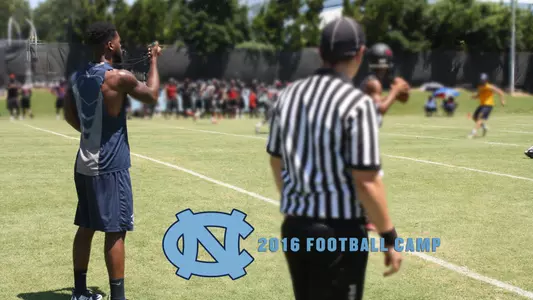
At 11:30 Thursday morning there are nine football games running concurrently on the Carolina campus—40-yard fields, seven players a team, 20 high schools from across the Carolinas, Virginia and Florida and two club/all-star teams, Tar Heel players running the stop watches to make sure each quarterback gets his throws off in four seconds or less. Kenan Stadium, Ehringhaus Field, Navy Field, Eddie Smith Field House and the soccer and field hockey fields are in use.
Seven-on-Seven. What used to be 15 minutes of practice on every level from high school to the NFL has morphed into what's almost a separate sports and culture. And every year, teams come for one day of the Tar Heel Football Camp for the “King on the Hill” 7-on-7 tournament.
“It's a lot of fun, the kids really enjoy it, it's kind of a circus-like atmosphere, a ball in the air every snap,” says Bill Renner, former East Chapel Hill HighSchool coach and father of former UNC QB Bryn Renner.
“It's an awesome day,” adds Bryn, who played 7-on-7 as a high school quarterback in Springfield, Va. “You show up early in the morning on a college campus. It's all very organized and structured and high-energy. For one day, you feel like you're a college athlete even if you're just a run-of-the-mill player. You've got butterflies and you run on adrenaline—you go from one field to another and the pace is really fast.”
Taking it all in and roaming the fields to evaluate prospects and lend a hand where they can are Carolina head coach Larry Fedora and his assistants.
“I love 7-on-7,” offensive line coach Chris Kapilovic cracks. “You can't give up a sack! Seriously, this is fun to see all these games. We were doing 7-on-7 all off-season back in the nineties in high school in Arizona. Now it's mainstream across the country.”
“There's nothing like a full day of grinding in the heat to learn what you're made of and bond with your teammates,” adds defensive coordinator Gene Chizik. “It's a valuable day for us. We can see a lot of kids in a lot of different situations.”
Nearby, defensive line coach Tray Scott laments in a good-natured voice that the “bigs,” as the trench warriors of the offensive and defensive lines are known, are nowhere to be seen.
“What we need to do is have a 'Hog Camp' while you've got 7-on-7 going,” he says. “We could bring the linemen in and spend a day with them while these kids are throwing and catching. That way you bring the whole team to camp.”
Some call it “football lite,” this competition that pits quarterbacks, running backs and receivers facing linebackers and defensive backs in a fast-paced game of “basketball on grass.” In fact, it was the ease of playing basketball all summer—10 players, a ball, two hoops and go at it—that sparked football coaches to covet a way to run meaningful competitions outside of their customary fall seasons.
“Football coaches looked at AAU basketball and saw them playing year-around,” Bill Renner says. “They said, 'How can we do this for football?'
“The last 10 years it's really taken off. People understand it and enjoy it.”
Reports say Nike is organizing a national 7-on-7 competition that would be held in five cities nationwide and will partner with a major hotel chain and airline. Carolina Panthers QB Cam Newton through his foundation runs invitational 7-on-7 competitions in Charlotte and Georgia in June and July.
“It's a beautiful thing,” says Myron Bell, a former NFL safety and father of Tar Heel cornerback Corey Bell. “The competition, the time spent together, the chance to get better.”
Bell found 7-on-7 a good way to get his athletic/coaching fix after a eight-year NFL career and to help his son grow in the game, so he started N.C. Elite Prep Football in Charlotte in 2013. After the high school season, he and his coaches stage tryouts in December, winnowing some 120 players to 60 to carry through the winter and spring season. This year they traveled to tournaments in Michigan, Tennessee, Florida and Virginia and next weekend will travel to Bradenton, Fla., for the IMG National 7-on-7 Championship. Corey honed his cornerback skills at Hough High and through his off-season 7-on-7 pursuits and is now a red-shirt freshman on the Tar Heel roster.
“I'm passionate about youth,” Myron says. “I don't do adults well, I can't abide their egos and agendas. I'm not in this to make any money or to recruit kids to come to this high school or that one. I'm here to see them develop. They push each other, help each other, ride in a van for 14 hours with each other, eat together, sleep together, visit college campuses together. I've seen a lot of players mature and improve by playing 7-on-7.”
Rules vary from one part of the country to another and one competition to the next, but essentially offenses start at the 40 yard-line, have four downs to go 20 yards and then four more to get to the end zone. There is no kicking, no blocking and no tackling. Quarterbacks have four seconds to release the ball. Games run 25 minutes with a running clock. Touchdowns count six points, with conversions for one point from the three yard-line and two points from the 10.
“It's valuable as a quarterback because, as a player in space and an athlete, you can't get enough reps in 7-on-7,” says Bryn, who's played in the pros with the Baltimore Ravens and is hoping for another NFL shot. “It makes you better. You don't have to worry about getting hit. You can master the offense in a short, summer window.
“Big plays are huge. You need a 6-5 receiver to go up and win jump balls. Five-yarders over the middle don't work because it's too easy to get one hand on a guy and bring him down. On defense, we always were going to play man-to-man and see what we've got. You need corners athletic enough to get their hands on a guy and lock him up.”
Bill Renner was head coach at West Springfield High 10 years ago when he gathered his team for Tuesday night practices in the spring on the school's turf field. They eventually played 7-on-7 games against other teams and soon Renner was organizing competitions for six to eight teams from northern Virginia schools.
“It's really good for defensive players,” Bill says. “You can practice offense any time. You throw and catch and it transfers pretty well to the game. But no one goes out and practices back-pedaling or playing safety. I really wanted to do 7-on-7 for our defenders to give them a chance to train their eyes and hone their technique.”
The King of the Hill is organized into four pods of five or six teams. They play a round-robin in the morning of four games starting 45 minutes apart, break for lunch and then play an elimination tournament in the afternoon.
“Is it 100 percent realistic? No,” Tar Heel QB coach Keith Heckendorf says. “It's a different element when the linemen are added. But I do think a lot of good stuff comes out of it—seeing coverages, reading defenses, working on your progressions.
“You have to be careful not to base your evaluation on what a guy does in camp or in 7-on-7 opposed to what he does on Friday nights in a real football game. We use 7-on-7 to gain more information, especially if a kid may not be exposed to the throwing game in his particular high school.”
A case in point was the previous Tar Heel staff under Butch Davis unearthing a diamond in the rough in 2008. Davis and receivers coach Charlie Williams were impressed during that 7-on-7 tournament with a skinny receiver from West Craven High named Erik Highsmith. Soon after, they offered a scholarship to the rising senior, and Highsmith committed to Carolina and went on to have a great career from 2009-12.
“Coach Davis called me and said, 'Wait 'til you see this receiver we found,'” Bryn Renner says. “They started recruiting Mook, he committed and made a lot of big plays for us over four years. That's what's great about 7-on-7—the athletes get a chance to show up on someone's radar.”
Chapel Hill writer Lee Pace has been writing “Extra Points” since 1990 and has been the sideline reporter for the Tar Heel Sports Network since 2004. Follow him on Twitter at @LeePaceTweet.