University of North Carolina Athletics
Extra Points: Mirror Images
August 29, 2016 | Football, Featured Writers
by Lee Pace
In 1857 a man named H.S. Thompson wrote a ballad about a young girl's tragic death. Thirteen years later, two Cornell students took the tune from Annie Lisle and penned lyrics to serve as their college's alma mater. The grace and grandeur of the melody spread to other institutions, one in Chapel Hill and another in Athens, Ga.
So at some point Sept. 3 at the Georgia Dome in Atlanta, you will hear the same notes emanating from different bands, with those in red singing:
From the hills of Georgia's northland
Beams thy noble brow,
And the sons of Georgia rising
Pledge with sacred vow.
And those in Carolina blue singing:
Hark the sound of Tar Heel voices
Ringing clear and true
Singing Carolina's praises
Shouting N.C.U.!
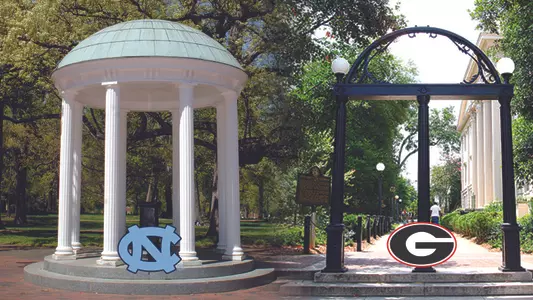
No better metaphor exists for the similarities in these universities that open the college football season in the Chick-Fil-A Kickoff Game. Tar Heels and Bulldogs, UNC and UGa, Chapel Hill and Athens—mirror images in so many ways.
Both are flagship institutions of vibrant southern states, each bathed in tradition, ambiance and leafy quads. Both claim to be the oldest public university in the nation, and both are right, depending on which yardstick you use. Georgia was the first chartered (1785), but Carolina was the first to actually admit students and hold classes (1795).
Carolina has the Old Well and Bell Tower, Georgia has the Arch and the Chapel Bell. Chapel Hill has Franklin Street, Athens has Broad Street. Athens produced R.E.M., Chapel Hill birthed James Taylor. For home cooking, check out the Mayflower in Athens, Sutton's Drug Store in Chapel Hill. Feast on shrimp and grits at Crook's Corner in Chapel Hill, on chicken bog and boiled peanuts at Weaver D's in Athens. Both schools have animals positioned on the sideline—a ram for Carolina and a bulldog for Georgia. And don't tell anyone if you're a member of the Gridiron Society at Georgia or the Order of the Gimghoul at Carolina (both are top secret).
The Bulldogs and Tar Heels were both coached by Dooleys when they last met on the football field, with older sibling Vince leading Georgia to a 7-3 victory in the 1971 Gator Bowl over Bill. The brothers were going to flip a ceremonial coin before Saturday's game, but Bill's death Aug. 9 prompted the substitution of two of his four sons on the field for the pre-game ritual.
There are even similarities to the original bowls in both football stadiums. Kenan Stadium was designed by architect Arthur Cleveland Nash and opened in 1927, featuring two rounded, cement grandstands facing one another. Immediately officials at Georgia visited the facility and hired Nash to design what would in 1929 become Sanford Stadium (as did the athletic hierarchy at Alabama, giving birth to Denny Stadium). Hedges were first planted inside the fence surrounding the field at Kenan Stadium in the late 1970s, apparently their long-time presence at Georgia providing the idea.
Unfortunately for those of the Chapel Hill persuasion, the similarities diverge when talking about the schools' success on the football field. Once the Justice Era players left Chapel Hill after the 1949 season, Carolina and Georgia have played 11 times, the Bulldogs winning nine and one ending in a tie.
Carolina's one shining moment came in 1963, when Coach Jim Hickey's team dispatched the Bulldogs 28-7 in Kenan Stadium en route to an 8-2 regular season, co-ACC title and eventual 35-0 pounding of Air Force in the Gator Bowl.
Carolina was 5-1 and Georgia 4-1-1 when the Bulldogs traveled to Chapel Hill in early November, and the build-up hovered over the idea of Georgia QB Larry Rakestraw versus the Tar Heels' vaunted secondary. Something would have to break.
Rakestraw was the No. 3 passer in the nation (with Roger Staubach of Navy at No. 1) and had thrown for 407 yards two weeks earlier against Miami. The Daily Tar Heel published a photo of Rakestraw the day before the game with a bulls-eye positioned over the quarterback's rear end, and there's no question Bud Carson, the secondary coach, and his lineup of Junior Edge and Ronnie Jackson at safety and Dave Braine and Eddie Kesler at cornerback were stoked for the challenge. Carolina had limited opposing offenses to 38-of-112 passing for 271 total yards and had picked 11 throws.
But good pass coverage is always a team effort—any quarterback with time can find an open receiver. And so it was a collective performance by Carolina in squeezing Rakestraw to hitting only 8-of-17 throws for a paltry 58 yards. With Edge hitting 15-of-20 throws and fullback Ken Willard rushing for 98 yards, Carolina collected a relatively easy win.
“These boys make me happier very week,” Hickey said. “They wanted this one pretty bad and they got it.”
“UNC is as good as any team we've seen this season. I think they are close to Alabama,” Bulldogs Coach Johnny Griffin said.
Rakestraw said the games and stunts by the Tar Heel linemen and linebackers wrought havoc on the Bulldogs' protection schemes.
“The UNC linemen were shifting and stunting all afternoon and messing up our pass blocking,” Rakestraw said. “Every time we had our blocks set, someone would shift.”
The loss started a losing avalanche to end the season, Georgia finishing 4-5-1 and Griffin being fired in favor of Vince Dooley, at the time an assistant at Auburn. Vince hired his brother to coach the offensive line, and over the next three years the 'Dogs popped the Heels 24-8, 47-35 and 28-3. When Bill was hired to lead Carolina's program after Hickey was fired in December 1966, he referenced those three games in his first team meeting with his players at Carolina.
“When I was at Georgia, we always loved to play the University of North Carolina,” Dooley told his new players. “We knew if we got to the third and fourth quarters and it was a close game, we'd win the football game. We knew we were mentally and physically tougher than North Carolina.”
Dooley instituted a new regimen at Chapel Hill and within four years his recruiting, off-season conditioning and smash-mouth style of football yielded considerable improvement. The Tar Heels won the 1971 ACC title, and their reward was a trip to Jacksonville and the Gator Bowl to play Georgia—“The Dooley Bowl,” it was billed. The fifth-ranked Bulldogs were favored by 10 points.
Each team punted seven times in the first half and there were eight first downs combined in a scoreless tie. Ken Craven nailed a 35-yard field for Carolina in the third quarter, and Jimmy Poulos broke a backfield tackle and scampered 25 yards for the game's only TD late in the third quarter for Georgia's four-point victory.
“I think my brother Bill outcoached me,” Vince said. “But we won and that's what it's all about. But I wouldn't want to play him again. There's too much emotion involved, and his team's too strong.”
Forty-five years later, the Tar Heels are driven to build on last year's 11-3 season and further ratchet up their record-breaking offense. Georgia, meanwhile, has switched gears with the installation of former Alabama defensive coordinator Kirby Smart as head coach. 'Dog fans are convinced the talent is available and that the program simply needed a reboot out of the perceived malaise of the Mark Richt era (never mind he only averaged 10 wins a year the last five years).
“It's nice to get some respect,” Tar Heel cornerback Des Lawrence says. “The winning helped with that. A lot of guys have been through some tough times here. Win a bunch of games like we did last year and our confidence is higher. We understand what's possible now.”
One thing's certain: Georgia and Carolina mirror one another with lofty expectations for 2016.
Chapel Hill writer Lee Pace has covered Tar Heel football for 26 years through “Extra Points” and a dozen as the Tar Heel Sports Network's sideline reporter. He has just published a book on Kenan Stadium, “Football in a Forest.” Follow him at @LeePaceTweet and contact him at leepace7@gmail.com.