University of North Carolina Athletics
Turner's Take: Defensive Identity
January 14, 2017 | Men's Basketball, Featured Writers, Turner Walston
By Turner Walston
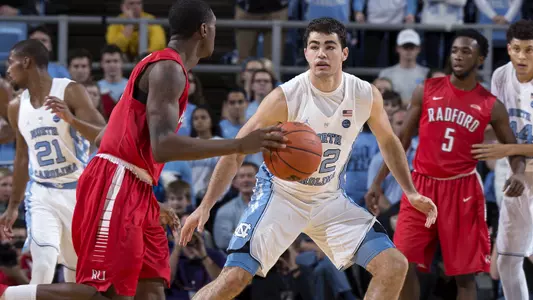
They've at times been brilliant defensively, these 2016-17 Tar Heels. Last weekend against NC State, Carolina put together separate runs of 20 and 22 straight points, one in each half. Thanks to a harassing Tar Heel defense, the Wolfpack made just six of 26 jump shots taken in the first half, and the home team cruised to a 51-point victory.
Contrast that with Wednesday's win in Winston-Salem. Two minutes in to the second half, the Tar Heels were up 19 points. But a defensive let-up –combined with lazy offense, 16 second-half fouls and Wake Forest turning up the aggression– allowed the Demon Deacons to slice all but one point off of that lead in fewer than nine minutes of play. The sleepy Tar Heels woke up in time to hold on for a six-point win, but they allowed the ACC's eighth-best scoring offense to score 53 second-half points, the highest such total by an opponent all season.
The potential is there to be a great defensive team, as evidenced by the efforts against NC State and in Maui against Oklahoma State and Wisconsin, but the pendulum has swung the other way as well, like against Hawaii, Georgia Tech and Wake Forest. Eighteen games into the season, the Tar Heels are consistently inconsistent, defensively.
So which is it? Which team is the real Tar Heels? Which defensive effort reflects the true character of this year's edition? Roy Williams would like to think that the performance against Wake Forest is the anomaly. "I think that's probably the way to look at it," he said Friday, "but that always scares you, because you don't want it to show up too much. It's like a bad rash - you don't want it to keep coming. You'd like to get rid of it and never see it." Williams then paused, chuckled and turned to athletic communications director Steve Kirschner. "That's the first time I've compared defense to a bad rash."
The first time, but perhaps an apt comparison. Recognize the rash, treat it and it can go away. Ignore it and just hope it goes away, and it can spread.
Now comes Florida State, one of the ACC's two teams undefeated in conference play. Leonard Hamilton's team has 12 straight wins and is averaging better than 82 points per game. The 16-1 Seminoles' lone loss was by three points against Temple, all the way back on November 24. Led by Dwayne Bacon, Florida State has four players averaging double figures in conference games. The Seminoles come to Chapel Hill as the higher-ranked team, and Saturday's game represents the toughest home challenge on the Tar Heels' schedule to date.
This year's Florida State team is one of the deepest in Hamilton's tenure. The Seminoles have length, and it's effective length: five players of 6'8 or taller who play at least 12 minutes per conference game. "It's hard around the basket, trying to get second-shot opportunities," Roy Williams said. "It's hard trying to get off an open shot, because they can close on you so much, and it's hard to get your offense rolling, because they can push you out three feet, four feet, eight feet farther than you want to be."
Complicating that challenge is the absence of Tar Heel freshman Tony Bradley. The forward suffered a concussion after a hard fall in Winston-Salem and will miss Saturday's game and perhaps Monday against Syracuse. The 6'11 Bradley averages 8.4 points and 6.4 rebounds in nearly 16 minutes off the bench in conference games (before Wednesday). The Tar Heels will have to counter Florida State's height with just three post players of 6'8 or taller: starters Kennedy Meeks and Isaiah Hicks and reserve forward Luke Maye. (Justin Jackson is 6'8, but he is most effective on the wing.)
"We don't have one of the weapons, so that makes it more difficult," Williams said, "but some way, somehow, we've still got to play, because they're not going to let us cancel the game since Tony's not playing."
The absence of Bradley, who is more than just a five-foul-giving big body, means that Hicks, Meeks and Maye all must carry a little more weight, and unlike Wednesday night, when each collected four fouls, they all must be smart defensively. And when the Tar Heels go small, perhaps with Theo Pinson at small forward and Jackson in the post, they will have to be assertive in starting their defense up top, getting into passing lanes and forcing turnovers like they did against NC State. "We're going to have to rebound a little bit more," Maye said Friday. "They're a big team. Without Tony, it's going to make it a little bit harder for us bigs, but we're all going to work together and help each other out."
That means being smart and picking spots defensively, playing efficiently and defending without fouling. Meeks had two crucial blocks late against Wake Forest, with one coming on the very next possession after being whistled for his fourth foul. And so even if foul trouble comes, the player in danger of disqualification must continue to play his game.
"You've got to stay engaged in the game, no matter what the situation is," Meeks said Wednesday of playing with four fouls. "We had Tony go out, and Luke and Isaiah got in foul trouble, so I just really wanted to be in the game and help my team the best way I could, which was rebounding and scoring buckets."
Rebounding and scoring buckets will certainly come in handy against the Seminoles. Saturday's game is decidedly not one in which the Tar Heels can catch their collective breath; they must bring consistent effort from tip to buzzer in order to win. The Tar Heels will want to run, and there will be plenty of possessions on Saturday, so they must commit to every one. "We talk all the time, ' Let's just get one stop and let's see what kind of shot we get. Let's get one more stop,'" Williams said. "We break it down to each individual possession."
"Our team has got to get a little bit more consistent," Maye said, "and build off of our defensive energy." One stop here, and then the next one. One at a time. Only by concentrating on one play at a time will the Tar Heels build the kind of defensive momentum that will carry them to wins in difficult games. And by forcing opponents into difficult situations, the team can get out and run and score.
So which Tar Heel team is it? The one that forces turnovers and bad shots, or the one that takes its foot off the gas and allows teams to hang around? Saturday's effort will go a long way toward establishing a true identity for this year's Tar Heels.